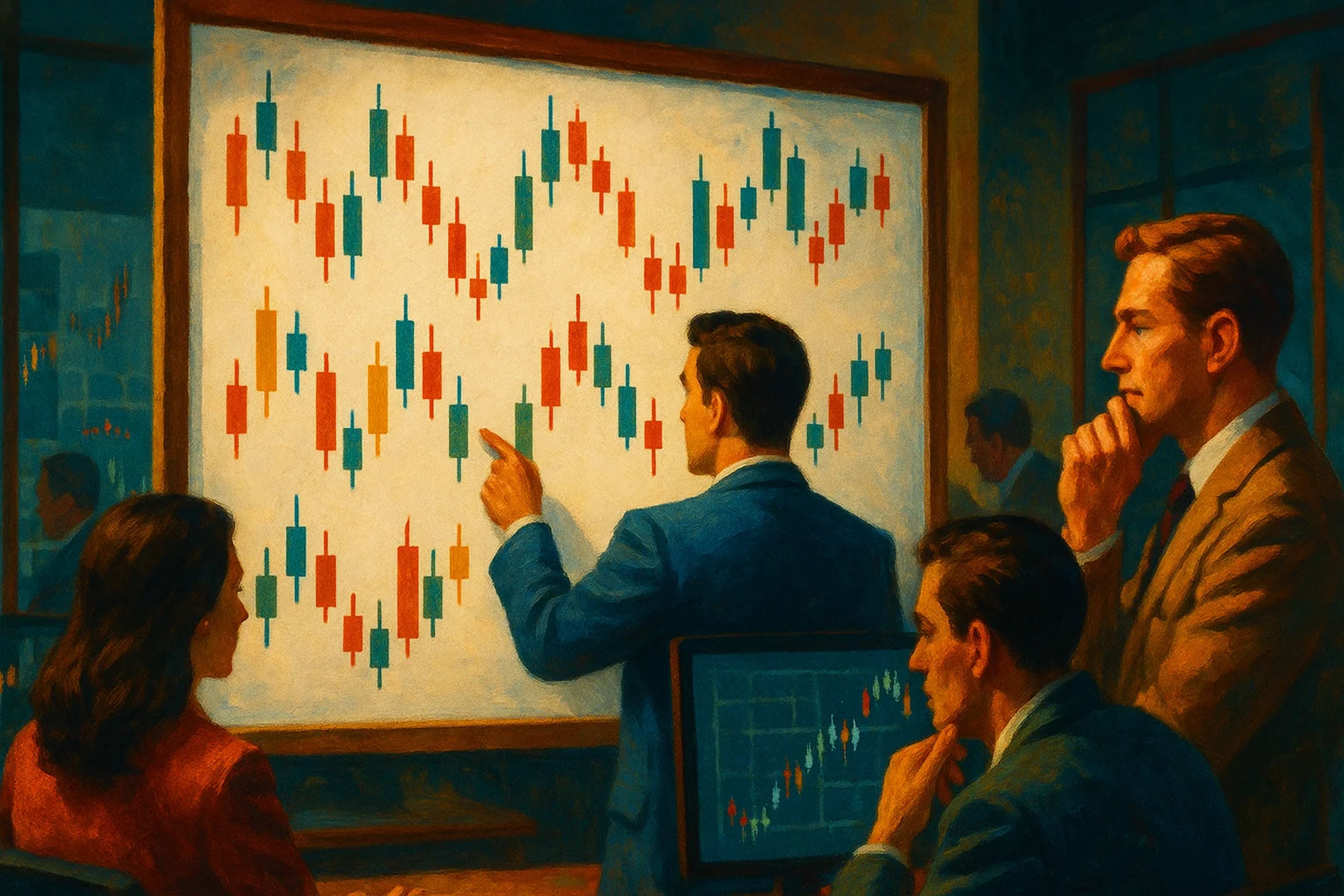
Candlestick patterns for crypto traders: a context-and-invalidation playbook
Candlestick patterns for crypto traders are recurring one-, two-, or three-candle formations that translate OHLC price bars into a read on who controlled the auction and where the other side got trapped. They become actionable only when they print at a meaningful level, get confirmation, and come with an invalidation point you can define before risk is taken.
Key Takeaways
- A candlestick encodes open, high, low, and close, with the body showing open-to-close and the wick showing the period’s extremes.
- Most crypto candlestick patterns are only useful in two buckets: continuation patterns and reversal pattern setups, and the same shape can flip meaning depending on trend and location.
- No pattern is 100% accurate, so traders typically demand confirmation using levels, volume, and indicators like moving averages, RSI, and MACD.
- If a setup does not have a clean invalidation level, it is not a trade idea, it is a chart annotation.
Candlesticks and market psychology basics
A candle prints four numbers every timeframe: open, high, low, close. The body is the distance between open and close, and the wick marks the high and low reached during that period. That sounds basic, but it is the whole game for crypto candle patterns because those two shapes map cleanly to acceptance versus rejection. A fat body means price accepted away from the open and closed with momentum. A long wick means price explored a level and got pushed back before the close.
The useful mental model is auction behavior. When price trades into a level and leaves a long wick, it often signals the market tested liquidity there and failed to hold it. When price closes strong through a level with a large body, it signals follow-through and willingness to hold inventory at the new price. That is why a doji candlestick matters less as a “name” and more as a statement of stalemate. It says neither side could force a close away from the open, which is only interesting when it happens where a decision is expected, like prior support or resistance.
Crypto’s volatility makes this visual compression valuable and dangerous. Valuable because the chart shows rejection and momentum quickly. Dangerous because random noise produces pattern lookalikes all day, especially on low timeframes. The way out is to treat every candlestick pattern as a hypothesis about control, not a forecast. The broader skill is learning to read crypto charts so levels, trend, and candle structure all point in the same direction.
How patterns signal continuation or reversal
Two labels matter day-to-day: continuation patterns and reversal patterns. “Bullish” and “bearish” are secondary because they depend on where the pattern appears. A hammer candle after a decline is a different statement than the same shape printed mid-range during chop. The TradingView breakdown explicitly groups patterns into continuation versus reversal, and also notes that context like support and resistance, volume, trend, and timeframe affects how they should be used.
Continuation patterns are about pause and resume. The market trends, consolidates without giving back much, then breaks in the original direction. Reversal pattern setups are about exhaustion and rejection. The market pushes, fails to extend, and then closes in a way that shows the other side finally absorbed the move.
A trader-friendly way to classify any pattern on the screen is to force three questions in order:
1. Where is it printing. If it is not at a level that has mattered before, the pattern is usually just a description of random order flow. 2. What was the trend into it. Many crypto candlestick patterns only “work” because they are a response to an existing move, not because the shape itself is magical. 3. What is the failure point. The pattern’s high or low often gives a natural line in the sand. If that line is not obvious, the setup is not well-formed.
This is also where confirmation comes in. Multiple sources warn no pattern is perfectly reliable and recommend waiting for confirmation and combining patterns with tools like support and resistance, volume, moving averages, RSI, and MACD. The pattern is the prompt. Confirmation is the filter that keeps the prompt from becoming a coin flip.
High-signal reversal patterns to recognize
Single- and multi-candle reversals show up constantly in crypto, but only a few are worth keeping in a core toolkit. The TradingView and FinSMEs primers both call out Hammer, Bullish Engulfing, and Morning Star as bullish reversal examples, with Shooting Star, Bearish Engulfing, and Evening Star as bearish reversal examples.
The hammer candle is the cleanest wick lesson. It has a small body near the top of the range and a long lower wick after a decline. The story is simple: sellers pushed price down, buyers rejected the lows, and the close recovered. The wick is the evidence of rejection, but the tradeable question is whether the next candle confirms by holding above the hammer’s low and pushing higher.
The engulfing candle is the “who got trapped” pattern. In a bullish engulfing, a large bullish candle fully covers the prior small bearish candle. It is a visible shift from sellers controlling the close to buyers taking the entire prior range. FinSMEs gives a concrete risk-management use: for a long position, a stop-loss can be placed below the low of the bullish engulfing candle. That is the right way to think about it. The pattern’s low is the invalidation point. If price trades back through it, the thesis that buyers seized control just failed.
Morning Star and Evening Star add a third candle to show transition. A Morning Star is typically a large bearish candle, then an indecision candle, then a strong bullish candle that closes deep into the first candle. The “indecision” middle candle is often where traders overfit names. What matters is that momentum stalled, then flipped with a decisive close. The bearish mirror, the Evening Star, is the same logic at the top of an uptrend.
Trend continuation patterns for riding moves
Continuation patterns are where candlesticks stop being a reversal-hunting hobby and start being a trend-management tool. The TradingView breakdown highlights Rising Three Methods and Falling Three Methods, plus Three White Soldiers and Three Black Crows as trend-following multi-candle sequences.
Rising Three Methods is a structured pause inside an uptrend: a strong bullish candle, then three smaller bearish candles that look like a controlled pullback, then another strong bullish candle that breaks higher. The key detail is that the pullback candles are small. That is the market telling you sellers could not reclaim much ground. Falling Three Methods is the same idea in a downtrend.
Three White Soldiers and Three Black Crows are more aggressive. Three White Soldiers is three strong bullish candles in a row, each closing higher than the previous, often with small lower wicks. The message is persistent demand and little intraperiod rejection. Three Black Crows is the bearish mirror. These sequences are often used as confirmation that a trend is not just bouncing, it is being carried by repeated closes in the same direction.
Continuation patterns still need location. A Rising Three Methods that forms right under a major resistance level is a different bet than one that forms after a clean breakout and retest. This is where crypto candlestick patterns are best treated as triggers, not scanners. Find the trend and the level first, then let the pattern tell you whether the pause is constructive or whether the market is losing control.
Confirmation, risk management, and common traps
The confirmation stack most traders reach for is boring because it works: levels, volume, and a small set of indicators. TradingView’s notes explicitly call out support and resistance, trendlines, moving averages, volume, RSI, and MACD as common companions. FinSMEs also flags that reliability varies with timeframe, market, and volume, which is why traders backtest and avoid assuming a universal win rate.
A repeatable checklist keeps candlestick patterns from turning into superstition:
1. Mark the level first. Use prior highs and lows or obvious support and resistance, then wait for the candle to interact with that area. 2. Demand a close that matches the story. Long wick into a level is rejection, but a close back through the level is stronger evidence than an intrabar spike. 3. Check for confirmation. Look for a break of structure, supportive volume, or alignment with a moving average, RSI, or MACD rather than treating the candle as a standalone green light. 4. Write the invalidation point. Many setups naturally fail beyond the pattern’s high or low. FinSMEs’ example of placing a stop below the low of a bullish engulfing is the model.
Three misconceptions repeatedly cost traders money. First, “this pattern means price will reverse or continue.” Sources are explicit that no pattern is 100% accurate, and Kraken’s summary of research frames any predictive value as conditional on factors like market conditions. Second, “bullish patterns are always bullish.” A doji candlestick at resistance after a rally is not the same as a doji after a selloff into support. Third, “more patterns equals more edge.” Memorizing a catalog increases false positives. A small toolkit, standardized rules, and confirmation beats pattern collecting.
This is also where timeframe arguments get messy. Some educators claim daily candles are most reliable, others emphasize higher timeframes like weekly for confirmation. The only defensible statement from the provided material is that effectiveness depends on variables like timeframe, market, and volume, and traders should standardize and test their own rules. That mindset is part of reading crypto charts well: the chart is the input, but the process is disciplined filtering and risk definition.
The Take
I’ve watched traders treat candlestick patterns like a vending machine. Insert “hammer,” receive “reversal.” Crypto punishes that fast because volatility prints convincing wicks everywhere, and the market can invalidate a clean-looking candle without blinking.
The expensive misconception is thinking the pattern is the signal. The signal is the pattern at a level, with confirmation, and with a failure point that is obvious enough to write down. If the chart does not give a clean invalidation line, it is not a setup, it is just a story. That posture turns candlesticks from flashcards into a repeatable way to read crypto charts under pressure.
Sources
Frequently Asked Questions
What are the most useful candlestick patterns for crypto traders to learn first?
A small core set covers most of what shows up on liquid crypto charts: doji candlestick for indecision, hammer candle for rejection after a decline, and engulfing candle for a control shift. For multi-candle structures, Morning Star and Evening Star are common reversal templates, while Rising Three Methods and Three White Soldiers are widely used continuation templates. These patterns still need level and trend context to be meaningful.
How do candlestick patterns work on crypto compared with stocks or forex?
The mechanics are the same because every candlestick is just OHLC data with a body and wick. The difference is regime: crypto’s volatility can generate more false lookalikes, which increases the value of confirmation using levels, volume, and indicators. Sources also emphasize that reliability varies by timeframe, market, and volume rather than being universal.
Are candlestick patterns actually predictive in crypto?
Kraken summarizes research suggesting candlestick patterns have some predictive value, but that efficacy depends on various factors and market conditions. Other sources emphasize that no pattern is 100% accurate and that confirmation is needed. The safest framing is that patterns provide a conditional bias, not a guarantee.
What confirms a reversal pattern on a candlestick chart?
Common confirmation includes a close that supports the reversal story, a break of a nearby structure level, and supportive volume. Traders also commonly cross-check with indicators like moving averages, RSI, and MACD. Without confirmation, a reversal pattern is often just a pause.
Where do traders place stops using candlestick patterns?
A common method is to use the pattern’s high or low as the invalidation point. FinSMEs gives a specific example: for a long position based on a bullish engulfing candle, a stop-loss might be placed below the low of that engulfing candle. The key is that the stop level is defined by where the pattern thesis is proven wrong.


