Fake hardware wallet letter scams: how the “migration trap” steals your seed phrase
Fake hardware wallet letter scams use physical mail to impersonate Ledger, Trezor, and other brands, then pressure recipients into a “security replacement” or “firmware upgrade” that extracts their seed phrase. Once those 12, 18, or 24 words leak, attackers can recreate the wallet elsewhere and move funds in transactions that are typically irreversible.
Key Takeaways
- These scams are a two-stage “migration trap”: a physical letter or package manufactures authority, then a forced recovery or import step captures the seed phrase.
- The attacker does not need to break a hardware wallet’s cryptography. They just need the seed phrase, which legitimate wallet companies do not need and will not ask for.
- “Sealed” packaging and brand-looking letters are not security signals. Provenance and independent verification are.
- If funds move after a key leak, recovery is usually unlikely even when investigators can track the trail, so prevention beats response.
How fake wallet letter scams work
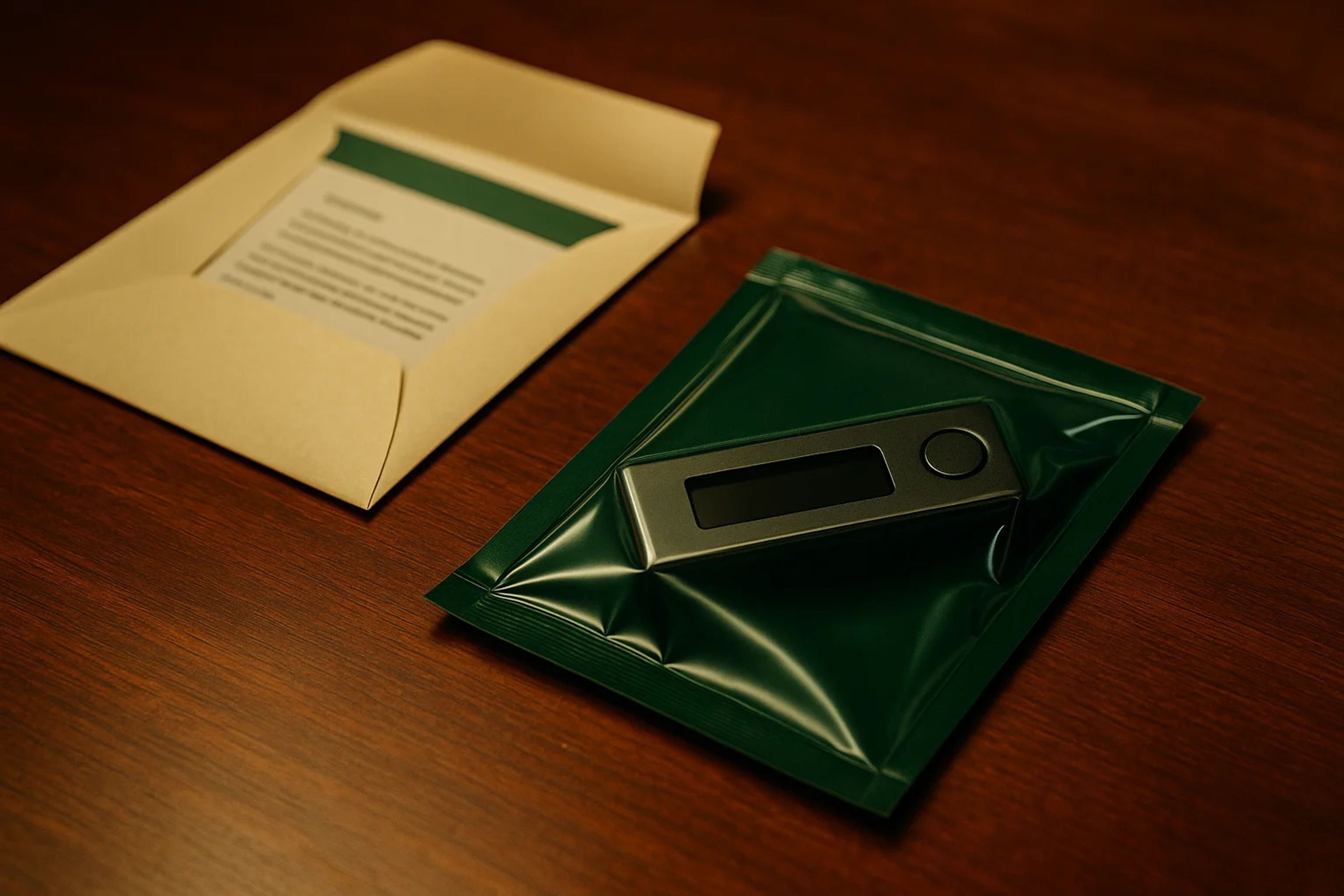
The play starts with physical mail because it bypasses the mental spam filters people use for email and DMs. A letter on brand-looking stationery, sometimes paired with an unsolicited device, creates the feeling that a known manufacturer is running an official remediation. That is why this pattern is often described as physical phishing: the delivery method is offline, but the payload is still a phishing workflow.
The scam’s structure is consistent across the “fake Ledger letter” and “Trezor letter scam” variants. The letter claims a breach, exploit, or urgent security issue and frames the recipient as exposed right now. PCMag documented a version where scammers shipped fake Ledger hardware with a letter claiming the victim’s existing device was not secure. Binance later described a similar setup: an unsolicited package containing a Ledger device and a letter claiming it was sent due to a Ledger data breach, instructing the user to replace their device.
From there, the letter funnels the victim into a migration step. The instructions usually point to a URL or a QR code wallet scam that lands on a lookalike site or prompts an app download. The victim is told to “verify,” “restore,” or “import” to secure funds. That step is the entire objective. If the victim types the seed phrase into anything connected to the internet, the hardware wallet purchase has been turned into a key-extraction event.
This is why the broader category of crypto wallet scams and how to avoid them keeps circling back to one rule. The scam collapses if verification happens through independently found official channels and the seed phrase never leaves the victim’s own offline backup process.
The mechanism behind the theft
A hardware wallet is a signing device, not a magic vault. It is built to keep private keys off an internet-connected computer while still allowing transactions to be signed. The weak point targeted by hardware wallet phishing mail is not the device’s cryptography. It is the recovery path.
The recovery path is the seed phrase: typically 12, 18, or 24 words that control the funds. The Bitcoin Manual is explicit on two points that matter here. First, those words function as the key to the wallet. Second, legitimate wallet companies do not need them and will not ask for them. That is why the “replace your device” narrative is so effective. It smuggles a request for the only secret that matters into a workflow that sounds like customer support.
Once an attacker has the seed phrase, the rest is straightforward. They can restore the wallet on their own device or software wallet and move assets out. The victim’s original hardware wallet can still be physically in hand and still be “secure” in the narrow sense, while the funds are already gone because the attacker is operating from a cloned wallet state.
“Sealed” packaging does not fix this. Cointelegraph described a case where a user trusted a sealed hardware wallet sourced via TikTok and lost $6.9 million. The excerpt does not fully detail whether the compromise came from a pre-generated seed, a manipulated setup flow, or a resealed package, but the lesson is clean: packaging is not a cryptographic guarantee of provenance.
When keys leak and funds move, the defender’s options shrink fast. Cointelegraph notes SlowMist could track the stolen funds, but described little hope of recovery after the cold wallet key leak. That is the asymmetry these scams exploit.
Real-world examples and common lures
The persuasion layer is remarkably repetitive across channels. The Bitcoin Manual describes phishing campaigns that lean on urgency phrases like “security update,” “assets undergoing upgrade,” and “suspicious activity,” paired with brand impersonation. The physical letter version uses the same script, just delivered in an envelope.
Three documented examples map the pattern:
1. June 20, 2021: PCMag reported scammers shipping fake Ledger devices with a letter claiming the recipient’s existing device was insecure. The letter is the authority prop, and the device is the trust amplifier. 2. January 24, 2024: The Bitcoin Manual describes a Trezor-impersonation email incident tied to a third-party provider compromise and cites Blockaid reporting losses exceeding $600,000 from victims who responded. This is not a letter, but it shows how effective “official-looking” brand comms can be even when they originate from a legitimate domain. 3. August 12, 2025: Cointelegraph recounted the $6.9 million TikTok “sealed wallet” loss and flagged TikTok and similar social platforms as common venues for compromised hardware wallet sales and other scams.
The lures converge on one action: get the victim to perform a recovery or import they did not initiate. That is why QR codes show up so often. A QR code removes the friction of typing a URL, and it makes the handoff from paper to phone feel like a normal onboarding step.
Some flows also try to escalate from seed capture to signature phishing, where the victim is pushed to approve a transaction or message that grants access or permissions. The letter scam’s core win condition is still the seed phrase, but the same urgency and authority tricks are used to get signatures when the attacker cannot get the words.
How to spot and avoid them
The defense is not “be smarter.” It is to remove the scam’s two advantages: the clock and the channel. Urgency is the edge, and the letter’s QR code or link is the trapdoor.
A simple decision process breaks most fake hardware wallet letter scams:
1. Stop the workflow immediately. Do not scan the QR code, do not click the link, and do not plug in an unsolicited device. 2. Verify through independent channels. Use a known-good bookmark or manually navigate to the manufacturer’s official site, then look for a security notice there. Do not use contact details printed in the letter. 3. Treat any request to enter a seed phrase into a website or app as hostile. The Bitcoin Manual’s rule is the one that matters: legitimate wallet companies do not need it and will not ask for it. 4. Separate “device replacement” from “key disclosure.” A new device can be set up without ever typing the seed into a web page. The only time the seed phrase should be used is a recovery the owner initiates, using trusted software, not a “security upgrade” someone else initiated.
This is where hardware wallet best practices stops being a generic checklist and becomes a posture. Assume inbound devices are untrusted until proven otherwise, and assume inbound instructions are adversarial until verified.
The TikTok case is the clean warning label for provenance. Cointelegraph describes social media platforms, including TikTok, as common venues for scams and compromised hardware wallet sales. “Sealed” is a marketing signal, not a security proof.
Near the end of any prevention conversation, the broader frame matters: wallet-scam prevention habits. The same verification discipline that blocks a fake Ledger letter also blocks lookalike domains, malicious app downloads, and impersonated support threads.
If you already interacted with one
Damage depends on which step was taken. Opening a letter is not the failure point. The failure point is giving up secrets or migrating under attacker instructions.
Triage the situation in order:
1. If the seed phrase was typed into any site or app, treat it as compromised. The Bitcoin Manual’s model is unforgiving here: whoever has the 12, 18, or 24 words controls the funds. 2. If a transaction was signed or a message was approved under pressure, assume the attacker was attempting signature phishing and review what was authorized. The goal in these flows is to turn a moment of panic into a durable permission. 3. If funds have already moved, expect a low probability of recovery. Cointelegraph’s example notes SlowMist could track the stolen funds but described little hope of recovery after the key leak.
The immediate objective after suspected exposure is to stop further loss, not to argue with the letter. That means halting any further “upgrade” steps, verifying through official channels found independently, and treating any new inbound messages as part of the same campaign.
The uncomfortable truth is that response is usually worse than prevention because crypto transfers are generally irreversible once confirmed. That is why these scams are built around one irreversible moment: getting the seed phrase off-device and out of the owner’s control.
The Take
I’ve watched people treat a branded envelope like a security update from Apple. That reflex is exactly what fake hardware wallet letter scams are buying with postage. The letter is not the hack. The hack is the forced “migration” workflow that turns a hardware wallet into a seed phrase extraction event.
The most expensive misconception is thinking the packaging is the security boundary. Cointelegraph’s $6.9 million TikTok “sealed wallet” loss is the reminder that provenance beats shrink wrap. Slow the clock, verify from your own bookmarks, and keep the seed phrase in its lane. If those words never get typed into a site or app, the scam has nothing to steal.
Sources
Frequently Asked Questions
What should I do if I receive a letter saying my Ledger or Trezor is compromised?
Treat it as hostile by default and stop the workflow. Do not scan any QR code or use any link or phone number printed in the letter. Verify by navigating to the manufacturer’s official site through your own bookmark or manual typing and checking for a matching security notice.
Do Ledger or Trezor support teams ever ask for your seed phrase?
No. The seed phrase is typically 12, 18, or 24 words and functions as the key to the funds, and legitimate wallet companies do not need it and will not ask for it. Any request to enter it into a website or app is a red flag.
Is a sealed hardware wallet safe if it looks unopened?
Not necessarily. Cointelegraph described a case where trusting a sealed hardware wallet sourced via TikTok led to a $6.9 million loss. Packaging is not a cryptographic proof of provenance, especially when the device comes from social media or marketplaces.
How do QR code wallet scams connect to hardware wallet letters?
The QR code is often the bridge from a physical letter to a phishing site or malicious download. It reduces friction and makes the “replace/upgrade” flow feel official. The end goal is usually to get you to reveal your seed phrase or approve an unsafe action.
If I entered my seed phrase on a website, can I get my crypto back?
Recovery is often unlikely once keys leak and funds move. Cointelegraph notes SlowMist could track stolen funds in one case but described little hope of recovery after the cold wallet key leak. The priority becomes stopping further loss and treating the seed phrase as compromised.


