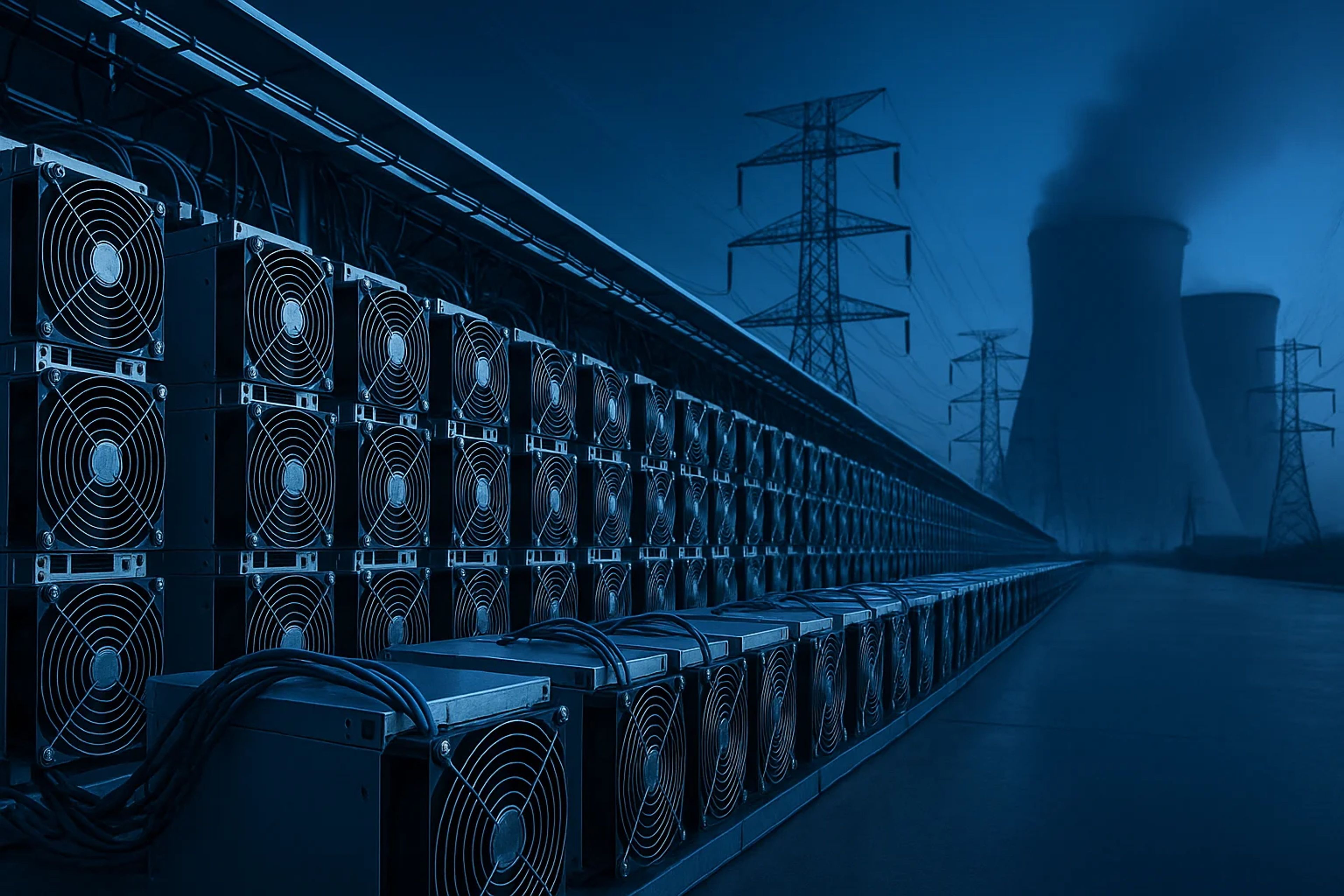
AI power scarcity is repricing Bitcoin miners’ grid-connected campuses
Miners have announced $70B+ in AI/HPC contracts, but retrofits can cost up to $15M per MW and timelines run into 2027.
AI data center power demand is turning permitted, grid-connected electricity into the binding constraint, and Bitcoin miners already control a meaningful slice of that infrastructure. Public miners are signing multiyear AI/HPC deals off energized campuses, but the capex jump and long commissioning timelines push the trade from narrative to execution.
Key Takeaways
- Global AI data center power capacity reached about 29.6 GW by end-2025, a level Stanford compared to New York state’s peak demand.
- Public Bitcoin miners have announced multibillion-dollar AI/HPC agreements, including Iren’s $9.7B GPU cloud deal with Microsoft and Hut 8’s $7B, 15-year lease with Fluidstack backed by Google.
- CoinShares tallied more than $70B in announced AI and HPC contracts across listed miners, with a large portion of value tied to projects years from delivery.
- AI-grade liquid-cooled buildouts were estimated at $8M–$15M per MW versus roughly $700K–$1M per MW for mining infrastructure, widening the financing and execution gap.
AI’s Power Crunch Makes Grid-Connected Sites the Scarce Asset
Stanford University’s annual AI industry report, released in April, pegged global AI data center power capacity at about 29.6 gigawatts by the end of 2025, framing it as enough to run all of New York state at peak demand. The implication for markets is straightforward. Compute hardware can be ordered, but power that is permitted, grid-connected, and ready to draw at scale is harder to source.
Stanford’s framing also undercuts the idea that chip efficiency will solve the constraint. The report said “the cost of GPU computation has dropped more than 99% since 2006,” yet total electricity demand keeps rising because the efficiency gains are reinvested into larger models. Stanford estimated the most demanding training runs, including systems such as Llama 4 Behemoth, have pulled upward of 100 megawatts, comparable to a small power plant. Capacity dedicated to AI rose about 200-fold in three years from under a gigawatt in 2022, and data center electricity use is projected to keep rising through 2030.
From ASIC Farms to HPC Campuses: What Miners Can Repurpose
The miner “AI pivot” is not about repurposing mining chips. ASICs are application-specific integrated circuits built to do one job, and the packet’s framing is explicit that mining ASICs are useless for AI training or inference.
What transfers is the surrounding infrastructure. Traders should think in terms of interconnection approvals, substations, power contracts, and shells that can be upgraded for dense racks and cooling. HPC, or high-performance computing, is the umbrella for these AI training and inference workloads. Commissioning is the gating process that proves the power, cooling, and redundancy stack works before a facility can run at contracted uptime.
Mining economics adds pressure to monetize those campuses. JPMorgan estimated Bitcoin’s all-in production cost at about $78,000 per coin versus BTC around $53,400 at the referenced time, while BTC was down more than 34% year-to-date in 2026 per CoinGecko. Hashprice, a common measure of mining revenue per unit of hashpower, was described as falling below breakeven for many miners, though the underlying methodology for the “about 20% unprofitable” estimate was not provided.
Deal Tape: $70B+ in Announced Contracts and the Hyperscaler Buyer List
The announced contract tape is now large enough to matter for equity pricing. CoinShares counted more than $70 billion in announced AI and HPC contracts across the listed miner sector, while emphasizing that much of the value is years out.
Named examples cluster around a small buyer set of hyperscalers and AI infrastructure operators. Iren signed a five-year GPU cloud agreement with Microsoft worth about $9.7 billion, served from a 750-megawatt campus in Childress, Texas. Hut 8 signed a 15-year, $7 billion lease with Fluidstack for 245 megawatts at River Bend in Louisiana, with payments backstopped by Google. Core Scientific expanded its CoreWeave agreement to $10.2 billion over 12-year terms. TeraWulf reported $12.8 billion in contracted HPC revenue and stated it now earns more from leasing than mining.
CoinShares also tied the pivot to valuation dispersion. Miners with HPC contracts were cited as trading at 12.3x the value of their 12-month revenue versus 5.9x for pure-play miners, and CoinShares projected listed miners could derive as much as 70% of revenue from AI by end-2026, up from roughly 30% in Q1.
Commissioning Timelines, Renegotiation Risk, and the Miner Re-Rating Trade
The risk for traders is the gap between headline contract value and realized earnings. Hut 8’s River Bend site is not expected to start commissioning until Q2 2027, a reminder that the cash-flow profile is long-dated even when the contract value is large.
The retrofit bill is the other choke point. CoinShares estimated mining infrastructure at roughly $700,000 to $1 million per megawatt, while AI-grade liquid-cooled infrastructure can cost $8 million to $15 million per megawatt. That delta forces financing decisions that can change the equity story. Iren disclosed about $3.75 billion in convertible note debt at the end of March, then raised another $3 billion through a new convertible note sale in May. A convertible note is debt that can convert into equity under specified terms, which can shift dilution and credit risk onto shareholders depending on structure and timing.
The forward signals are concrete. Commissioning milestones and capex updates at River Bend matter more than new press-release totals. New miner-to-hyperscaler contracts will be read against any cancellations or renegotiations, especially given customer concentration. Financing activity tied to AI buildouts, particularly incremental convert issuance, is a live tell on whether the retrofit gap is widening. CoinShares-style metrics, including announced contract totals, AI revenue-mix progress toward the end-2026 projection, and relative revenue multiples for HPC-exposed miners, will keep anchoring the re-rating.
The Trade Is Shifting From BTC Beta to Execution Beta
I treat this pivot as a power-market trade wearing a crypto ticker. The scarcity is grid-connected capacity, not ASIC optionality, and Stanford’s 29.6 GW figure frames why energized sites are getting repriced.
The threshold that matters is whether long-dated contracts translate into commissioned megawatts on schedule without forcing repeated rounds of expensive financing. If commissioning timelines hold and the retrofit capex stays inside guided ranges, the setup starts to look structural rather than narrative-driven, and the miner complex earns a different multiple for reasons that are not purely BTC-linked.


