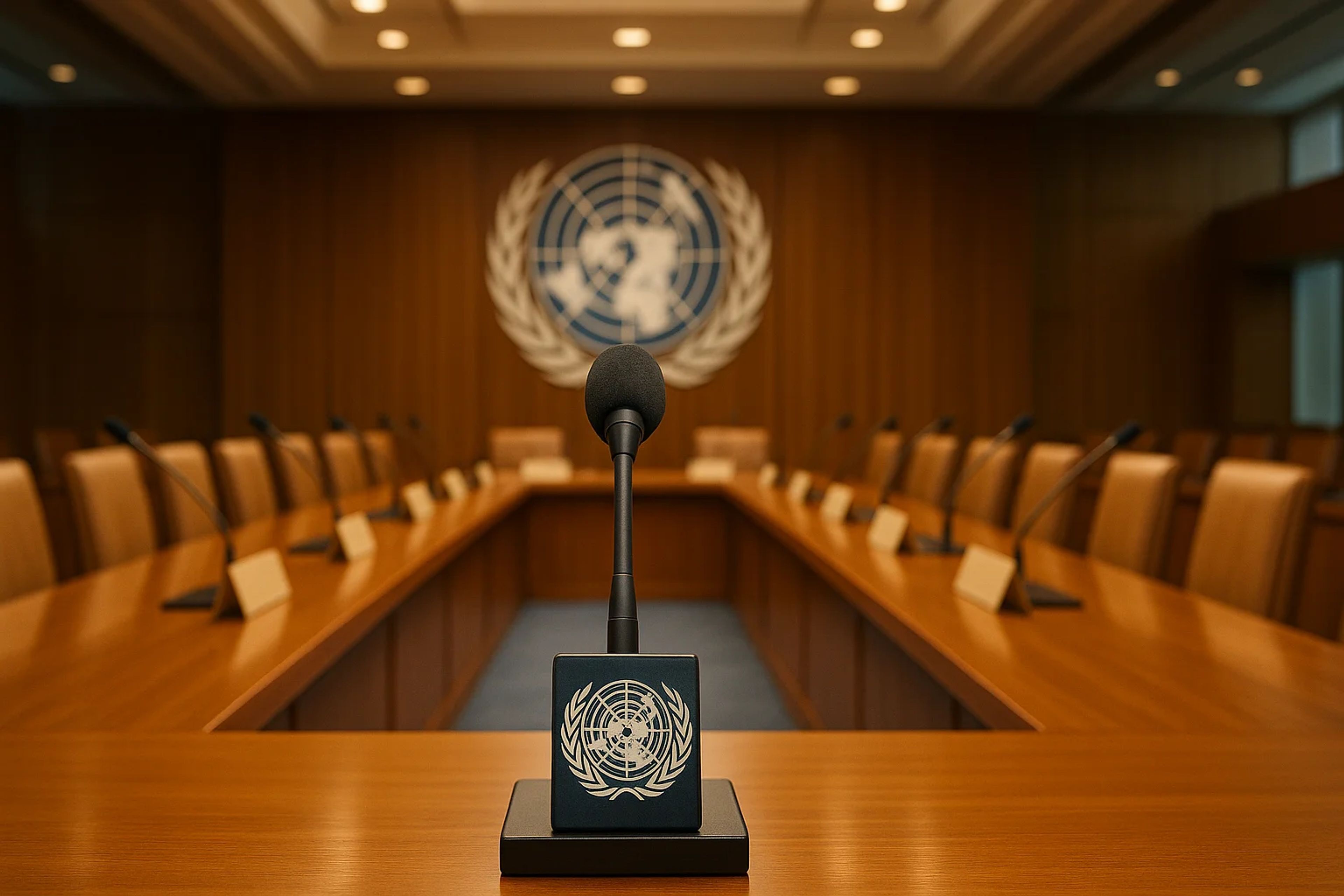
Altman and Amodei expected to brief UN Security Council on AI security risks
France convenes the session, with invited statements from Chinese AI firms DeepSeek and Moonshot.
OpenAI CEO Sam Altman and Anthropic CEO Dario Amodei are expected to brief the United Nations Security Council on Wednesday as it examines artificial intelligence risks and implications for international security. The United Nations has confirmed their participation, while several other attendance details remain described as expected rather than finalized.
Altman and Amodei Head to the Security Council as AI Risk Moves Up the Diplomatic Agenda
France is convening a United Nations Security Council meeting on Wednesday focused on artificial intelligence risks and their implications for international security, with OpenAI CEO Sam Altman and Anthropic CEO Dario Amodei slated to brief the council.
The United Nations has confirmed Altman and Amodei’s participation. Beyond that confirmation, several elements of the session are still framed in probabilistic language, with multiple participants described as expected to take part and no detailed agenda or outcome document disclosed ahead of time.
The framing matters. The Security Council is the United Nations body responsible for addressing threats to international peace and security, and when it puts a topic on its calendar it tends to elevate the issue from a technical-policy debate into a diplomatic one, where the incentives shift toward cross-border coordination, signaling, and narrative control rather than immediate rulemaking.
The meeting is described as responding to growing concerns about increasingly capable frontier AI systems and the potential loss of human control. That is a broad risk frame, and it leaves open whether the session is aimed at surfacing a shared threat model, testing political alignment, or laying groundwork for follow-on work that would happen elsewhere in the UN system.
Who’s in the Room: Frontier Labs, UN Scientific Panel, and Invited Chinese AI Firms
Alongside Altman and Amodei, Hugging Face CEO Clément Delangue is expected to participate, as is Yoshua Bengio in his role as co-chair of the UN’s Independent International Scientific Panel on AI. The panel is a UN-linked scientific group focused on AI capabilities and risks, designed to inform policymakers rather than to set binding rules.
The participant mix is notable because it blends frontier-model leadership with a scientific risk-framing channel that can travel across jurisdictions. If Bengio’s panel language is echoed in official Security Council messaging, it can become a reference point for national regulators and diplomatic statements even without any formal Security Council action.
China is also explicitly in the room, at least by invitation. Chinese AI companies DeepSeek and Moonshot were invited to make statements at the meeting. DeepSeek is expected to participate, but its founder Liang Wenfeng does not plan to attend, leaving unresolved who will represent the company and in what capacity.
That representation detail is not procedural trivia. In these settings, who speaks and under what mandate often determines whether the event reads as a genuine cross-border exchange or a carefully managed set of parallel statements, especially when the topic is framed as international security.
Wednesday’s Briefing as a Narrative Catalyst for AI-Policy Risk
This is not the Security Council’s first pass at the topic. It first formally discussed artificial intelligence in 2023 as governments began examining AI’s security implications, and Wednesday’s session sits on that track rather than appearing as a one-off.
What is still missing is the part traders usually want: a concrete policy output. No specific resolutions, recommendations, or enforcement-linked measures have been described for this meeting, and outreach for confirmation or comment from OpenAI, Anthropic, and the UN spokesperson’s office did not yield responses before publication.
The near-term tells will come after the meeting, not before it. A UN readout that names follow-on sessions, working groups, or formal recommendations would be a different signal than a general statement of concern. Separate, direct confirmation from OpenAI, Anthropic, or the UN spokesperson’s office about the format and content of the briefings would also tighten the market’s read on whether this was a substantive exchange or primarily a diplomatic stage.
The other open thread is China’s representation. Clarity on who speaks for DeepSeek and Moonshot, and whether those statements are treated as substantive contributions in the official record, will shape how much this session is interpreted through a US–China competition lens.
My Read: This Is a Policy-Temperature Check, Not a Concrete Rulebook—Yet
The filing-equivalent detail here is the language: “confirmed” for Altman and Amodei’s participation, “expected” for much of the rest, and nothing concrete on outcomes. That combination usually produces headline volatility and narrative spillover, not a deterministic regulatory trigger.
The threshold that matters is whether the Security Council’s post-meeting language elevates the UN scientific panel’s risk framing into a named next step, because that is how a one-day briefing turns into an institutional process other governments can cite.


