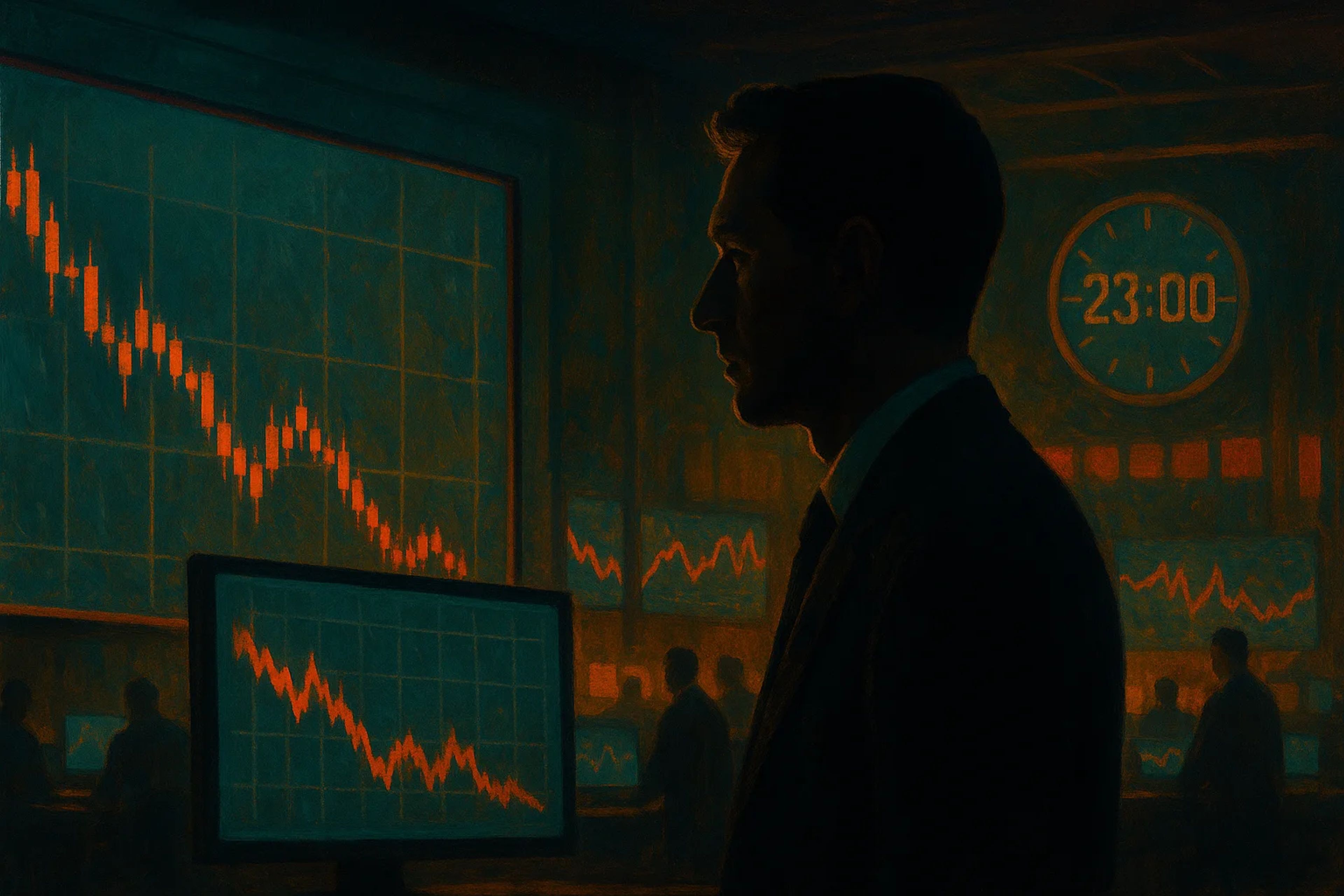
Bitcoin slips below $77K at CME open as Trump’s Iran warning hits risk assets
Oil briefly topped $112 as $677M in crypto liquidations and a drop in open interest signaled forced deleveraging.
Bitcoin fell about 2.4% to roughly $76,500 around the Sunday 23:00 UTC CME futures open, its lowest level since April 30, after President Donald Trump warned Iran the “clock is ticking.” The drop landed into a broader risk-off pulse as Brent crude briefly topped $112 and crypto derivatives saw a $677 million liquidation spike alongside heavier futures volume and lower open interest.
Key Takeaways
- Bitcoin dropped about 2.4% to roughly $76,500 around the Sunday 23:00 UTC CME futures open, the lowest level since April 30.
- The selloff hit after President Donald Trump warned Iran the “clock is ticking” and that “they better get moving, fast, or there won't be anything left of them.”
- Cross-asset risk-off showed up at the same time, with Brent crude briefly above $112 and U.S. index futures modestly lower.
- Derivatives data pointed to a liquidation-led reset: futures notional volume rose 65% to $159B, open interest fell 1.48% to $125B, and liquidations jumped 500% to $677M.
CME Open Shock: Bitcoin Breaks $77K After Trump’s Iran Warning
Bitcoin’s slide under $77,000 was clean on the tape and awkward on the clock. The move accelerated around the Sunday 23:00 UTC CME futures open, with BTC down about 2.4% to roughly $76,500, marking its lowest level since April 30.
The immediate headline catalyst was geopolitical. President Donald Trump posted a warning to Iran that the “clock is ticking,” adding that “they better get moving, fast, or there won't be anything left of them.” Markets did what they usually do with sudden, hard-to-model geopolitical language. They repriced risk quickly, then forced leveraged positioning to catch up.
What stands out here is the timing. The CME open is a liquidity and positioning reset window for bitcoin futures, and that matters because thin conditions can turn a macro headline into something that trades like a gap. You do not need a huge net seller to print a big move when the market is leaning and the first wave is forced.
Oil Above $112 and Softer Index Futures Set a Risk-Off Backdrop
The crypto move did not happen in isolation. Brent crude briefly topped $112 per barrel in the same window, a classic signal that the market is pricing some combination of supply risk and geopolitical escalation. At the same time, U.S. equity index futures softened, with S&P 500 futures down 0.3% and Nasdaq 100 futures down 0.25%.
That cross-asset alignment matters for crypto traders because it changes the type of selling you’re dealing with. When oil is spiking and index futures are leaking, crypto tends to trade less like an idiosyncratic story and more like a high-beta risk sleeve. In that regime, the marginal price setter is often leverage and hedging flows, not long-horizon conviction.
Ether tracked the same risk-off impulse, falling around 3.5% after Sunday’s open and trading near $2,116. The move was described as erasing April’s rally after a wave of liquidations, though the exact size of that April rally was not specified.
Deleveraging Tape: Volume Surges, Open Interest Slips, Liquidations Jump
The derivatives read-through is the spine of this story. Over 24 hours, market-wide futures notional volume surged 65% to $159 billion while open interest slipped 1.48% to $125 billion. Liquidations spiked 500% to $677 million.
Those three numbers together are the tell. Higher notional volume with lower open interest is consistent with positions getting closed and transferred rather than a clean build in new net exposure. Layer on a liquidation figure that large and the simplest interpretation is forced deleveraging, not traders confidently putting on fresh directional risk.
This is where second-order effects show up. Liquidations don’t just move price, they change who holds risk. When the market is flushed, the remaining open interest is often held by better-capitalized participants or by traders who entered after the move. That can stabilize conditions, but it can also set up sharper two-way swings because the next catalyst hits a market with less “cushion” from passive leverage.
Under the surface, breadth confirmed the selling pressure. Excluding ZEC, TON, and HYPE, all other top 25 tokens posted negative 24-hour cumulative volume deltas (CVDs), signaling that the decline was driven by aggressive market selling rather than passive limit-order distribution.
There were still pockets of idiosyncratic flow. Bitcoin Cash (BCH) was down 10% since midnight UTC and its positioning looked like a crowded short setup: open interest jumped 13% to 1.47 million coins, the most since April 6, while annualized perpetual funding fell to -72%, the most negative among major cryptocurrencies. Its 24-hour CVD was also the most negative among majors, reflecting aggressive selling at market.
That combination is the kind of structure that can turn into a squeeze if broader risk stabilizes. Rising open interest means more outstanding risk. Deeply negative funding means shorts are getting paid to stay short, which often happens when the trade is crowded. A sharply negative CVD says the selling is urgent, not patient.
Zcash (ZEC) looked materially different. Open interest rose a third straight day above 2 million tokens, its 24-hour CVD was the most positive among majors, and annualized funding was around 4%, described as below overheated territory. ZEC was up 111% this quarter despite a pullback, a relative-strength profile that reads as constructive if the broader tape stops bleeding.
Volatility Pricing Signals: BVIV Up, MOVE Jump, and Straddles in Demand
Volatility moved with the selloff, but not in a panic-print way. Bitcoin’s 30-day implied volatility index (BVIV) edged up to 42% from 40% since May 9, maintaining an inverse relationship with spot price in this episode.
Macro vol was already flashing yellow. The MOVE index, which tracks implied volatility in U.S. Treasuries and is widely used as a stress barometer, jumped 14% on Friday, the largest single-day rise since March 26. The linkage is straightforward: if Treasury volatility keeps rising, it tends to bleed into broader risk premia, and crypto implieds rarely stay cheap for long in that environment.
Options flow backed that up. On Deribit, large block trades showed a clear bias toward BTC straddles, positioning for a sharp move in either direction. That is not a directional call. It is a statement that traders wanted convexity and, importantly, that some viewed implied volatility as inexpensive relative to the risk of a bigger two-way range.
For altcoins, the tape stayed heavy into Monday by the “since midnight UTC” cut. DOGE was down 4.5%, and the CoinDesk Memecoin Select Index (CDMEME) fell 2.2%. The DeFi Select Index (DFX) lost around 1.1% while the bitcoin-heavy CoinDesk 20 (CD20) shed around 0.6%. A few names bucked the move: RUNE rose 3.8% as it began recovering from last week’s exploit, and KAIA gained 1.6% since midnight and 3.5% over 24 hours as daily trading volume nearly tripled to $53 million.
How I’d Trade the Post-CME Deleveraging Regime
I’m treating this as a positioning event first and a narrative event second. The narrative is loud, but the market mechanics are louder. When futures notional volume jumps to $159B, open interest drops to $125B, and liquidations print $677M, the dominant actor is forced risk reduction. That’s not a moral judgment. It’s a map of who had to do what.
Scenario one is stabilization through exhaustion. If BTC can reclaim $77,000 in the next CME session and liquidation totals stop building beyond the $677M spike while open interest remains contained or starts rebuilding, that would fit the “flush and reset” template. In that case I’d expect volatility pricing to stay supported but not explode, with BVIV holding near 42% unless macro vol re-accelerates.
Scenario two is continuation driven by macro stress. If BTC extends below the ~$76,500 area that marked the lowest level since April 30 and the MOVE index follows its 14% Friday jump with more upside, the odds rise that BVIV pushes meaningfully higher. That would tell me the market is shifting from a one-off liquidation wave into a broader repricing of risk premia.
Scenario three is the messy one, and it’s common after liquidation events: range expansion without trend. The Deribit straddle bias is consistent with that. If price chops while implieds stay bid, it means the market is paying for protection and convexity because it doesn’t trust the calm.
On alts, I’m watching positioning tells more than spot prints. BCH is the cleanest “crowded short” structure in the data provided. If its deeply negative funding (reported -72%) persists alongside elevated open interest (1.47M coins) and CVD stops being the most negative among majors, the squeeze risk rises quickly. ZEC is the opposite marker. If it keeps positive CVD with funding around 4% and open interest stays above 2M tokens, it remains a relative-strength tell that risk appetite is selectively returning.
The core thesis is simple: this was a CME-open, geopolitics-triggered shock that turned into a liquidation-led deleveraging wave, and it will be confirmed if liquidations normalize while BTC reclaims $77,000 without BVIV and MOVE re-accelerating higher.


