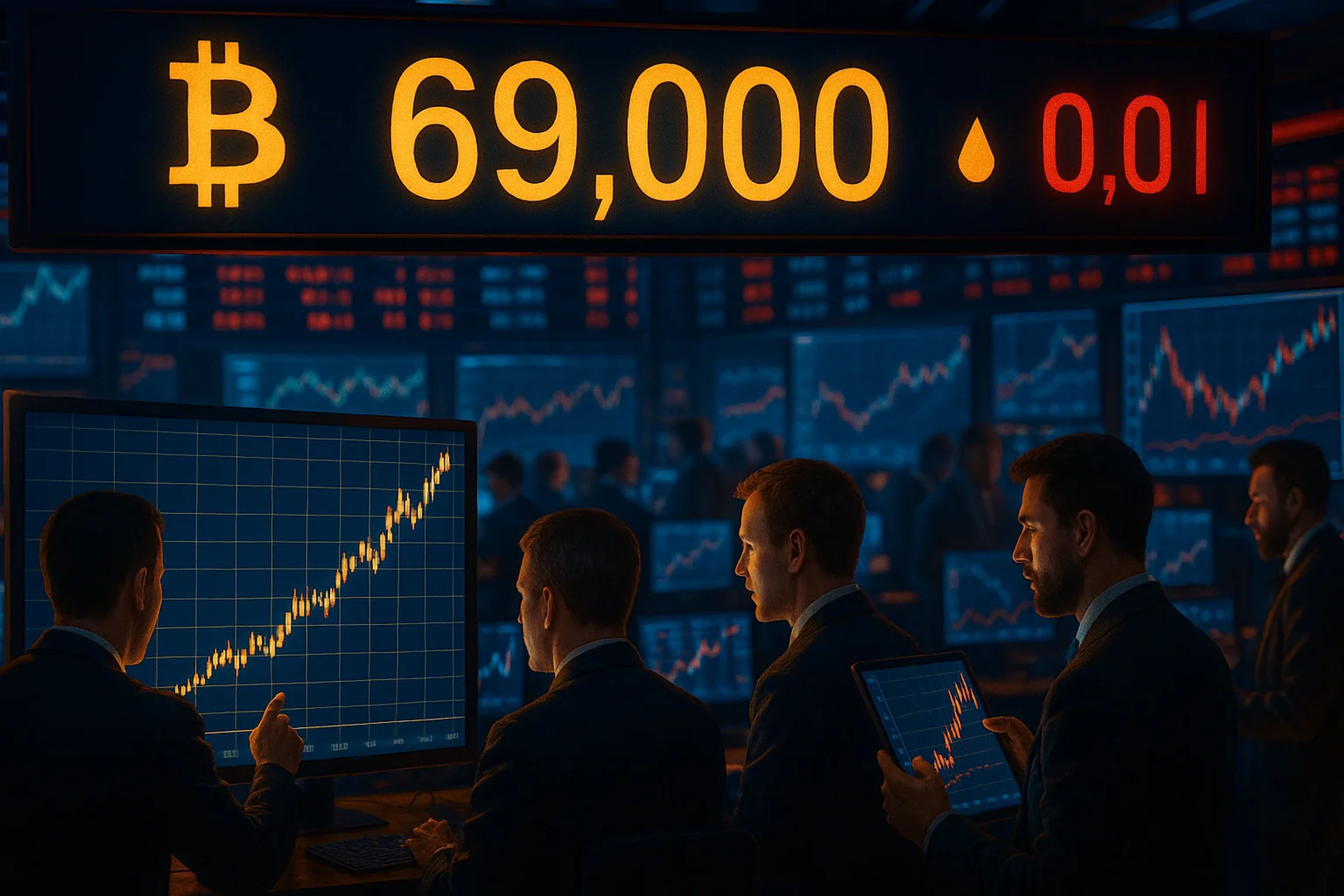
Bitcoin traders eye $69K squeeze as WTI breaks below $80 ahead of Warsh’s first FOMC
Positioning near the 200-week EMA and mixed CryptoQuant demand signals set a two-sided week for BTC.
Bitcoin entered the third week of June with traders pointing to a potential squeeze toward $69,000 as oil slid below $80 on expectations of a US-Iran agreement. The week’s macro risk is front-loaded with new Fed chair Kevin Warsh’s first FOMC decision on Wednesday and conflicting on-chain reads on whale behavior versus demand.
Key Takeaways
- Bitcoin traders highlighted the ~$69,000 area as a near-term target tied to leveraged short positioning near the 200-week EMA.
- US WTI crude traded below $80 per barrel for the first time since mid-April as markets priced a prospective US-Iran agreement and a potential reopening of the Strait of Hormuz.
- CME FedWatch showed just 3.4% odds of a 0.25% cut at Wednesday’s FOMC meeting led by new chair Kevin Warsh.
- CryptoQuant data showed whale inflow coin days destroyed (CDD) dropping from 2.16M to 33K, while a separate CryptoQuant read flagged apparent demand as still negative.
Oil Drops Below $80 as US-Iran Signing Looms, Lifting Risk Assets
Risk sentiment improved into the weekly close as markets leaned into a prospective US-Iran agreement for a 60-day pause in hostilities, expected to be signed in Switzerland on Friday. The timeline had previously centered on a Sunday deadline before shifting to Friday.
Oil was the cleanest macro tell. US WTI crude traded below $80 per barrel for the first time since mid-April as the deal narrative gained traction. US President Donald Trump wrote on Truth Social that the agreement would include reopening the Strait of Hormuz upon signing on Friday for mine removal, adding: “With the opening of the Strait upon the signing of the Deal on Friday, for purposes of mine removal, oil will flow on both ends again for the Region, and the World!”
For BTC traders, the second-order effect matters more than the headline. Oil strength during the conflict had been framed as a headwind for Bitcoin even as US equities printed repeated all-time highs. The current impulse is risk-on, but it is tied to an event that is still pending. If the signing slips again or the details disappoint, the oil move can unwind quickly and drag risk assets with it.
The $69K Squeeze Thesis: 200-Week EMA and Leveraged Short Clusters
Bitcoin pushed toward two-week highs into Sunday’s weekly candle close, with TradingView showing local highs of $65,988 as the new week began. Traders also pointed to $60,000 as a key support level, alongside the 200-week simple moving average (SMA) near $62,000 holding as support.
The near-term upside framing is explicitly positioning-driven. Trader SuperBro described the weekly close as constructive, writing: “Closed near the highs with almost no upper wick, favoring a push higher this week.” SuperBro tied the next magnet to a liquidation dynamic: “There are a lot of leveraged shorts up to the 200 EMA around $69K. Good chance that is where this is headed,” adding, “Q2 closes in just 2 weeks. Let's see if bulls can keep the heat on.”
Trader CrypNuevo separately targeted the same zone, writing: “Still seeing a recovery to the mid-range $69k,” while warning that BTC could still revisit local lows in range-bound conditions.
Mechanically, the thesis is straightforward. If spot grinds into the 200-week EMA area, shorts clustered into that level can become forced buyers. That can add reflexive bid through covers, even if the move starts as a macro beta trade off weaker oil.
On-Chain Cross-Currents: Whale CDD ‘Floor’ Call vs. Negative Apparent Demand
On-chain reads are not aligned, which is why conviction should be sized to uncertainty.
CryptoQuant contributor Woo Minkyu argued whale behavior has flipped from distribution to accumulation. Woo pointed to whale exchange inflow coin days destroyed (CDD) collapsing from 2.16M to near-zero at 33K and concluded: “Whales have locked in the $60,000–$61,500 range as a rock-solid floor.” Woo also described an “aggressive bottom buy” around $61,000 and claimed: “The wealth transfer from weak hands to strong hands is complete.”
A separate CryptoQuant commentary from contributor XWIN Japan leaned the other way. XWIN wrote that apparent demand remained negative, a condition that has historically coincided with bear markets. CryptoQuant head of research Julio Moreno’s definition in that analysis framed apparent demand as Bitcoin issuance minus the supply inactive for over a year, adding: “If the decrease in inventory exceeds production, demand is increasing, and vice versa.” XWIN’s takeaway was blunt: “This suggests that Bitcoin may not be declining simply because ‘the cycle says so.’ Instead, demand growth has slowed.” The same commentary also pointed to declining Bitcoin futures open interest and left room for a final capitulation event.
Net: whales may be reducing sell pressure, but the broader demand picture has not confirmed a durable regime shift.
Warsh’s First FOMC: Market Pricing vs. Policy Surprise Risk
Wednesday’s FOMC is the week’s highest-volatility macro node because it is Kevin Warsh’s first rate decision as Fed chair. CME Group’s FedWatch Tool priced just 3.4% odds of a 0.25% cut, which implies the market is positioned for no cut.
That asymmetry is the point. With odds that low, any deviation from “no cut” is a surprise relative to current pricing and can reprice the front end fast. The Kobeissi Letter summarized the setup on X: “All eyes are on the Fed this week.”
Political pressure is part of the backdrop. Trump has repeatedly pushed for a cut and said in an April interview he “would” be disappointed if Warsh did not deliver a cut at the first opportunity. Portfolio manager Danny Dayan framed the bind as credibility risk either way, writing: “If he is hawkish, he will be breaking promises made to Trump,” and warning that leaning on lower oil for a wait-and-see stance could raise the odds of a later “panic hike” if the economy overheats.
How I’d Trade the Week’s Catalyst Stack
I treat this as a catalyst stack where the cleanest trade is in positioning, not prophecy. The threshold that matters is BTC’s reaction as it approaches the ~$69,000 zone near the 200-week EMA, because that is where the reported leveraged short cluster can turn into mechanical buy pressure via forced covers.
The real test is whether the macro impulse holds through two binary events: Warsh’s first FOMC decision on Wednesday and the expected US-Iran signing on Friday, including any concrete follow-through on the Strait of Hormuz reopening. If oil’s drop is confirmed by the deal actually getting signed and BTC can hold above the $60,000–$62,000 support band while apparent demand stops printing negative, the setup starts to look structural rather than narrative-driven.


