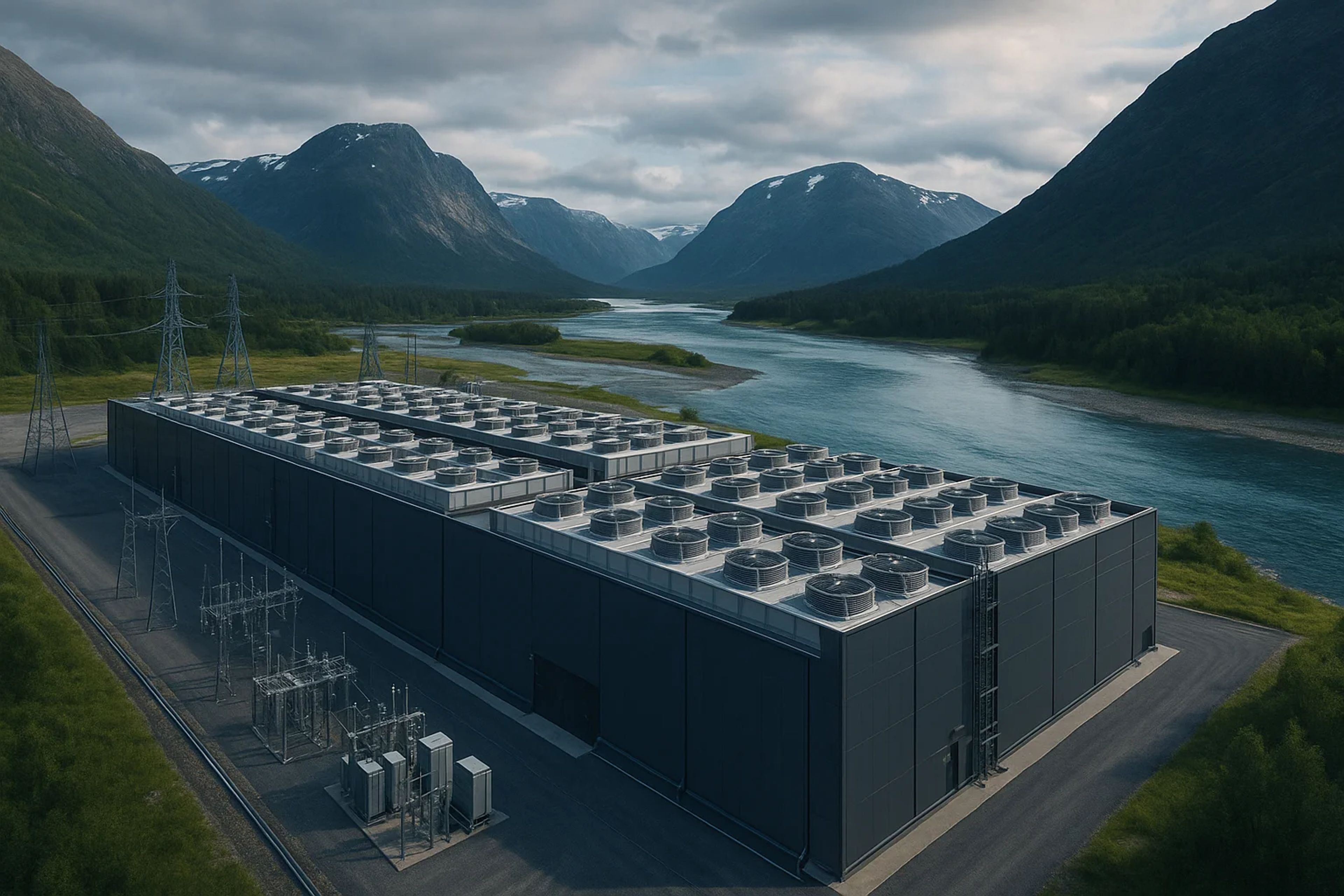
Bitdeer signs up-to-$4.7B Norway AI lease for 121 MW of Nvidia GPU-ready capacity
The 16-year deal is pending closing conditions and is expected to be backed by about $1.3B in letters of credit.
Bitdeer has signed a 16-year lease agreement valued at as much as $4.7 billion to provide 121 megawatts of AI and high-performance computing capacity at its Tydal, Norway site. The lease is not yet effective, but BTDR shares still gained about 8% in early Nasdaq trading as investors leaned into the miner-to-AI pivot narrative.
Key Takeaways
- Bitdeer agreed to a 16-year lease valued at as much as $4.7 billion tied to AI/high-performance computing data center capacity in Norway.
- The contract covers 121 MW of IT capacity at the company’s Tydal, Norway site, configured to support Nvidia GPU-based AI workloads.
- The lease has been announced but is not yet effective because it remains subject to customary closing conditions.
- About $1.3 billion in letters of credit are expected from affiliates of JP Morgan and another global financial institution to secure the tenant’s payment obligations.
Bitdeer’s $4.7B Norway Lease Puts 121 MW of GPU-Ready Capacity in Play
Bitdeer signed a 16-year lease agreement valued at as much as $4.7 billion to provide AI and high-performance computing (HPC) data center capacity at its Tydal, Norway facility. The agreement is framed around 121 megawatts of IT capacity, a power-delivery measure that matters to traders because it is the hard ceiling on how much compute the site can run once servers are installed and operating.
The company said the Tydal facility will be configured to support Nvidia GPU-based AI workloads. In practice, that means the buildout is aimed at the same class of accelerated computing used for modern AI training and inference, rather than the more specialized, single-purpose infrastructure associated with Bitcoin mining.
Equity markets treated the announcement as another step in the “miner-to-AI” rerating trade. Bitdeer shares jumped about 8% in early Nasdaq trading following the disclosure, a move that sits less on near-term earnings impact and more on the idea that contracted AI/HPC capacity can command a different multiple than pure hashprice exposure.
Tenant Opacity, Closing Conditions, and the $1.3B Letter-of-Credit Backstop
The catch is that the lease is not yet a live contract in the way the headline number implies. Bitdeer said the lease remains subject to customary closing conditions and is not yet effective, and it did not provide a closing date or specify which conditions remain outstanding.
Counterparty clarity is also incomplete. Bitdeer identified the tenant only as a subsidiary of Volta Infra and did not disclose the tenant’s identity, nor did it specify whether Volta is the end customer or an intermediary that will sub-allocate capacity. That distinction matters because it determines who ultimately bears the economics of the contract and, in a stress scenario, who is incentivized to keep paying.
To secure the tenant’s payment obligations, affiliates of JP Morgan and another unnamed global financial institution are expected to issue approximately $1.3 billion in letters of credit. A letter of credit functions as a bank-backed payment guarantee, designed to reduce landlord credit risk if the tenant fails to meet contractual obligations, but the packet does not include the final terms, the identity of the second institution, or whether the guarantee amount could change at closing.
A separate linkage circulating around Volta’s broader business cannot be treated as confirmed from the materials here. The source text relays that Bloomberg cited people familiar with the matter saying Volta’s Nvidia-backed $10 billion cloud contract is with Anthropic, but Bitdeer did not confirm that relationship in its own disclosure and no primary documentation is provided in this packet.
From Bitcoin Mining to AI/HPC: How Bitdeer Is Funding the Pivot
Bitdeer has been steadily positioning itself as more than a Bitcoin miner, and the Norway lease fits that sequencing. Alongside its push into AI and HPC infrastructure, the company has expanded mining hardware manufacturing operations to reduce reliance on third-party suppliers, a strategy that can matter when supply chains tighten and delivery schedules become the constraint rather than power.
In July 2026, Bitdeer announced a $36 million investment in a manufacturing facility in Nevada to support that manufacturing expansion. The company has also taken a notably different approach to balance-sheet Bitcoin than many of its publicly traded mining peers, choosing liquidity and capex flexibility over a long-duration BTC treasury posture.
In early February 2026, Bitdeer said it reduced its Bitcoin holdings from roughly 943 BTC to zero while stating it remains committed to the Bitcoin ecosystem. Bitdeer executive Ross Gann tied that decision directly to funding needs: “According to Bitdeer executive Ross Gann, the sales were made to help fund the company’s broader expansion strategy, including acquisitions of powered land for AI and Bitcoin mining infrastructure.”
That capital allocation choice stands out because it runs against the prevailing public-miner playbook of holding large BTC treasuries. BitcoinTreasuries.NET lists MARA Holdings, Riot Platforms, CleanSpark, and Hut 8 as each holding at least 10,000 BTC, with MARA’s holdings exceeding 36,000 BTC. For Bitdeer, the Norway lease is the kind of contract that can justify that tradeoff if it closes cleanly and produces durable, bankable cash flows.
Signals to Watch for Bitdeer signs $4.7B Norway AI lease
The first gating item is procedural rather than narrative: confirmation that the lease has satisfied closing conditions and becomes effective, including any disclosed closing date or amended terms that change the economics implied by “up to $4.7 billion.”
The second is counterparty disclosure. Traders will want clarity on the ultimate tenant or end-customer and whether Volta Infra is acting as an intermediary or principal, because that determines how to underwrite credit quality and renewal risk over a 16-year term.
The third is the structure behind the payment backstop. The market has a headline figure of roughly $1.3 billion in expected letters of credit from affiliates of JP Morgan and a second unnamed global financial institution, but the identity of that second institution and any changes to the guarantee amount or triggers will shape how much “contract certainty” investors should actually assign.
Finally, relative performance will matter as a reality check. If BTDR continues to outperform other public miners like MARA, RIOT, CLSK, and HUT as the story matures, it suggests the market is buying the AI/HPC revenue-mix shift rather than treating the move as a one-day sentiment catalyst.
My Read: The Trade Is About Contract Certainty—Not the Headline Number
The lease is being priced like a clean pivot moment, but the procedural detail is doing more work than the $4.7 billion headline. The agreement is not yet effective, the tenant is only described as a Volta Infra subsidiary, and even the credit support is still framed as “expected,” with one letter-of-credit provider unnamed.
The threshold that matters is whether this becomes a closed, enforceable contract with a clearly underwritten counterparty and a finalized bank guarantee structure. If those pieces land without dilution to the economics, the setup starts to look structural rather than narrative-driven, because it gives Bitdeer a path to monetize 121 MW as contracted AI/HPC capacity instead of living and dying by mining-cycle volatility.


