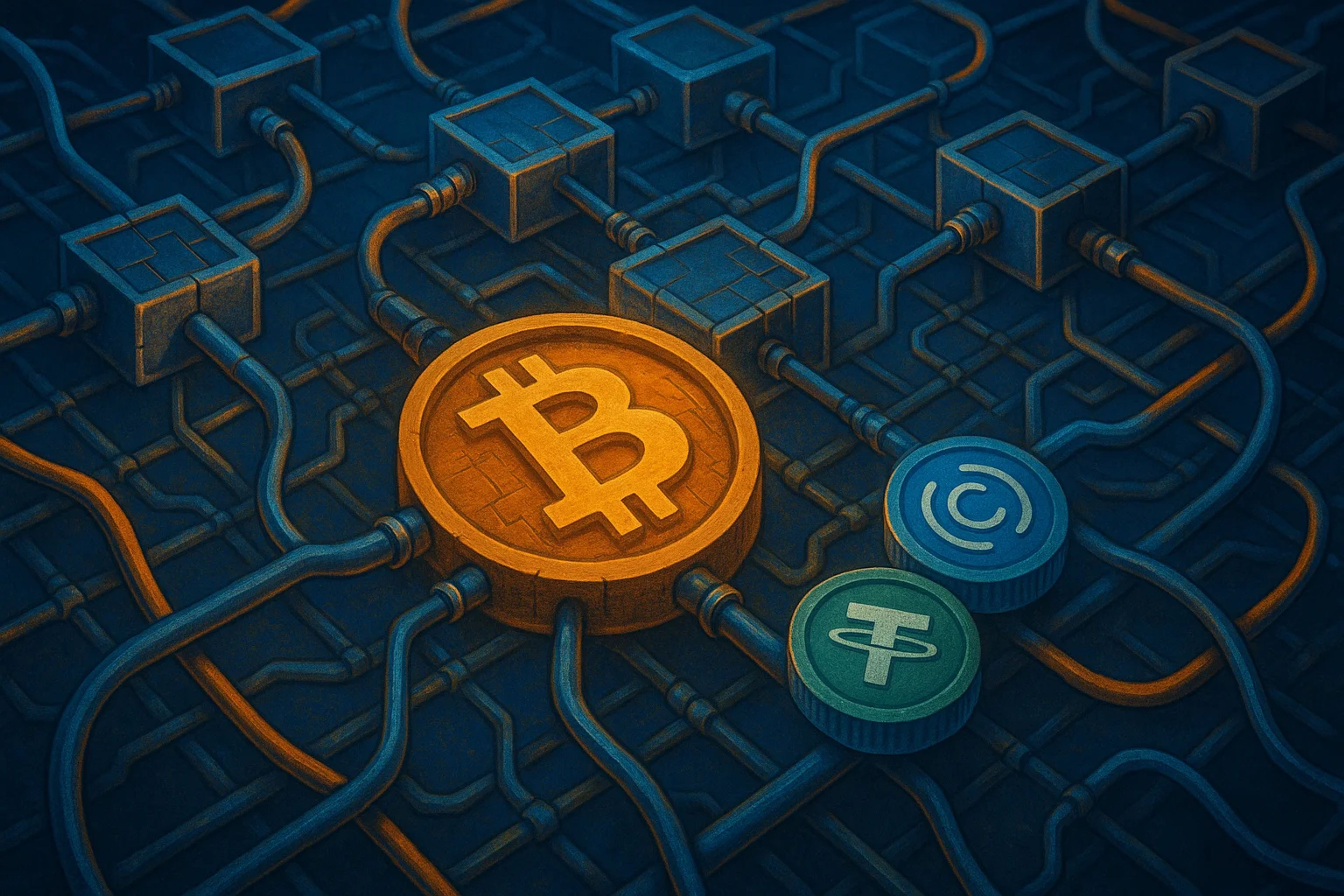
Breez SDK adds BTC-funded USDC/USDT payouts across 30+ blockchains
The Lightning-routed flow converts BTC via liquidity providers and delivers stablecoins to the recipient’s chain without the sender holding them.
Breez shipped a new Breez SDK capability that lets apps send USDC and USDT to recipients across more than 30 blockchains directly from a user’s Bitcoin balance. The feature routes payments over the Lightning Network and uses third-party liquidity providers to convert and deliver stablecoins on the destination chain.
Key Takeaways
- Breez SDK now supports sending USDC and USDT across more than 30 blockchain networks while funding the payment from a Bitcoin balance.
- Lightning Network routing is combined with automated conversion so the recipient receives stablecoins on their preferred chain.
- The SDK detects the destination chain from the recipient address and shows the amount, network, and fees before confirmation.
- Flashnet and Boltz are part of the execution path, converting BTC into stablecoins and delivering them on the selected blockchain.
Breez SDK Adds BTC-to-USDC/USDT Payouts Across 30+ Chains
Breez added a new feature to Breez SDK that lets developers enable USDC and USDT payouts across more than 30 blockchain networks, funded directly from a user’s Bitcoin balance. The core promise is operational simplicity for apps and users: the sender does not need to pre-convert BTC or maintain separate stablecoin balances to pay out in USDC or USDT.
Breez CEO Roy Sheinfeld framed the design as an interoperability play rather than a stablecoin-on-Lightning requirement, saying the feature does not require USDT or USDC to be issued on the Lightning Network and instead relies on “interoperability.” In practice, that positions Lightning less as the final settlement venue and more as the front-end rail that can originate payments even when the recipient’s end asset is a stablecoin on another chain.
Inside the Payment Path: Address-Based Chain Detection, Lightning Routing, and Conversion
The user flow starts with an address. After a sender inputs the recipient’s wallet address, Breez SDK identifies the destination blockchain, calculates a conversion route, and displays the amount, network, and fees before the payment is confirmed.
Execution then moves off the app and into the liquidity layer. The transaction is routed through liquidity providers, including Flashnet and Boltz, which convert the sender’s Bitcoin into stablecoins and deliver the USDC or USDT on the recipient’s chosen blockchain.
For traders and builders, that external dependency is the fulcrum. Breez can abstract the UX, but pricing quality and reliability will hinge on how conversion routes are priced and executed by the liquidity providers that sit between BTC on Lightning and stablecoin delivery on the destination chain.
Non-Custodial, Outbound-Only at Launch: What’s Live vs. What’s Next
Breez described the feature as non-custodial, with users holding Bitcoin until they initiate a payment. At launch, the scope is explicitly one-way: it initially supports only outbound stablecoin payments.
Inbound support is not live yet. Breez said receiving stablecoins from external blockchain networks is planned for a future release, but no timeline or implementation details were provided. That constraint narrows near-term loops like paying out to a stablecoin chain and then pulling funds back into the same app without leaving the Breez SDK flow.
Signals to Watch for Breez adds BTC-to-USDC/USDT payment routing
The first practical signal is transparency on coverage. Breez has not published the specific list of the “more than 30” supported blockchains, and any exclusions by region or wallet type would matter for real distribution.
Second is conversion disclosure. The market will want clarity on fee schedule, slippage behavior, and how routes are selected between liquidity providers like Flashnet and Boltz, since that determines whether the feature feels like a cheap rail or an expensive convenience.
Third is the inbound roadmap. A concrete timeline and scope for receiving stablecoins from external networks would expand use cases from outbound payouts into two-way treasury and commerce flows.
Finally, usage proof will matter more than narrative. Breez has not shared metrics yet, so case studies or volume routed via the new SDK feature will be the cleanest read-through, alongside broader Lightning adoption indicators like River’s estimate that monthly Lightning transaction volume surpassed $1 billion in late 2025, up from around $12 million in 2021.
Marcus Hale’s Take: A Stablecoin Rail Without Stablecoin Balances
Lightning’s pitch has always been speed and cost. Breez is stretching that pitch into a more pragmatic framing: Lightning as the originating rail, stablecoins as the delivery asset, and “interoperability” as the glue. That’s constructive for BTC utility because it meets users where demand already is, which is stablecoin settlement on the chain their counterparty actually uses.
The threshold that matters is execution quality at the conversion layer. If fees and slippage stay tight and routing is consistent across the supported chains, the setup starts to look structural rather than narrative-driven, especially with Lightning already being tested for larger transfers like Secure Digital Markets’ $1 million payment to Kraken in under half a second. If pricing is opaque or inconsistent, this looks more like a sentiment catalyst than a fundamental shift, and the feature becomes a UX wrapper around third-party liquidity risk.


