Coinbase and WisdomTree shift crypto’s growth playbook toward retention and distribution
Coinbase outlined a rewards-driven adoption flywheel as WisdomTree opened MoonPay access to its $1.2B tokenized fund WTGXX.
Crypto firms that spent years shipping tokenization, lending, and payments rails are now treating repeat usage as the harder problem. Coinbase is designing a rewards-driven “flywheel” to keep assets on-platform, while WisdomTree is pushing its tokenized money market fund WTGXX into MoonPay to cut retail onboarding friction.
Key Takeaways
- Coinbase framed adoption as a three-step loop: bring money onto the platform, give customers reasons to keep it there (including rewards), then expand ways to use it through spending, trading, and payments.
- WisdomTree said its tokenized money market fund WTGXX has about $1.2 billion in assets, within a firm described as a $150 billion asset manager.
- Eligible U.S. retail customers will be able to access WTGXX through MoonPay and buy using stablecoins, with MoonPay’s existing KYC intended to remove the need to separately onboard with WisdomTree.
- Kevin O’Leary argued that blockchains pitching institutions will be judged on visible adoption and commercial deals, with competitor-to-competitor word of mouth acting as a key accelerant.
Retention Replaces Product Shipping as the New Crypto Battleground
After a multi-year buildout of tokenization, lending, and payments infrastructure, the competitive line is shifting from “can it be built” to “will anyone keep using it,” and the answers being offered by large platforms are increasingly behavioral rather than technical. Coinbase executives described product design in terms of habit formation and trust, WisdomTree described distribution as the next phase for tokenized funds, and Kevin O’Leary put a blunt institutional filter on the whole category: adoption needs to be observable, and it needs to come with deals.
Ben Shen, Coinbase’s head of financial services and loyalty products, said the sector has historically been “very technology oriented,” which often meant jargon-heavy products that exposed users to the underlying rails. As crypto overlaps with traditional financial services, Shen said customers are optimizing for outcomes like “grow their money, hold it, send it, spend it or borrow against it,” not for the fact that a blockchain is involved.
That shift matters because it changes what “progress” looks like. Shipping another onchain product can be a milestone for builders, but it does not automatically translate into retained balances, repeat transactions, or institutional production usage. O’Leary, speaking at the Avalanche Summit in New York last month, framed the institutional version of the same problem as a demand for proof: “show me, show me adoption,” and “you got to get some deals, and you got to get adoption, not just tests.”
Coinbase’s Adoption Flywheel: Rewards, Trust, and New Distribution Paths
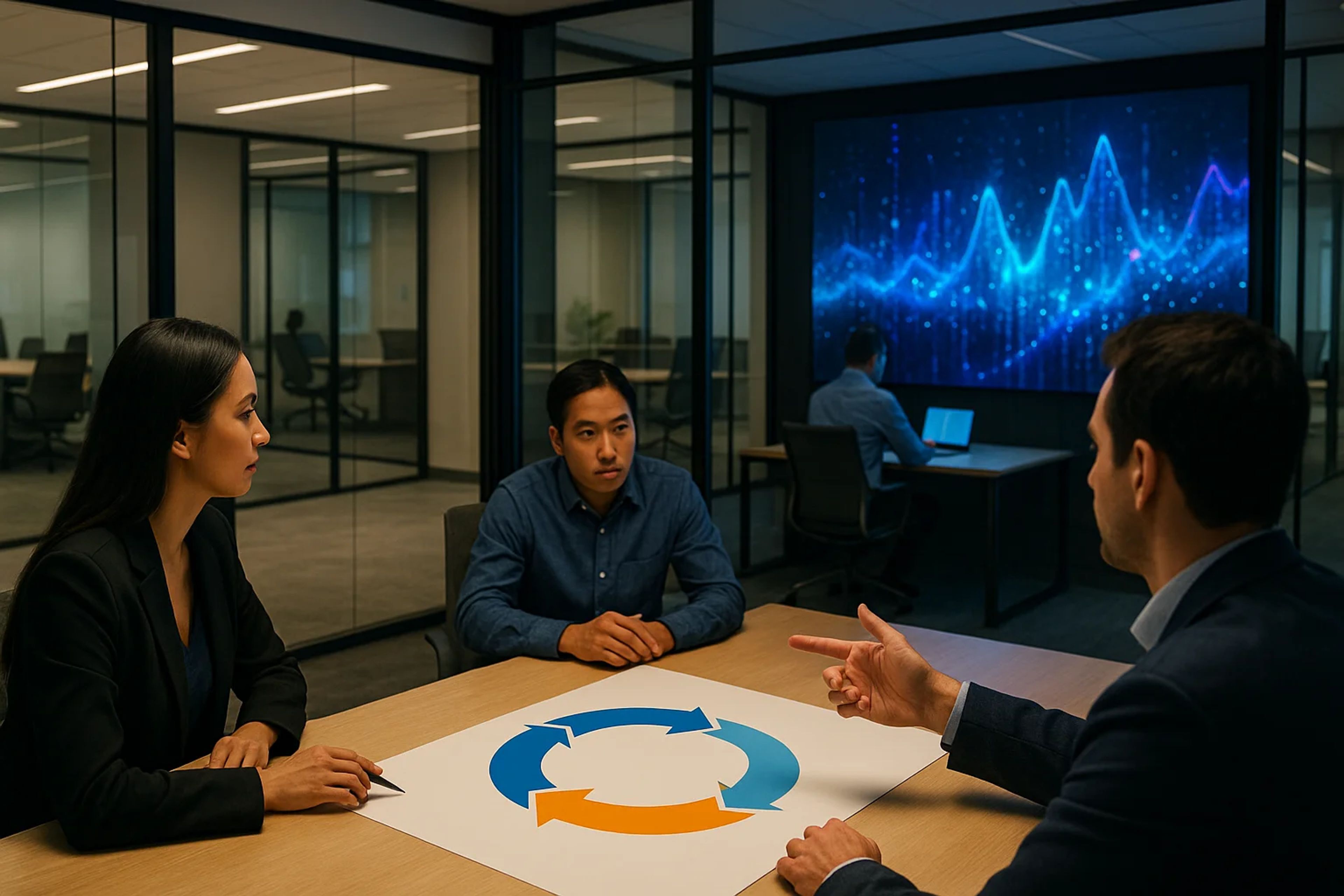
Coinbase’s retention thesis is structured as a loop rather than a funnel. Shen described adoption as a cycle where money comes onto the platform, customers have a reason to hold it there, and then they have ways to use it, including spending, trading, and making payments. The point of the framing is to treat each stage as a product surface that can be tuned, so a one-time “try” becomes a multi-product relationship.
Shen tied that loop to what he called “magic moments,” meaning the early experiences where a customer immediately understands why a product is useful. “If you create the right magic moments across these three parts of the flywheel, then that'll get people to increasingly bring more and more money onto the platform,” he said, explicitly linking retention to increasing wallet share over time.
Rewards sit in the middle of that design, and Shen was careful to separate embedded rewards from temporary incentives. Some rewards are part of the product itself, while other promotions are meant to persuade users to move money from tools they already use. Those incentives can “break inertia,” Shen said, but Coinbase does not want the pattern where funds arrive for a promotion and leave when it ends. The bet, as he described it, is that once assets are on-platform, users will discover additional use cases, for example arriving for a yield incentive and later using the same assets to trade or spend.
Trust is the other constraint that makes the flywheel work or fail. Shen said financial services adoption depends heavily on trust because users are handing over money, sometimes paychecks and savings, and he pointed to “social proof” as a driver of repeat behavior. “There's like a social proof thing for financial services that is important,” he said, which is the consumer analog to O’Leary’s institutional point that one credible user can help land the next.
Coinbase also positioned distribution as a parallel track to first-party product building. Shen said he expects most firms to maintain their own apps and websites while also finding other ways to distribute services, and he pointed to AI agents as a potential new route. Coinbase is working on ways for its services to connect with third-party AI tools, with AI agents described as another distribution surface alongside first-party channels, though no specific partners or timelines were provided.
Tokenized Funds Go to Where Users Are: WTGXX Lands on MoonPay
WisdomTree’s approach to the same adoption problem is distribution-first: put tokenized funds in front of users where they already transact, and reduce the number of steps between interest and purchase. Will Peck, WisdomTree’s head of digital assets, said the firm has built a suite of tokenized funds, including WTGXX, a tokenized money market fund with about $1.2 billion in assets. WisdomTree was described as a $150 billion asset manager.
Peck described the next step as expanding access beyond WisdomTree’s own front end. “You don’t need to just come to WisdomTree,” he said. “There’s going to be other access points that you can go through, where you’re effectively coming to WisdomTree, but through a different front end.”
That strategy is now being operationalized through a collaboration with MoonPay. WisdomTree said the partnership will let eligible U.S. retail customers access WTGXX through MoonPay’s platform. Peck said customers who have already provided their information to MoonPay can buy the fund using stablecoins without separately onboarding with WisdomTree, making stablecoin rails and prior KYC the mechanism for reducing friction.
Two practical questions remain open because the announcement, as described, did not include rollout specifics. The timing, eligibility details beyond “eligible U.S. retail customers,” fee structure, and any early volume indicators were not provided, and the market impact will hinge on whether this becomes a meaningful new inflow channel rather than a convenience feature for existing users. Peck also said MoonPay is not intended to be the only venue for WisdomTree’s tokenized funds, but no additional partners were named.
Signals Traders Should Track: Distribution Deals, Repeat Usage, and AI-Agent Channels
The next set of signals is less about new product launches and more about whether distribution and retention strategies turn into measurable behavior.
For WisdomTree and MoonPay, the threshold is operational detail: when access to WTGXX actually rolls out, what “eligible” means in practice for U.S. retail customers, what fees apply on the MoonPay path, and whether WisdomTree discloses any early indicators that stablecoin-funded purchases are adding incremental demand rather than shifting existing flows.
A second signal is whether WisdomTree’s “other access points” language turns into additional integrations beyond MoonPay. One partnership can be a proof of concept, but a repeatable distribution strategy usually shows up as a pattern of deals across multiple front ends.
For Coinbase, the watch item is whether AI agents move from a conceptual distribution route to named integrations with clear transaction flows. Shen said Coinbase is working on connections to third-party AI tools, but without partners, launch dates, or supported actions, it remains an ambition rather than a channel.
On the institutional side, O’Leary’s “deals, not tests” framing sets a clean scoreboard for networks courting enterprise usage. New production deployments and commercial agreements are the evidence that matters, and the absence of them is what keeps tokenization narratives stuck in pilot purgatory.
My Read: The Next Winners Will Be the Best Distributors, Not the Most Prolific Builders
The easy misread here is to treat this as a soft branding pivot, when it is really a shift in what large firms are willing to optimize for. Coinbase is describing retention as a product design problem, where the deposit→hold→use loop is engineered with rewards to “break inertia” but ultimately aims to convert one-off incentives into multi-product behavior that keeps balances sticky.
The threshold that matters is whether distribution deals and reduced onboarding steps translate into repeat usage that can be pointed to in public, because that is the bridge between Shen’s consumer “magic moments” and O’Leary’s institutional demand for “deals” and “adoption, not just tests.” If MoonPay access to WTGXX produces visible traction and Coinbase’s AI-agent talk turns into named integrations with real transaction flows, retention stops being a narrative and becomes a measurable growth surface.


