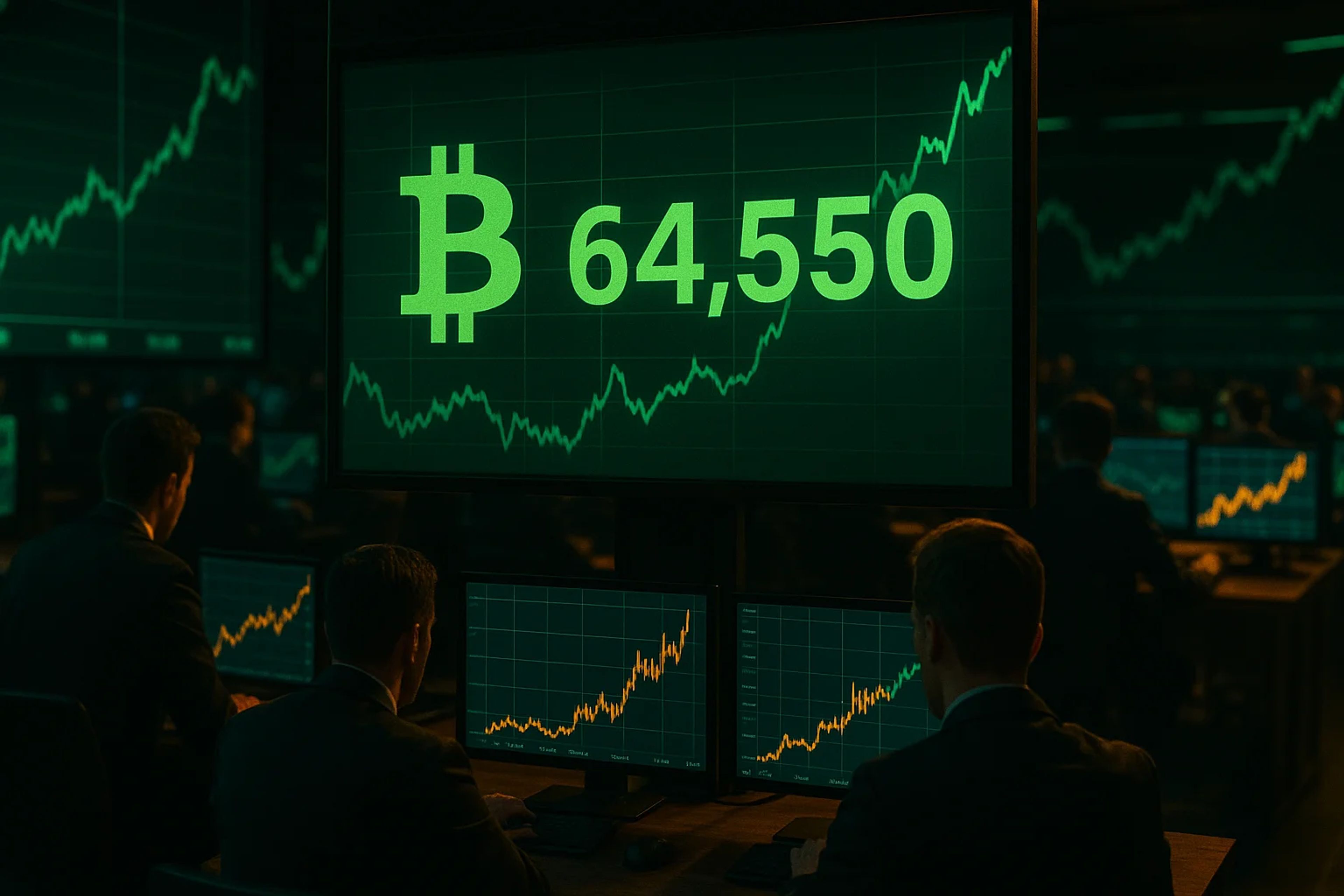
CryptoQuant flags BTC’s $64.5K spike as a derivatives-led short squeeze
Data showed 637 BTC of short liquidations on Monday, while spot demand and ETF flows were cited as the constraint.
Bitcoin pushed to one-week highs near $64,550 on Monday after rebounding from around $62,750, a move CryptoQuant tied to a derivatives-driven short squeeze. The on-chain analytics firm labeled the pop a “low-volume liquidity trap” and pointed to weak spot demand and $267.2 million in prior-week US spot Bitcoin ETF outflows as the main headwind to follow-through.
BTC Tags $64.5K as Shorts Get Forced Out
BTC/USD rallied after the Sunday weekly close and gained up to roughly 3% on Monday, topping out around $64,550 on Bitstamp after trading near ~$62,750 before the rebound. CryptoQuant attributed the move above $64,000 to a derivatives-market short squeeze, arguing that crowded short positioning and cross-exchange funding-rate imbalances created the conditions for forced buying.
The liquidation print matched that read. CryptoQuant data put total Bitcoin short liquidations at 637 BTC for Monday, the largest single-day tally since July 21, a level that tends to show up when price runs through clustered stops and margin thresholds rather than when spot buyers steadily lift offers.
CryptoQuant’s own language was blunt about the character of the move, describing the spike as a “low-volume liquidity trap.” The packet does not include independent spot-volume figures or a venue-by-venue volume breakdown, so the “low-volume” label can’t be verified from the data provided, but the liquidation burst and the speed of the push into $64K are consistent with a positioning-driven impulse.
Funding-Rate Imbalances and the ‘Liquidity Trap’ Read
The mechanics CryptoQuant pointed to sit in perpetual futures, where funding rates act as a recurring payment between longs and shorts to keep perp prices anchored to spot. When funding diverges across major venues, it often signals that positioning is lopsided and that the unwind can be abrupt once price moves against the crowded side.
CryptoQuant said that around the ~$62,750 area, funding rates between exchanges began to diverge. Shorts were dominant on Binance, Bybit, OKX, and Deribit, while HTX’s funding rate briefly spiked to 0.05%, a split that can happen when one venue’s positioning or liquidity profile gets stretched relative to the rest of the complex.
CryptoQuant framed that crowding as the catalyst for the squeeze, writing: “This crowded short positioning served as the primary catalyst, fueling a short squeeze that drove prices higher.” In practice, that means shorts either bought back voluntarily into a rising tape or were liquidated by exchanges as margin fell below maintenance requirements, turning risk management into market buys.
A second piece of the setup is what happens after the squeeze. CryptoQuant noted a downward funding-rate reset from 0.006% to 0.003% over a 24-hour window, and suggested that declining funding could set conditions for additional squeezes if traders rebuild short exposure. That is the catch with “liquidity trap” moves: the first leg can clear out one side of the book, then the market either finds real spot demand to hold the new range or drifts back once the mechanical bid fades.
Spot and ETF Flows as the Constraint on Follow-Through
CryptoQuant’s constraint is straightforward: it flagged weak or absent spot demand and cited $267.2 million in net US spot Bitcoin ETF outflows over the prior week as reasons the upside may not be sustainable. The packet does not specify the exact date range covered by that “prior week” figure, but the directionality is the point CryptoQuant is making, that the dominant marginal buyer has not been consistently showing up through the ETF channel.
The near-term confirmation level is whether BTC can hold above $64,000 or slips back toward the ~$62,750 pre-squeeze area referenced in the move. If price gives back the squeeze zone quickly while funding normalizes, that tends to validate the “positioning first, demand later” framing.
Downside risk in CryptoQuant’s scenario work is conditional and level-driven. It said: “A break below $60K alongside rising exchange inflows would weaken the structure and increase downside risk toward $50K. Selling pressure is cooling, but demand still needs to return,” tying the bear case to both price and the on-chain signal of coins moving onto exchanges.
Overhead, CryptoQuant cited short-term holders’ cost basis at around $68,700, using UTXO age under 155 days as the definition. That level matters because it often acts as supply from recent buyers looking to get back to breakeven, so a squeeze that stalls below it can still leave the market capped until spot participation improves.
My Take: Treat the Pop as Positioning-Driven Until Spot Demand Shows Up
The move is being read as a breakout attempt, but the details in the packet point to a mechanical squeeze first and a demand story second. When the cleanest hard number attached to the rally is 637 BTC of short liquidations, and the same analysis flags weak spot demand plus $267.2 million of prior-week US spot Bitcoin ETF outflows, the burden of proof shifts to follow-through flows rather than another round of perp positioning.
The threshold that matters is whether spot and ETF flows flip from headwind to tailwind while BTC holds above $64,000, because without that, the setup looks more like a sentiment catalyst than a fundamental shift and $60,000 remains the line that turns a squeeze into a structural problem.


