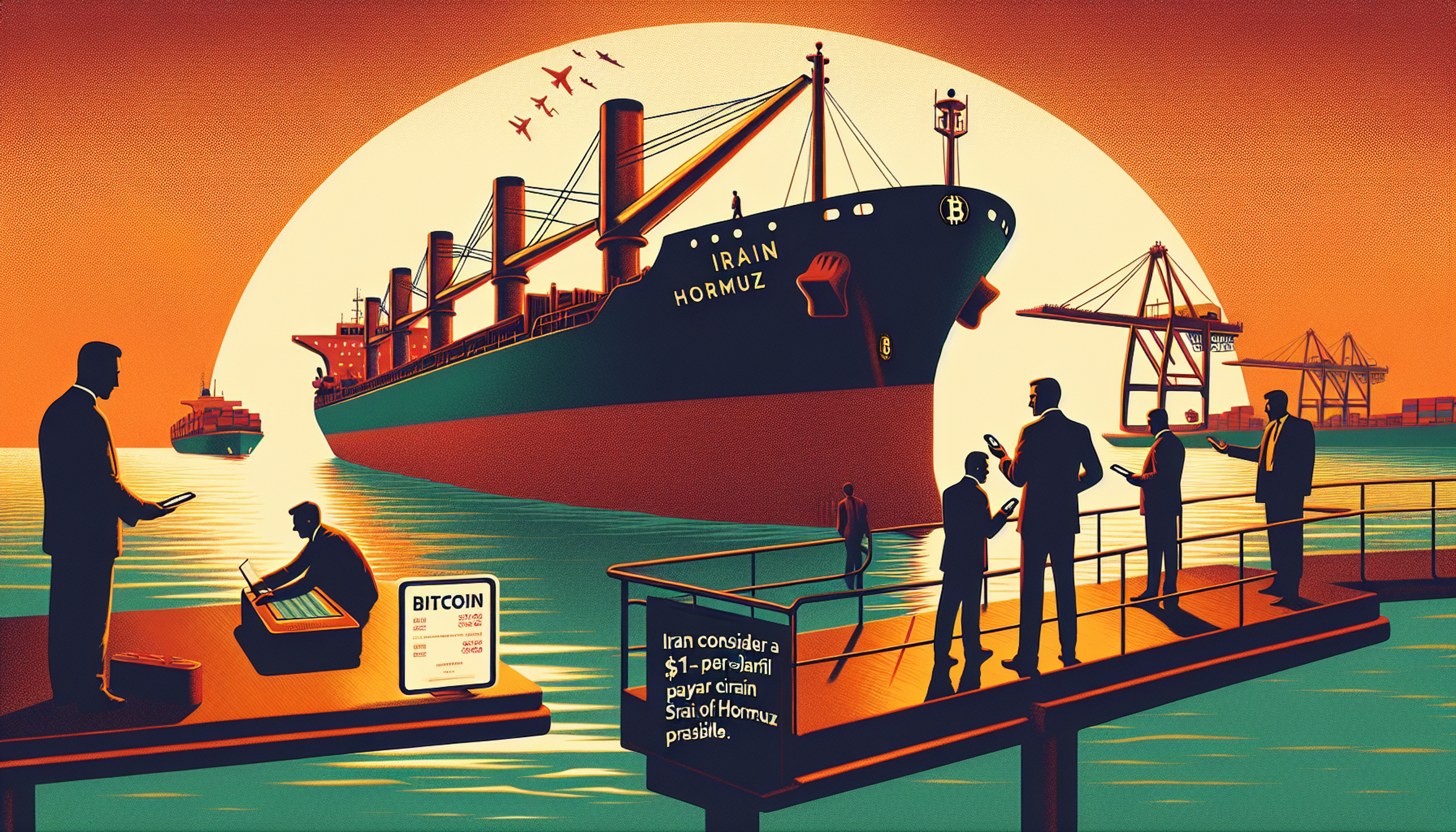
Iran weighs $1-per-barrel Bitcoin tariff for some Strait of Hormuz transits
The proposal is tied to a claimed two-week ceasefire window and would exempt empty oil tankers, per a union spokesperson.
Iranian authorities are reportedly considering a $1-per-barrel tariff payable in Bitcoin for certain ships transiting the Strait of Hormuz during a claimed two-week ceasefire window. The idea links sanctions-constrained crypto settlement directly to a critical oil-shipping chokepoint, with key details still unconfirmed.
Key Takeaways
- Iran is reportedly weighing a $1-per-barrel tariff, payable in Bitcoin, for certain vessels using the Strait of Hormuz.
- Empty oil tankers would be allowed through without charges, while other ships would face screening during the two-week period, according to union spokesperson Hamid Hosseini.
- Hosseini described a process where ships would have only seconds to pay in BTC after an assessment, citing sanctions risk around funds being traced or confiscated.
- The two-week window is tied to President Donald Trump’s claimed ceasefire and “safe opening” of the strait, while Iranian state media described conditions including continued control of the waterway and an end to sanctions.
A Bitcoin Toll at Hormuz: The $1-Per-Barrel Proposal
Iran is considering charging some ships a tariff of $1 per barrel of oil to transit the Strait of Hormuz, with payment denominated in Bitcoin. The proposal is framed as a short-window policy concept tied to a claimed two-week ceasefire period.
For traders, the novelty is not the fee size. It is the explicit linkage between access to a global oil chokepoint and a crypto settlement rail that is designed to function under sanctions pressure.
The scope remains unclear. The available details describe “certain ships” being charged, without a published list of categories beyond an exemption for empty oil tankers.
How the Screening-and-Pay Flow Would Work, According to Hosseini
Hamid Hosseini, spokesperson for Iran’s Oil, Gas and Petrochemical Products Exporters’ Union, said empty oil tankers would be permitted to pass without charges. Other vessels would be assessed during the two-week period, including checks to ensure they are not transporting weapons.
Hosseini also described a rapid payment workflow after screening, saying: “Once the email arrives and Iran completes its assessment, vessels are given a few seconds to pay in Bitcoin, ensuring they can’t be traced or confiscated due to sanctions,” tying the payment choice directly to sanctions-related constraints.
That rationale matters more than the optics. A BTC-denominated tariff in this context reads less like a consumer payments experiment and more like a settlement workaround for counterparties that view conventional rails as monitorable or interruptible.
Ceasefire Claims, Iran’s Conditions, and Control of the Waterway
The timing is anchored to President Donald Trump’s claim that the United States and Iran agreed to a two-week ceasefire that included suspending the “bombing and attack of Iran for a period of two weeks” and the “complete, immediate, and safe opening of the Strait of Hormuz.”
Iranian state media, however, described a conditional framework. It said Iran delivered a 10-point plan as a condition for the deal, including continued control of the waterway and an end to sanctions on Iran.
That gap is the core risk variable. If the ceasefire terms and operating conditions of the strait are not cleanly verifiable, the tariff concept should be treated as conditional rather than actionable policy.
Signals Traders Can Monitor During the Two-Week Window
The first signal is confirmation that the tariff moves from “considered” to implemented, including which ship categories are covered beyond the empty-tanker carve-out and when enforcement actually starts.
The second is whether the claimed two-week ceasefire translates into the “complete, immediate, and safe” operating conditions described by Trump, or whether Iran’s stated conditions around control and sanctions dominate the real-world flow of shipping.
Cross-asset sensitivity is the third. During the February–March disruption tied to US-Israel air strikes on Iranian targets, many ships were effectively cut off from using the strait to transport oil and supplies. In that period, crude oil exceeded $100 per barrel for the first time in four years, while Bitcoin traded with volatility between $65,000 and $75,000.
Finally, the broader pattern is worth tracking. Blockchain analytics firm Elliptic reported in January that Iran’s central bank acquired half a billion dollars worth of Tether’s USDt (USDT). TRM Labs tracked about $3.7 billion in total crypto flows in Iran between January and July 2025. Those figures provide context for state-linked crypto usage that can scale beyond a symbolic toll.
Why This Matters More as a Macro Volatility Trigger Than a BTC Demand Story
I treat this as a conditional headline until there is hard confirmation that the tariff is implemented and enforceable, because the ceasefire and “safe opening” framing is presented as Trump’s claim alongside Iran’s stated conditions. The threshold that matters is whether shipping access normalizes in practice or remains subject to discretionary screening and payment demands.
Even if the BTC toll goes live, the real test is whether it changes perceived shipping risk at the strait. If access holds, the setup starts to look structural rather than narrative-driven. If it doesn’t, the market impact should run through oil and risk sentiment first, with Bitcoin reacting as a volatility asset rather than as a beneficiary of incremental $1-per-barrel settlement flow.


