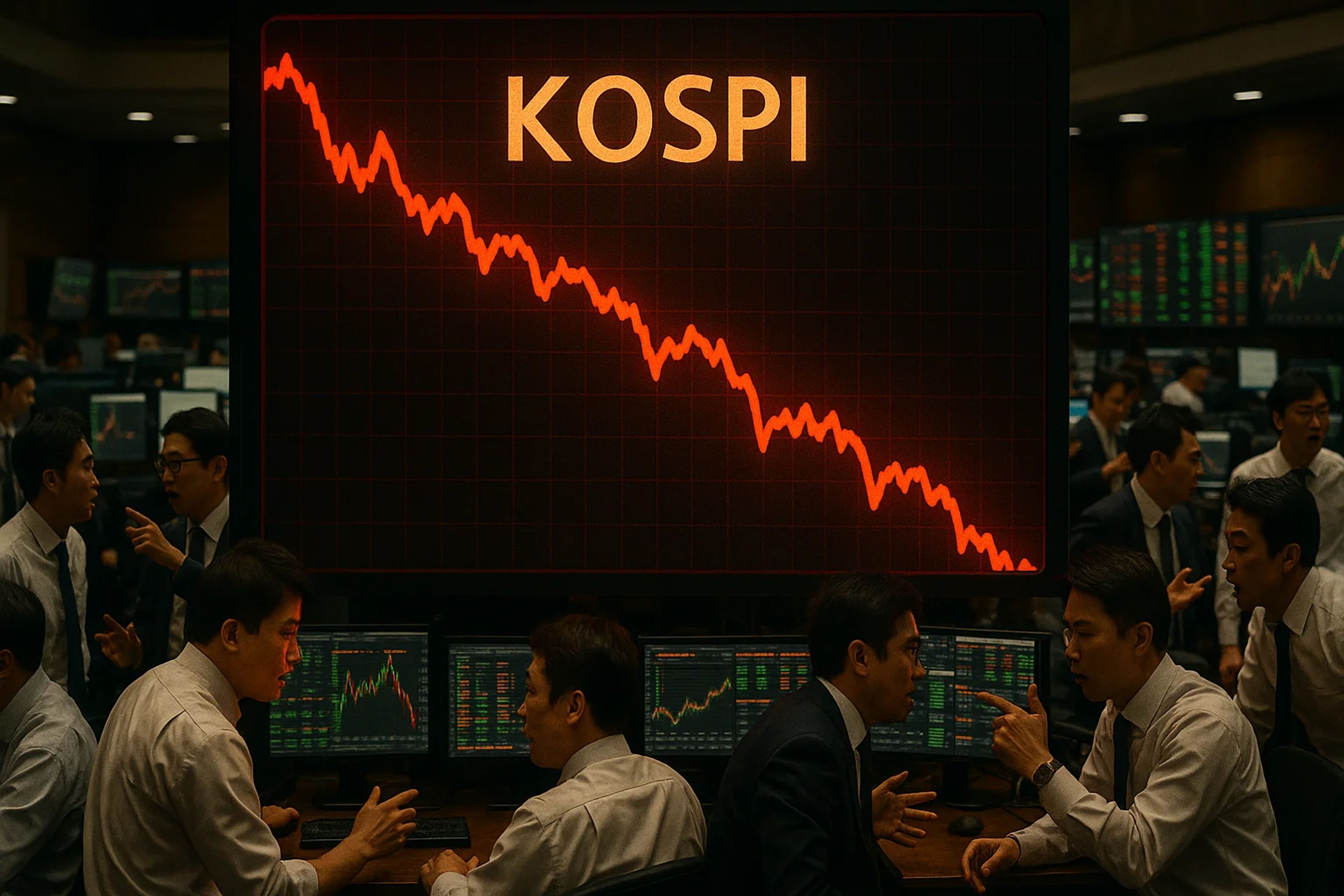
Kospi options price bigger swings than bitcoin after AI-trade drawdown
Kospi 30-day implied vol was cited at 81% versus bitcoin BVIV around 38% as BTC stayed below its 50-day average.
Options markets are pricing South Korea’s Kospi as more than twice as volatile as bitcoin after a sharp AI-linked equity drawdown. The volatility flip lands as BTC trades below its 50-day moving average and U.S. policy headlines around the Clarity Act sit near-term on the tape.
Key Takeaways
- Kospi’s 30-day options-implied volatility was cited at an annualized 81%, versus bitcoin’s BVIV around 38% using Bloomberg and Volmex data.
- South Korean equities fell nearly 25% over four weeks as an AI-boom trade was described as unwinding.
- Forced liquidations tied to Korean retail margin trading and leveraged ETFs were put at more than $2 trillion in less than three months.
- Bitcoin traded below its widely followed 50-day moving average, while Nansen saw no meaningful rotation into stablecoins by “first mover” wallets during the geopolitical flare-up.
Kospi Options Reprice Risk Above Bitcoin
Kospi options are now pricing larger near-term swings than bitcoin options, a reversal of the usual “crypto is the outlier” framing traders default to. Kospi’s options-based 30-day implied volatility index was cited at an annualized 81%, compared with bitcoin’s BVIV around 38%, per Bloomberg and Volmex data.
Implied volatility is the market’s price for protection. When IV gaps higher, it typically means hedging demand is rising and dealers are charging more for convexity. The practical read is straightforward: in the next month, options traders are paying up for Kospi tail risk more aggressively than they are for BTC.
That does not make bitcoin “safe.” It does, however, flag that the marginal stress point in risk is showing up in South Korean equities first, not in crypto.
AI-Trade Unwind and the Retail Leverage Liquidation Wave
The repricing follows a fast drawdown. Kospi fell nearly 25% over four weeks, described as a key beneficiary of the AI boom that is now unwinding.
The more important second-order effect is leverage. Forced liquidations among Korean retail traders using margin trading and leveraged ETFs were said to total more than $2 trillion in less than three months. The source does not detail the methodology, including venue coverage or whether the figure is notional turnover versus realized losses, which matters for how traders should weight it.
Still, the combination of a near-25% index slide and a liquidation number of that scale fits a deleveraging narrative. When crowded equity themes unwind through retail leverage, the spillover channel is usually risk appetite and funding conditions, not a clean one-asset story.
Bitcoin’s Technical Posture vs. On-Chain Positioning Signals
Bitcoin remained under pressure and traded below its widely followed 50-day moving average at the time of writing. That keeps the technical posture defensive, even if BTC’s options market is not pricing the same magnitude of near-term turbulence as Kospi.
On-chain positioning offered a counter-signal. Nansen said wallets that typically move first and in the largest size during geopolitical flare-ups had not meaningfully shifted into stablecoins. Nicolai Sondergaard, a research analyst at Nansen, described the pattern as: “This is consistent with prior Middle East flare-ups: Short-term leveraged longs get flushed, and then accumulation resumes,” he said in an email.
The cohort definition behind “first mover” wallets is not specified, but the stablecoin non-rotation is still a concrete datapoint for whether de-risking is broadening beyond leveraged positioning.
Clarity Act Hearing Risk Into the August Recess
Policy remains a live catalyst. Marex analysts said the Clarity Act faced what could be its “final test today,” while flagging hurdles including “Trump conflict of interest provisions” and “fresh Senate hurdles” before the August recess. “This is the regulatory clarity the institutional bid has been waiting for,” Marex analysts said.
For traders, the immediate variable is procedural. Any update from the 2026-07-17 hearing, and any signal on the Senate path into the August recess, can reprice regulatory risk quickly, especially with BTC already leaning below a key trend indicator.
What the Volatility Flip Suggests for Cross-Asset Risk
I treat the Kospi-BTC volatility flip as a risk-sentiment tell, not a victory lap for bitcoin. The threshold that matters is whether Kospi’s ~81% 30-day IV compresses as the index stabilizes, or whether elevated IV persists and forces more hedging demand into the system.
The real test is whether BTC can reclaim its 50-day moving average without seeing “first mover” wallets rotate into stablecoins. If BTC stays technically weak while on-chain de-risking finally shows up, the setup starts to look structural rather than narrative-driven, and the cross-asset deleveraging signal becomes actionable in practical terms.


