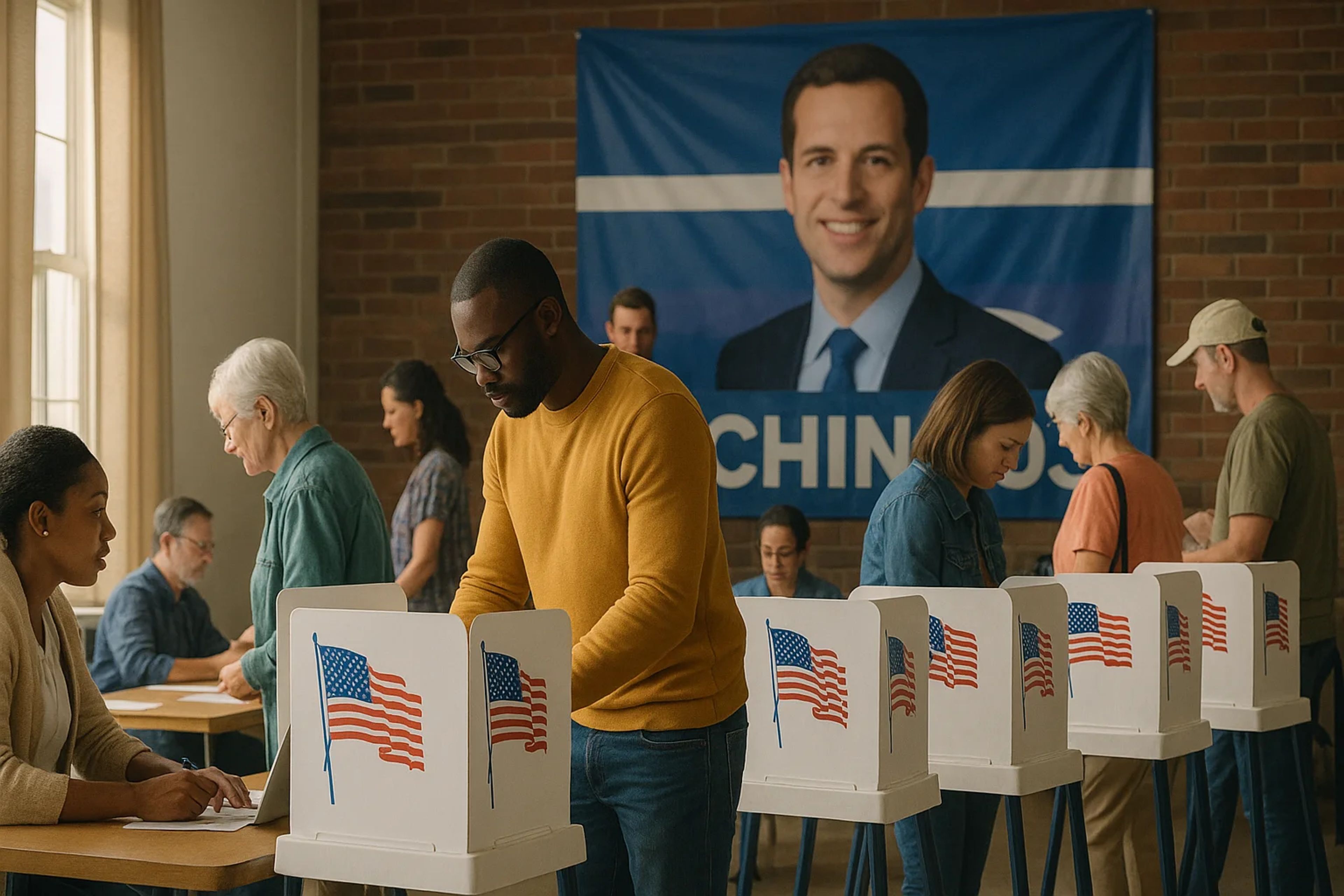
Protect Progress reports $189K pro-Auchincloss media spend ahead of Massachusetts primary
The Fairshake affiliate’s late-cycle push lands as the network reports $122 million cash on hand for 2026.
Protect Progress PAC, a Fairshake affiliate, reported spending just over $189,000 on media supporting Rep. Jake Auchincloss ahead of Massachusetts’ Tuesday primary in the state’s 4th congressional district. The spend drew a public rebuke from Democratic challenger Jason Poulos and refocused attention on Fairshake’s $122 million cash-on-hand as crypto market-structure legislation remains pending in the Senate.
Protect Progress Drops $189K Behind Auchincloss as Massachusetts Holds a Late Primary
Federal Election Commission records as of Tuesday show Protect Progress PAC spent just over $189,000 on media supporting Representative Jake Auchincloss as he runs for reelection in Massachusetts’ 4th congressional district. Protect Progress is described as an affiliate of Fairshake, the crypto-industry-backed political action committee network that has made outside spending a recurring feature of federal races.
The timing is the point. Massachusetts is one of the last states to hold primaries, with just over two months until the general election, so even a comparatively small House primary spend lands late in the calendar when campaigns are trying to lock in message discipline and avoid unforced errors.
The spend also arrived with a side narrative that is harder to control than a policy ad. Democratic candidate Jason Poulos alleged some of Protect Progress’ funds were used to create “AI-generated slop mailers” supporting Auchincloss ahead of the primary, and in an Aug. 16 letter he urged Auchincloss to “publicly renounce” Protect Progress’ efforts to influence both the primary and the general election. The packet provides no independent verification of the mailers’ provenance, how the $189,000 was allocated across channels, or whether any content was AI-generated.
Poulos also attempted to tie the outside support to crypto policy directly, claiming Auchincloss accepted $77,500 from “crypto-industry sources” since 2020 and pointing to Auchincloss’ vote for the Digital Asset Market Clarity Act in July 2025. The bill is described as having passed the House but not been signed into law, and it remains awaiting consideration in the Senate.
Fairshake’s $122M Cash-on-Hand Keeps Crypto’s Policy Machine in Play
For traders who track Washington risk as a driver of listings, enforcement posture, and market-structure timelines, the Massachusetts spend matters less as a standalone number than as proof-of-life for the broader network. Fairshake and its affiliates reported $122 million cash on hand ahead of the 2026 midterms, after spending about $3.6 million on House and Senate races in Alaska, Florida and Wyoming in August.
That posture fits a multi-cycle strategy rather than a one-off burst. Fairshake is described as having poured more than $130 million into ads and media during the 2024 election cycle, and its spokesperson Geoff Vetter framed the current balance as runway rather than a wind-down: “With dozens of wins in House and Senate races across the country, and $122 million ready for the fall, we’re not slowing down heading into November,“ he said in August.
The catch for crypto-aligned political spending is that the most viral takeaway is not always the intended one. A policy-sensitive market participant might care about whether a pro-crypto coalition is building durable support for market-structure legislation, but a primary electorate may instead fixate on the allegation that outside money funded “AI-generated” campaign material. Without itemized filings or vendor documentation in the packet, the reputational risk sits in the gap between what was spent and what can be proven about how it was spent.
Primary Calendar, FEC Filings, and the Clarity Act: Near-Term Signals to Track
Three near-term datapoints will determine whether this stays a one-day headline or becomes a repeatable template into the midterms.
1. Massachusetts result and response: The immediate signal is the MA-04 primary outcome on Tuesday and whether Auchincloss addresses, or declines to address, Poulos’ demand that he “publicly renounce” Protect Progress’ involvement. 2. More detailed campaign-finance disclosure: Subsequent Federal Election Commission filings that itemize the roughly $189,000 media spend, including vendors, timing, and channel mix, will clarify whether the controversy is about a mail program, digital placements, or something else. 3. Policy follow-through in the Senate: Poulos’ letter explicitly tied the outside support to Auchincloss’ vote for the Digital Asset Market Clarity Act. The practical policy signal is whether the Senate moves the bill forward or leaves it pending, because the packet describes it as awaiting Senate consideration.
The other open loop is evidentiary. If the “AI-generated slop mailers” claim is substantiated or rebutted with vendor records, disclaimers, or PAC documentation, that will shape how future crypto-linked spending is received in late-cycle races.
My Read: Small-Dollar Race, Big-Dollar Network—and the Narrative Risk of the Mailer Allegation
The $189,000 number is being treated like a scale-back story, but the more market-relevant detail is that the Fairshake network is still liquid and operational, with $122 million in reported cash on hand after recent August spending across multiple states. Even modest, late-calendar House primary outlays can matter as a reminder that crypto-aligned election spending is not a 2024 artifact, it is positioned as a standing capability into 2026.
The threshold that matters is whether the next Federal Election Commission disclosures and any campaign or vendor documentation resolve the “AI-generated” mailer allegation, because if that narrative sticks without a clean paper trail, it becomes a reputational tax on the same policy machine that is trying to keep the Digital Asset Market Clarity Act moving in the Senate.


