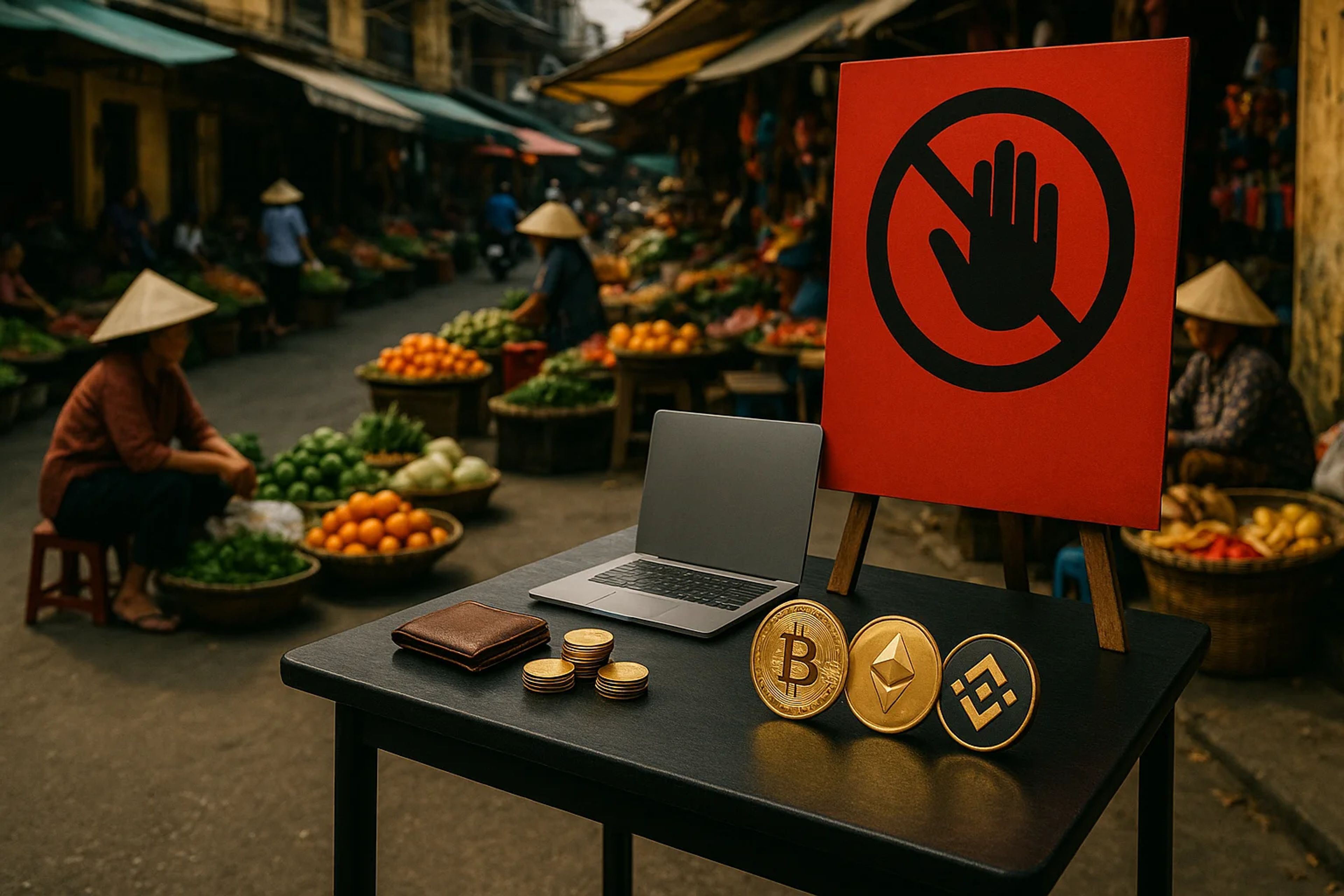
Vietnam targets offshore exchange users with $1,900 fines ahead of Sept. 1 market launch
Japan and South Korea also tightened crypto’s legal footing, pairing new enforcement hooks with longer-dated framework shifts.
Vietnam outlined fines of up to $1,900 for retail users who trade on unlicensed overseas crypto exchanges, even as the country has yet to issue any local exchange licenses ahead of a Sept. 1 regulated-market start date. Japan moved crypto under its Financial Instruments and Exchange Act with an insider-trading ban and tougher penalties, while South Korea paired “national asset” framing with post-hack sanction procedures against Upbit operator Dunamu.
Key Takeaways
- Vietnam outlined fines of up to $1,900 for retail users trading on unlicensed overseas exchanges, despite no local exchange licenses being issued ahead of the Sept. 1 market start date.
- Japan reclassified cryptocurrencies as “financial assets” under the Financial Instruments and Exchange Act, adding an insider-trading ban overseen by the Securities and Exchange Surveillance Commission.
- Penalties in Japan for unlicensed platforms were set at 10 million yen or up to 10 years in jail, while proposed tax relief is stated as delayed until 2028.
- South Korea proposed folding crypto into a “national assets” framework as regulators also began sanction procedures tied to a $30 million hack at Upbit’s operator.
Vietnam’s $1,900 Retail Fine Threat Lands Before Any Licenses Exist
Vietnam’s Finance Ministry outlined fines of up to $1,900 for retail users who trade on unlicensed overseas platforms, explicitly naming Binance, OKX, and Bybit. The policy targets venue choice, not just platform operators, and it lands before the compliance path is clear.
Vietnam’s regulated digital asset market is stated as due to start on Sept. 1, and five exchanges have been approved in principle. No exchange licenses have been issued yet. That sequencing matters for traders because it introduces user-level enforcement risk while leaving open the basic question of where compliant liquidity is supposed to migrate in the near term.
The same framework also sketches higher penalties elsewhere in the stack. Domestic investors can be fined up to $3,800 for trading crypto designated exclusively for foreign investors. Crypto companies face fines up to $7,600 for providing or advertising services without a license, failing to properly identify customers, or unlawfully dealing with crypto account data.
Japan Moves Crypto Under the Financial Instruments and Exchange Act
Japan’s parliament passed revisions to the Financial Instruments and Exchange Act that classify cryptocurrencies as “financial assets,” moving crypto oversight out of the Payment Services Act and into Japan’s main framework for securities and financial products.
For market structure, the key change is that enforcement scope expands from licensing and consumer protection toward market conduct. Japan added a ban on insider trading in crypto, policed by the Securities and Exchange Surveillance Commission, putting crypto closer to the surveillance posture applied to traditional financial assets.
Japan also set criminal penalties for unlicensed platforms at 10 million yen or up to 10 years in jail. That raises the cost of operating at the margins and increases the probability that access and listing decisions become more conservative.
Tax is the headline-friendly part, but the timeline is the tradeable detail. Japan’s crypto tax rates described as up to 55% are stated to be cut to approximately 20%, with a three-year carryforward for losses. The new tax rules are stated as not effective until 2028, which structurally delays any behavioral shift tied to after-tax returns.
South Korea’s Two-Track Message: National Assets + Post-Hack Sanctions
South Korea proposed rewriting the 1950 State Property Act as the National Asset Basic Act to include crypto and intellectual property under “national assets.” The Ministry of Economy and Finance said the rewrite is meant to better reflect the government’s asset mix and shift emphasis toward generating value from assets.
At the same time, South Korea’s Financial Supervisory Service began sanction procedures against Dunamu, the operator of Upbit, after a $30 million hack stated as occurring in November. The FSS investigated whether the incident violated the Virtual Asset User Protection Act, which is stated as not providing sanctions for hacks or IT failures. That gap is expected to be addressed in the forthcoming Digital Asset Basic Act, with legislators restarting talks after a four-month pause.
Traders’ Watchlist: Licenses, Enforcement Actions, and Effective Dates
Vietnam’s immediate catalyst is administrative, not legislative. The market will be watching whether the Finance Ministry issues any exchange licenses before the stated Sept. 1 start date, and whether enforcement begins against retail users who keep trading on offshore venues.
In Japan, the next signal is implementation guidance for the new “financial assets” classification and how insider-trading enforcement will be operationalized under the Securities and Exchange Surveillance Commission. Traders will also want confirmation on the pathway to the stated 2028 effective date for the ~20% tax rate and three-year loss carryforward.
In South Korea, the timing and outcomes of the FSS sanction procedures against Dunamu are the near-term enforcement tell, especially given the stated limitation that the current user-protection law lacks explicit sanctions for hacks or IT failures.
Asia’s Regulatory Pulse Is Shifting From Platform Policing to User-Level Risk
I see Vietnam’s move as the most immediate market-access risk in this batch because it targets retail users’ venue choice while the licensing regime is still not live. The threshold that matters is whether licenses are issued before Sept. 1 and whether enforcement is real rather than rhetorical. If that gap persists, liquidity fragmentation becomes a practical outcome, not a theoretical one.
Japan and South Korea look more like structural tightening than a one-off headline. Japan’s reclassification and insider-trading ban increase the odds of market-conduct cases, while the tax relief narrative is time-shifted to 2028. South Korea is institutionalizing crypto in the asset framework while keeping supervisory pressure on major venues, and the real test is whether enforcement actions and new framework laws translate into measurable changes in exchange operations and user access.


