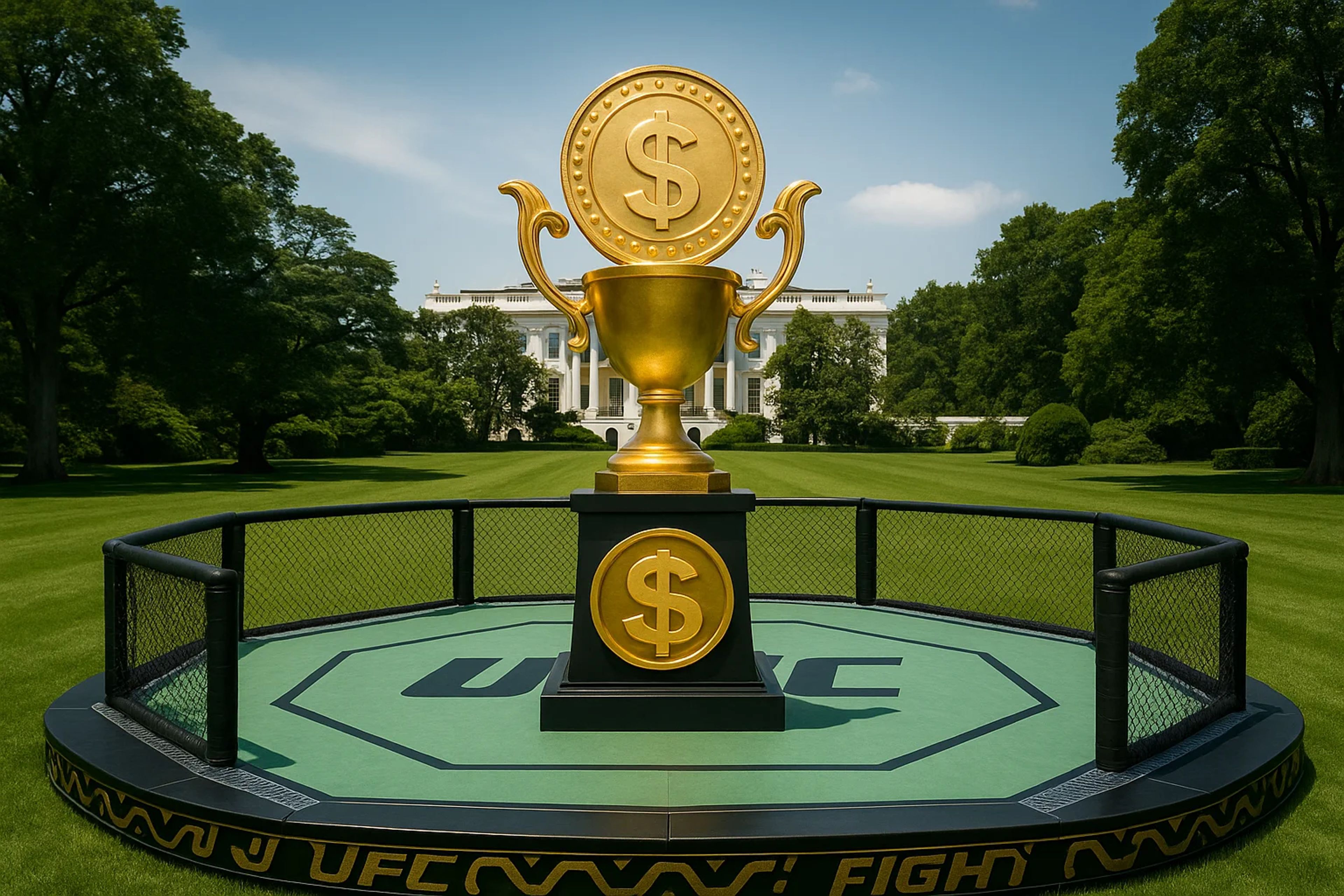
World Liberty Financial’s USD1 pays $250,000 UFC bonuses on White House lawn
The stablecoin’s supply is cited near $4.6B as the issuer pursues an OCC license amid DeFi and legal overhangs.
World Liberty Financial’s USD1 stablecoin was used to pay a $250,000 fighter performance bonus pool at UFC Freedom 250 on the White House south lawn on June 14, President Donald Trump’s 80th birthday. The showcase lands as USD1 supply expands and the issuer seeks a federal banking license while carrying unresolved DeFi-liquidity and litigation headlines.
Key Takeaways
- USD1 was used to distribute a $250,000 UFC performance bonus pool at UFC Freedom 250 on the White House south lawn on June 14.
- USD1 circulating supply is described around $4.6 billion, up from about $3.3 billion on Jan. 1.
- A prior Dolomite borrowing episode pushed a USD1 lending pool to 93% utilization, temporarily blocking retail withdrawals until repayment.
- World Liberty Financial has applied for an OCC banking license and is in active litigation with Justin Sun over allegedly frozen WLFI holdings and a defamation countersuit.
USD1 Hits the White House: $250,000 UFC Bonuses Paid in Stablecoin
UFC Freedom 250 put World Liberty Financial’s USD1 stablecoin in front of a mainstream audience with a clean, easy-to-message use case: paying people. The event took place on the White House south lawn on June 14, and the $250,000 performance bonus pool was paid out in USD1 across seven matches.
For traders, the mechanics are not the point. Todd Phillips of Klaros Group framed it bluntly: “Paying the fighters in the USD1 stablecoin would have the same economic function as writing them a check,” while the announcement itself functions as distribution marketing tied to the UFC and the White House.
That distinction matters. A stablecoin payment is economically similar to traditional rails, but the branding moment can still pull incremental attention, new wallets, and venue integrations toward USD1. In stablecoins, visibility can become flow.
Supply Growth Check: USD1 Expands From ~$3.3B to ~$4.6B in 2026
USD1’s circulating supply is described around $4.6 billion, up from roughly $3.3 billion on Jan. 1. That is a meaningful expansion in a short window, and it changes the trading surface area.
More supply means more USD1 can realistically show up across centralized venues and DeFi pools, which can improve day-to-day liquidity when distribution is healthy. It also increases exposure to issuer-specific headlines because more market participants end up holding, lending, or using the token as collateral.
World Liberty Financial has also shown it is actively managing supply. Through April 2026, it repaid $25 million of a DeFi borrowing position and then minted $25 million in fresh USD1 days later.
DeFi Liquidity Flashpoint: The Dolomite Borrow That Drove 93% Utilization
The White House marketing moment sits on top of a prior stress test that traders should not ignore. World Liberty Financial previously borrowed more than $75 million in stablecoins from the Dolomite DeFi lending protocol, using 3 billion WLFI governance tokens as collateral and depositing USD1 as part of the arrangement.
That borrowing pushed the USD1 pool to 93% utilization. In practice, high utilization means most lendable funds are already borrowed, so depositors who expected to withdraw on demand can get stuck until loans are repaid. In this case, retail depositors were temporarily prevented from withdrawing USD1 until repayments came in.
World Liberty Financial did not respond to a request for comment about the borrowing episode.
Signals to Watch for USD1 stablecoin used for White House
The next catalyst is regulatory. World Liberty Financial has applied for a banking license from the Office of the Comptroller of the Currency, but the timeline and status are not described. Any OCC requests for information, acceptance signals, or denial would reprice perceived issuer risk quickly.
On-chain, traders will watch whether USD1 supply moves materially away from the ~$4.6B level via large mints or burns, which can hint at new distribution or redemptions. Dolomite’s USD1 pool utilization is another live wire. A return toward very high utilization levels would raise the odds of withdrawal friction reappearing.
Legal headlines remain a parallel risk. Justin Sun sued World Liberty Financial alleging it improperly froze his WLFI holdings, and the company countersued for defamation. Docket updates, motions, rulings, or settlement signals can spill into WLFI sentiment and, by extension, USD1 narrative flow.
Marcus Hale’s Take: Visibility Up, but Traders Still Have to Price Liquidity and Headline Risk
I treat the White House UFC payout as a distribution event, not a payments revolution. The threshold that matters is whether this kind of visibility converts into durable venue support and deeper secondary liquidity for USD1, because the economic function is the same as a check even if the marketing is louder.
The real test is whether USD1 can expand supply without repeating the Dolomite-style squeeze where utilization spikes and withdrawals get impaired. If liquidity holds while the OCC process advances and the Sun litigation stays contained, the setup starts to look structural rather than narrative-driven, and that is what would make this matter in practical trading terms.


