
Crypto
Polls and prediction markets lean Democratic ahead of Nov. 3, raising crypto policy stakes
A House flip looks likelier than a Senate call, keeping 2027 oversight and near-term crypto tax bills in focus after Clarity Act failure.
U.S. Securities and Exchange Commission and its impact on crypto.
A House flip looks likelier than a Senate call, keeping 2027 oversight and near-term crypto tax bills in focus after Clarity Act failure.

The deal implies a pro forma equity value up to $1.1 billion as OpenPayd targets a U.S. launch by April 2027.

Midterm timing, retiring Senate champions, and unresolved ethics concerns leave no clear year-end path.

The White House called the reports speculation as Trump pushes an AI agenda built around industry “self-policing.”

The plan opens a 60-day comment window after Federal Register publication and hinges on asset-by-asset custody availability.
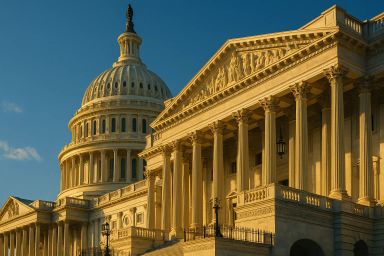
Disclosures tie about $8M to the market-structure bill, pushing the next catalyst toward SEC and CFTC rulemaking.

Seven open seats across the agencies will leave three commissioners overseeing parts of a roughly $3 trillion crypto market.

The stalled market-structure push shifts near-term policy focus back to SEC and CFTC actions ahead of Election Day.

The fund is distributed into institutional crypto settlement workflows without tokenizing shares onchain.

A Friday SEC filing said the miner ended the line without early termination fees or penalties.

The staff guidance puts issuer communications and token-econ programs back in the securities-law risk frame for altcoins.

The guidance addresses token marketing “essential managerial efforts,” staking receipt tokens, and secondary-market promoter risk.

The deal lands as Canadian banks test tokenized deposits and NYSE and Blockchain.com pursue tokenized stocks via an ATS.

At $5, XRP would imply a roughly $300B market cap, but the analysis argues usage and regulation are not yet aligned.

He tied early-2025 dismissals to a coming “180-degree change” in SEC crypto rulemaking.

The framework allows AMM trading on public blockchains but caps venues and gives issuers an objection right.

The proposal targets 24/5 stock exposure without share ownership and follows a Sept. 1 SEC Form 1-N filing tied to security futures.

The position reduces introducing-broker and associated-person registration risk for qualifying wallets and apps under strict non-discretionary conditions.

The vote decides whether the market-structure bill advances to debate, not whether it becomes law.

Negotiators were still short of 60 votes as of Friday afternoon, with the midterm calendar compressing the 2026 window.
 btc$85,116-0.11%
 eth$2,686.16-0.41%
 usdt$1-0.00%
 bnb$785.78-0.33%
 xrp$1.49-0.72%
 usdc$1+0.00%
 sol$119.15-1.91%
 trx$0.34+0.16%
 doge$0.09+0.06%
 link$13.77-2.41%
 ada$0.26+6.05%
 xlm$0.21-2.45%
 bch$313.74-0.74%
 uni$8.87-1.66%
 ltc$69.94-1.97%
 sui$1.18-4.58%
 avax$10.85-1.95%
 hbar$0.1-1.42%
 dot$1.19+0.04%
 etc$8.83-0.06%
 algo$0.13-4.11%
 pol$0.11-2.14%
 atom$1.79+1.16%
 fil$1.09+3.45%
 vet$0.01-0.53%