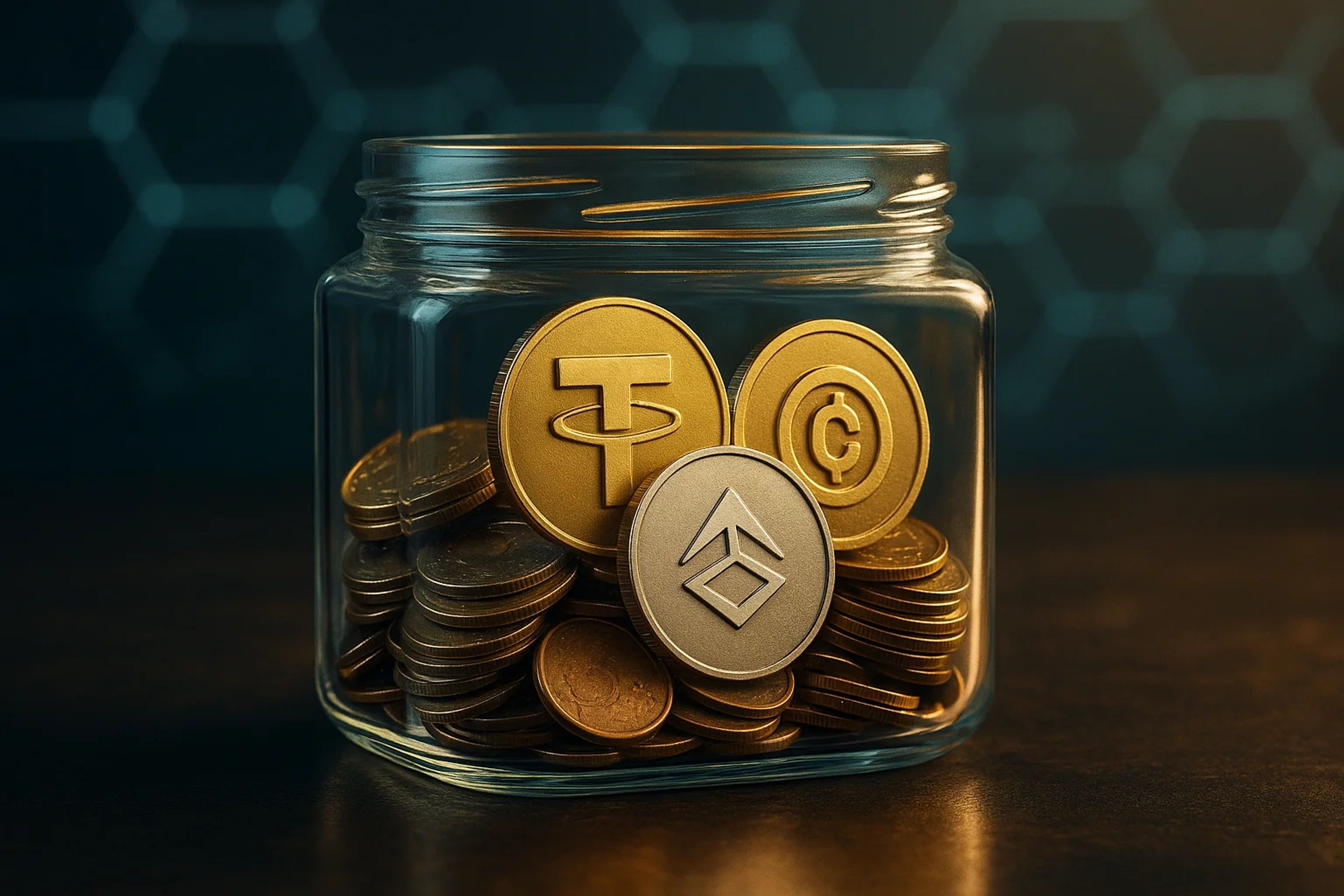
Best stablecoins compared: USDT, USDC, DAI, and what breaks first
“Best stablecoins compared” only makes sense if the comparison starts with failure modes: what breaks first under stress is usually liquidity, reserve proof cadence, or issuer control. That maps cleanly to tether as the exit ramp, usd coin as the transparency trade, and dai as the on-chain, governance-led option.
Key Takeaways
- There is no universally “best stablecoin” because each design optimizes a different failure mode: liquidity/exit, reserve verification cadence, or issuer control.
- USDT is the most widely used and most liquid stablecoin, which is why it often becomes the default quote asset on exchanges when markets get messy.
- USDC is positioned around transparency and compliance, with monthly reserve verification described as attestations or audits depending on the source.
- DAI is minted on-chain via MakerDAO using over-collateralization, which shifts the main risk from issuer behavior to collateral and market structure.
How stablecoins stay near $1
The peg is defended by a simple loop: issuance and redemption. A fiat-backed token targets $1 because an issuer mints when dollars come in and redeems when tokens go out, with off-chain assets meant to cover the liability. That is the core promise behind stablecoin reserves for names like tether and usd coin, where reserves are described as combinations of cash and government bonds or other assets depending on the issuer.
Crypto-collateralized designs keep the peg with on-chain collateral and liquidation rules instead of a bank account. MakerDAO’s dai is created when users lock collateral into smart contracts and mint against it. The key mechanic is over-collateralization, described as typically 150%+ in the provided material, which is the buffer meant to absorb collateral volatility before the stablecoin itself takes the hit.
Algorithmic stablecoins try to manage supply and demand without hard reserves. The problem is that the “backing” becomes confidence and market reflexivity. The provided sources flag that this category has mostly failed, with TerraUSD cited as the canonical example. That history is why algorithmic designs do not belong in a “safest stablecoin” conversation unless the goal is explicitly to model tail risk.
A depeg is the visible symptom when one of these loops fails. It can come from liquidity disappearing, from questions about what backs the token, or from collateral moving too fast for liquidation systems to keep up. The mechanism matters because it tells a trader which screen to watch when stress hits.
The comparison criteria that matter
Most “best stablecoins” lists rank by market cap and vibes. A trader-grade framework starts with what fails first, then works backward into which stablecoin fits the job. Three axes do most of the work.
1. Liquidity and exit quality. Market cap is not a safety score. It is a proxy for how easy it is to get filled across venues and chains when everyone is trying to do the same thing. Analytics Insight puts the stablecoin market above $320 billion in 2026 and reports USDT near $190 billion, about 59% share. That scale tends to show up as tighter spreads and deeper books, not automatically better backing. 2. Reserve verification cadence and clarity. “Audit” and “attestation” get used interchangeably in marketing, but they are not standardized terms in the provided materials. What matters is what is being verified, the cutoff date, and how often the issuer updates the public. Bitget points to monthly USDC attestations with cash and Treasury breakdowns and to USDT quarterly reporting plus real-time reserve tracking resources. 3. Issuer control and censorship resistance. Centralized issuers can freeze tokens or change redemption terms under policy pressure. Bleap explicitly lists custodial or issuer control, regulatory risk, and counterparty or transparency risk as core stablecoin risks. A decentralized issuance path can reduce single-entity control, but it introduces different fragilities like collateral drawdowns.
This is the same argument that sits underneath the USDT vs USDC debate. The question is not “which is best,” it is which failure mode is least acceptable for the specific use case.
USDC vs USDT vs DAI
The top stablecoins 2026 discussions keep circling the same trio because each one is optimized for a different job.
USDT: liquidity and ubiquity. Sources describe USDT as the most widely used and most liquid stablecoin, with broad multi-chain availability and dominance in exchange liquidity. Analytics Insight frames it as the trading workhorse and reports USDT near $190 billion market value in 2026, about 59% share. The trade-off is that reserve transparency has been debated for years, and the provided sources still flag that debate even while noting improved reporting.
USDC: verification cadence and compliance posture. USDC is described as fiat-backed and positioned around transparency and regulatory alignment, with reserves described as cash and short-term U.S. Treasuries. The verification language differs by source, which is exactly the point traders should internalize. Bleap describes monthly audits by Deloitte, while Bitget emphasizes monthly attestations with detailed breakdowns. Either way, the product is built to feel like the most trusted stablecoin for users who want a cleaner reserve story, with the explicit cost that a centralized issuer can exert control.
DAI: on-chain issuance and DeFi-native behavior. DAI is described as a crypto-collateralized stablecoin issued via MakerDAO, minted by locking collateral in smart contracts, and governed by a community process. The 150%+ over-collateralization figure in the provided material is the shock absorber. It does not remove risk, it relocates it into collateral volatility and liquidation dynamics. Bleap also notes that DAI’s collateral mix can include centralized assets like USDC, which means “decentralized” is not the same as “no centralization exposure.”
Side-by-side, the cleanest mental model is: USDT tends to be the best stablecoin for exiting size, USDC tends to be the cleanest for reserve proof cadence, and DAI tends to be the DeFi-native option when issuer control is the thing that matters most.
Other notable stablecoins to consider
Two alternatives show up repeatedly in 2026 comparisons because they solve narrower problems than the big three.
TUSD is positioned as a fiat-backed stablecoin that emphasizes real-time reserve verification via third-party audits, with Armanino named in the provided material. The obvious trade is adoption. Smaller footprint usually means thinner liquidity and fewer integrations, which matters if the token is being used as collateral or as a transfer rail between venues.
PYUSD is described as issued by Paxos in partnership with PayPal, backed by cash and U.S. Treasuries, with strong familiarity for users who already live inside PayPal and Venmo. The limitation in the provided material is on-chain adoption, especially in DeFi, which makes it less useful as a universal settlement asset even if the issuer story reads clean.
Regulation is the other reason alternatives matter. Bleap flags mica regulation as a coming standardization force for licensing and transparency in the EU. The important point for comparison is not predicting the exact implementation. It is recognizing that regulatory posture can change which stablecoins are easy to access on certain platforms and which ones get preferred by payment and fintech rails.
These “other” stablecoins are not trying to beat USDT or USDC at their main game. They are trying to offer a different mix of verification style, issuer brand, and distribution channel.
Choosing the best stablecoin for you
Selection gets easier when it is framed as a panic button. The best stablecoins are the ones that still work when the market is stressed in the specific way that matters to the user.
A simple mapping covers most use cases:
1. High-frequency trading, exchange transfers, and cross-venue collateral. Liquidity and ubiquity dominate, which is why USDT often becomes the default. That is not a claim that it is the safest stablecoin. It is a claim about exit quality when spreads widen. 2. Parking value with an institutional-style comfort level. USDC is built around a clearer reserve narrative and regular verification, described as monthly attestations or audits in the provided sources. The cost is accepting issuer control as a feature, not a bug. 3. DeFi-native usage where on-chain issuance and governance matter. DAI fits when the user wants the stablecoin to behave like a protocol asset, not a bank IOU. The trade is living with collateral and liquidation dynamics.
A basic hygiene routine reduces unforced errors:
1. Read the latest reserve or verification document for the token being used. The word attestation matters less than the scope, date, and asset breakdown. 2. Size exposure assuming a depeg can happen, because the sources explicitly list depeg risk as a core stablecoin risk. 3. Avoid single points of failure by splitting exposure across types, not just across tickers.
This is also where the USDT vs USDC framing becomes useful again. One is usually chosen for liquidity, the other for reserve proof cadence. The “best” choice is the one that matches the failure mode the user cannot tolerate.
The Take
I’ve watched traders treat “best stablecoin” like a product ranking, then get surprised by the boring constraint that actually mattered: the exit. When volatility spikes, the token that fills instantly across the most venues becomes the default, and that is why USDT’s dominance keeps showing up on screens even while reserve debates keep running in the background.
I’ve also seen the opposite mistake with USDC, where people confuse a clean attestation cadence with a promise of neutrality. The comfort trade is issuer control, and that can matter more than a few basis points of perceived safety. The clean posture is picking the stablecoin that matches the failure mode you fear most, then checking the stablecoin reserves and verification cadence like it is part of the position, not a footnote.
Sources
Frequently Asked Questions
What are the best stablecoins in 2026?
USDT, USDC, and DAI are consistently cited as the leading options in 2026 comparisons. They are optimized for different priorities: USDT for liquidity, USDC for transparency and compliance posture, and DAI for DeFi-native issuance and governance. The best choice depends on which failure mode matters most to you.
What is the safest stablecoin to hold long term?
USDC is positioned around transparency and regulatory compliance, with monthly reserve verification described as attestations or audits in the provided sources. That tends to appeal to users who want a clearer reserve story. The trade-off is accepting issuer control as part of the design.
How do I check stablecoin reserves and an attestation?
Start with the issuer’s published reserve materials and look for the date, the asset breakdown, and whether the document is an attestation or an audit. Bitget points to monthly USDC attestations with cash and Treasury breakdowns and to USDT quarterly reporting plus real-time reserve tracking resources. The key is what is being verified and how often, not the label.
Is DAI really decentralized if it uses USDC in its collateral mix?
DAI is described as issued via MakerDAO smart contracts and governed by a community process, which makes issuance and accounting on-chain. The provided sources also note that some centralized collateral can appear in the backing mix, including USDC. That means DAI can reduce single-issuer dependence while still carrying indirect exposure to centralized assets.
Why are algorithmic stablecoins usually excluded from “best stablecoins” lists?
The provided sources categorize stablecoins into fiat-backed, crypto-collateralized, and algorithmic designs. They also warn that algorithmic stablecoins have mostly failed, citing TerraUSD as an example. Without hard reserves or over-collateralization, confidence breaks can become self-reinforcing.


