Hardware wallet best practices: a threat-model checklist for backups and recovery
Hardware wallet best practices are about running a two-sided risk book: stop seed phrase exposure that leads to theft, and stop backup failure that leads to permanent loss. The right setup keeps your keys offline while keeping your recovery path simple enough to execute years later.
Key Takeaways
- Anyone with your seed phrase can take your funds, and if you lose the seed phrase and device access, recovery is impossible.
- A 24-word BIP-39 seed phrase is effectively unbrute-forceable, so the dominant risk is operational exposure like photos, cloud notes, and copy-paste.
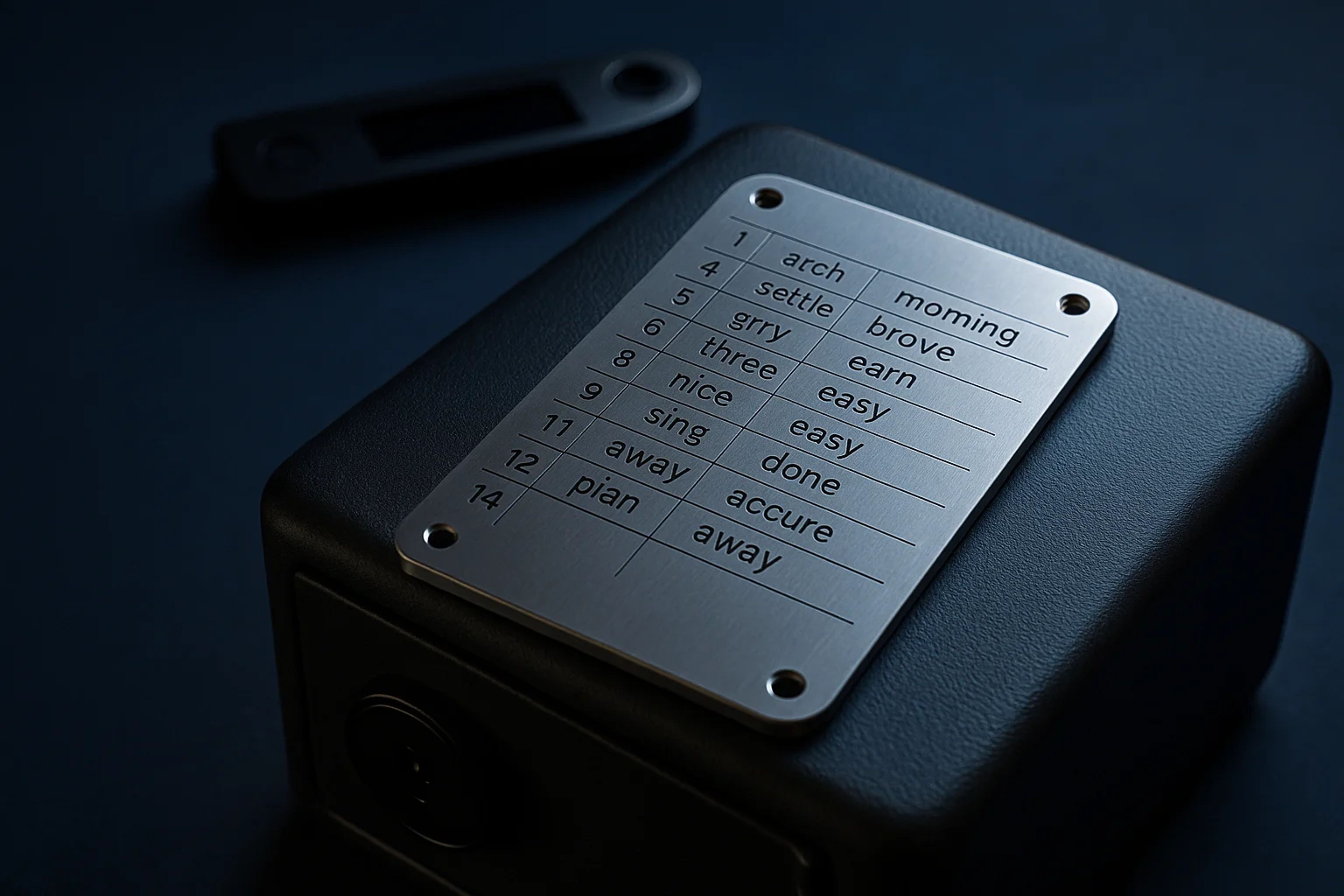
- Metal backups are positioned as the default durable option because they resist fire and water, and Trezor also cites pressure and corrosion resistance.
- Advanced layers like passphrases, SLIP39 multi-share backups, multisig, second-device backups, and encrypted recovery services reduce specific risks but add complexity that can create new failure modes.
The security model of hardware wallets
Hardware wallet best practices start with a clean mental model: the device is there to keep private keys off internet-connected machines, but the recovery system is what decides whether funds are stealable or recoverable. The hardware wallet signs transactions without exporting the private key, yet the seed phrase can recreate the entire wallet on another device. That makes the seed phrase the master key for your crypto wallet, not a “reset link.” Ledger and Trezor both treat it that way: anyone who gets the phrase can access the associated funds.
This is where most “Ledger security” and “Trezor safety” discussions get mispriced. People fixate on whether someone can brute-force a seed. Ledger’s own numbers make that a dead end: BIP-39 uses a 2048-word list, and a 24-word phrase has about 1.1579×10^79 combinations. That is not the attack path. The attack path is exposure, meaning the phrase shows up somewhere it should not: a photo roll, a notes app, an email draft, a cloud drive, or a clipboard history.
The other side of the risk book is permanent loss. If the device is lost or destroyed and the seed phrase is also gone, the funds are unrecoverable. That is not a scare line, it is the custody model. So the job is operational design: a backup and recovery process that survives both attackers and your future self, without adding layers you cannot reliably execute.
Seed phrase handling rules that matter
The non-negotiables are boring, and that is why they work. The first rule is privacy: the seed phrase must never be shared, because possession equals control. Ledger and Trezor both frame this as total access, not partial access. If a support agent, a “wallet sync” site, or a fake app asks for it, that is the whole game.
The second rule is staying off the internet. Ledger and Trezor both warn against non-encrypted digital storage for the seed phrase, including screenshots, photos, cloud storage, and notes apps. The reason is not subtle. Malware and phishing do not need to break a hardware wallet if they can steal the backup that regenerates it.
The third rule is accepting that you cannot “change your seed” like a password. Ledger is explicit that a seed phrase is immutable. Rotation means creating a new wallet with a new seed phrase and transferring funds over. That matters because the correct response to suspected exposure is not to hunt for a setting. It is to treat the wallet as compromised and migrate.
The fourth rule is transaction discipline. A hardware wallet protects keys, not judgment. Blind signing is the failure mode where the device approves a transaction the user does not actually understand, often because the screen cannot show meaningful details. The habit to build is how to verify a transaction before signing: confirm the destination address, the network, and what the transaction is authorizing on the device screen, not just in a browser pop-up.
Choosing durable offline backup storage
The backup medium is a disaster-recovery decision, not a hacker-proofing contest. Paper works until it does not. Ledger calls out the obvious physical issues, and Trezor adds more: paper is vulnerable to fire and water, and over time it can degrade. Metal backups are positioned by both Ledger and Trezor as more durable than paper because they resist threats like fire and water, and Trezor also cites pressure and corrosion resistance.
Location strategy is where people accidentally turn “safe” into “unrecoverable.” A single copy in a single place concentrates disaster risk. Multiple copies in multiple places reduce that, but every extra copy increases the number of places an attacker can find it. The clean way to think about it is two separate failure plans: (1) what happens if the seed is exposed, and (2) what happens if the seed is lost.
For (1), the goal is minimizing exposure paths. That means no digital copies, no “temporary” photos, and no typing the phrase into a computer except when a device explicitly requires it for recovery. For (2), the goal is survivability. A metal backup in a home safe is a different risk profile than a metal backup in a bank box. Trezor flags that bank access can be conditional on bank policies, which is a reminder that “secure” and “available when you need it” are not the same.
A useful stress test is travel. If recovery had to happen while away from home, after a theft, or during a move, would the locations and instructions still work. If the answer is no, the setup is not finished.
Advanced protections for higher threat models
Extra layers are tools, not badges. Each one reduces one side of the risk book while often increasing the other through complexity.
Passphrases are the most common upgrade. Trezor recommends using a strong, unique passphrase and writing it down and storing it securely. The trade-off is obvious: a passphrase can protect funds if a seed phrase is exposed, but forgetting or mis-recording it creates a self-inflicted lockout.
SLIP39 and Shamir-style splitting aim at the “single point of failure” problem. Trezor supports SLIP39 backups on Safe 3, including 20-word backups, and it is also BIP39 compatible for restoring 12-, 18-, or 24-word backups. Ledger discusses Shamir’s Secret Sharing as an advanced option and explicitly calls out that it is complex and must be implemented carefully. Complexity is not abstract here. If the threshold scheme, share locations, or labeling is wrong, recovery fails.
Multisig changes the authorization model. Both Ledger and Trezor describe multisig as requiring multiple keys to authorize transactions, reducing reliance on a single key. They also make the key point people miss: multisig does not replace secure seed storage. Each underlying key still has a backup problem.
Second-device backups sit in a middle ground. Ledger describes storing the seed phrase in a second hardware wallet as a safeguard against losing or damaging the original phrase and as a way to access funds from either device. That reduces downtime risk if one device fails, but it does not remove the need to protect the seed phrase itself.
Recovery planning and long-term maintenance
A setup that cannot be recovered years later is not secure, it is just delayed loss. Long-term maintenance starts with a periodic check that the backup is still legible and still where it is supposed to be. Trezor explicitly recommends checking for wear and tear, especially for paper backups. Metal reduces that risk, but it does not remove the need to confirm the backup exists and is accessible.
Write recovery instructions like they will be used under stress, because they will. That means documenting what type of backup it is, what device family it restores to, and what extra secrets exist. If a passphrase is used, the instructions must make clear that the seed phrase alone is not sufficient. If SLIP39 multi-share is used, the instructions must state the threshold needed to recover and how shares are identified.
Service-based recovery sits in a contested zone, and the sources reflect that split. Ledger describes an encrypted digital backup approach where the Secret Recovery Phrase is encrypted, duplicated, divided into three fragments, and distributed via end-to-end encrypted and authenticated channels to HSMs operated by three independent companies. Ledger Recover is presented as a paid optional service, provided by Coincover, intended to restore access if the seed phrase is lost, damaged, or out of reach. Trezor’s guidance in these sources leans hard the other way, emphasizing avoiding digital copies and focusing on offline storage plus SLIP39 and passphrases.
The right way to evaluate that choice is operational, not ideological. Encrypted recovery services aim to reduce “I lost it” risk. They also introduce identity and provider dependencies that purely offline methods avoid, and the sources do not provide a neutral, quantified comparison. The decision belongs inside the broader question of your crypto wallet security posture, not as a default checkbox.
The Take
I’ve watched people spend hours debating secure element specs and then casually take a photo of their seed phrase “just for a minute.” That is the most expensive mismatch in this whole category. Ledger’s math on BIP-39 entropy makes brute force a non-issue. Exposure is the issue.
The habit that holds up is simple: treat the seed phrase like a bearer instrument, and treat recovery like a fire drill. If the steps are not clear enough that a competent stranger could execute them from your written instructions, the setup is too complex. That mindset does more for how to secure your crypto wallet than any extra feature toggle ever will.
Sources
Frequently Asked Questions
What are the most important hardware wallet security tips for beginners?
Keep the seed phrase private, keep it off the internet, and store it in a damage-resistant way. Ledger and Trezor both warn against non-encrypted digital copies like photos, cloud storage, and notes apps because exposure defeats the hardware wallet.
Can I change my seed phrase if I think it was exposed?
No, a seed phrase is immutable. Ledger’s guidance is that changing it means creating a new wallet with a new seed phrase and transferring funds to that new wallet.
Is a 24-word seed phrase actually crackable?
Ledger describes a 24-word BIP-39 seed phrase as having about 1.1579×10^79 possible combinations, which makes brute forcing impractical. The dominant risk is operational handling, like storing it digitally or sharing it.
Is a metal backup better than paper for a hardware wallet seed phrase?
Both Ledger and Trezor position metal backups as more durable than paper because they resist fire and water. Trezor also cites pressure and corrosion resistance, which targets long-term disaster recovery rather than online hacking.
Do multisig or SLIP39 backups mean I can stop worrying about seed storage?
No. Ledger and Trezor both frame multisig as requiring multiple keys to authorize transactions, but it does not replace secure seed phrase storage for the underlying keys. Ledger also flags Shamir-style splitting as complex and needing careful implementation.


