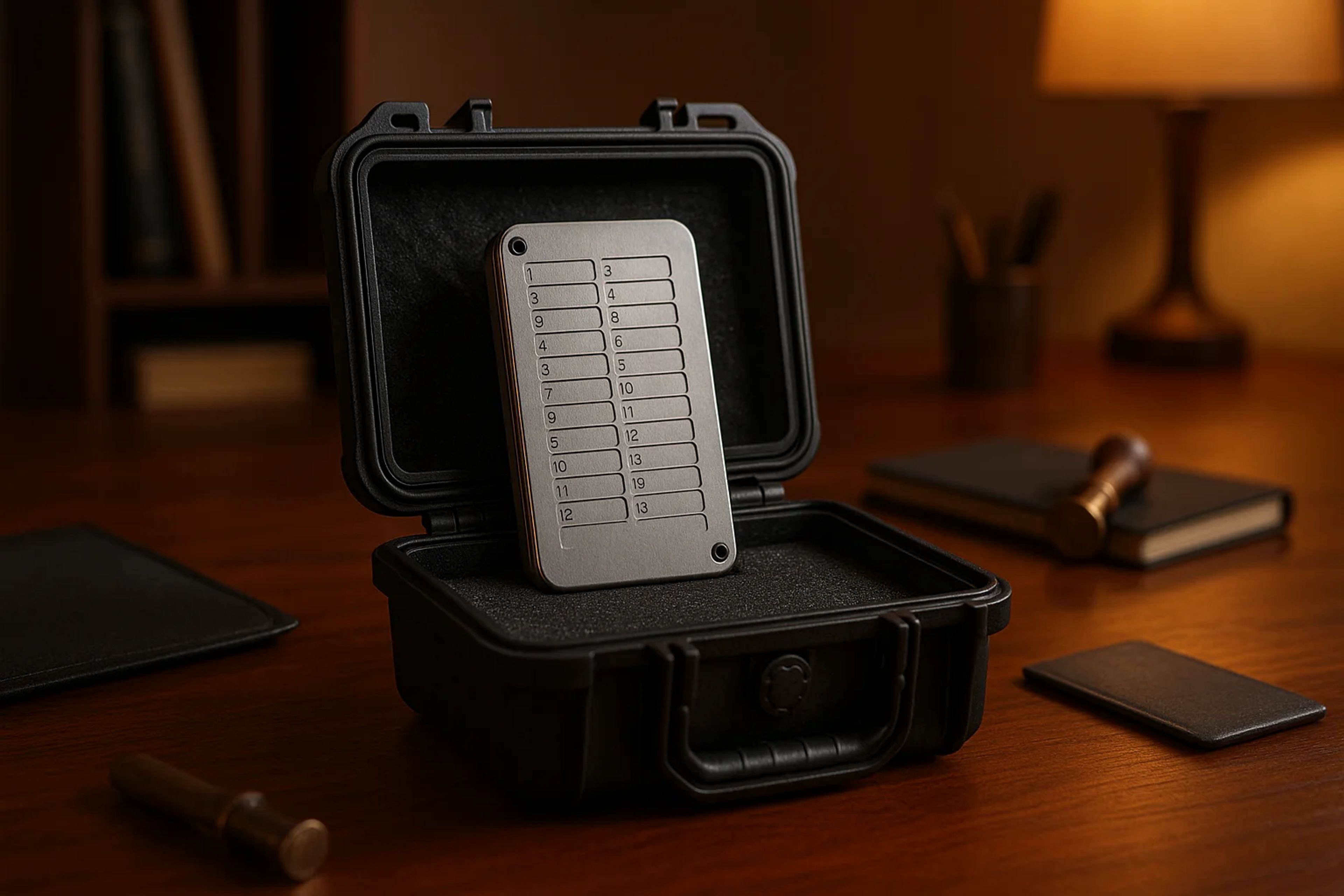
How to back up a seed phrase without leaking it
Backing up a seed phrase means recording the words offline, verifying they restore the wallet, and storing the backup so it survives disasters without being easy to copy. The goal is to prevent two wipeouts: losing the only copy, or accidentally giving someone else a perfect copy.
Key Takeaways
- A seed phrase can restore a crypto wallet if the device is lost or malfunctions, and anyone who gets the words can access the accounts.
- The non-negotiable rule is never digitize the phrase: no typing it into a phone or computer, no photos, and no cloud storage.
- Paper works as a short-term note, but a metal seed phrase backup is built for fire, water, and long-term legibility.
- Redundancy lowers disaster risk but raises exposure risk, so storage has to be discreet and designed to resist quick visual capture.
Why seed phrase backups matter
A wallet device is a piece of hardware or an app. The seed phrase is the master key that recreates the wallet if the device is lost, stolen, or simply dies. That asymmetry is the whole game in self custody. The device is replaceable. The seed phrase is not. Ledger’s security guidance is blunt on the two outcomes that matter: lose the seed and there is no backup, leak the seed and whoever has it can access the accounts.
Most people treat a recovery phrase backup like a document they need to “store somewhere safe.” That framing misses the two failure modes that actually show up in losses. The first is online leakage, where convenience creates a perfect copy for an attacker. The second is fast, casual visual capture, where the phrase gets seen, photographed, or memorized without the physical backup ever being stolen. Cryptosteel explicitly calls out this dynamic: the information can be taken without taking the medium.
That is why “offline” is necessary but not sufficient. A good backup is engineered for survivability and for privacy under time pressure. Survivability means the words remain readable after fire, water exposure, corrosion, or mechanical damage. Privacy means the words are not sitting in a format that can be copied in seconds by a phone camera or a curious person who gets a lucky angle.
This is also why the broader crypto wallet security conversation keeps circling back to seed handling. The seed phrase is the one secret that collapses every other control if it is exposed.
Non-negotiable handling rules
The fastest way to lose funds is to create a digital copy of the seed phrase. Ledger’s rule set is clear: never enter the seed into a smartphone, computer, or any internet-connected device, and never take pictures or upload it to cloud storage. The reason is not theoretical. A typed seed can end up in synced notes, clipboard history, backups, screenshots, photo libraries, or malware logs. One “just this once” entry is enough.
The second rule is social, not technical: the seed phrase is never shared. Anyone who has it can access the accounts, so “trusted” is not a category that matters here. The only safe assumption is that if another person can read it, it can be copied.
The third rule is time-in-the-open. The seed should not be visible longer than it takes to record and verify it. Cryptosteel’s point about theft without stealing the medium is the operational clue. The risk is not only burglary. It is a moment: a visitor, a contractor, a camera, an airport inspection tray, or a desk setup with always-on devices.
A simple handling checklist keeps this tight: do the recording in a private room, keep phones and cameras out, avoid smart speakers, and do not leave the words on a table “to deal with later.” The whole point is to avoid creating a window where unauthorized observation is easy.
Choosing a durable offline medium
Paper is fragile in exactly the ways that matter over years. Ledger flags the obvious failure modes: water can make ink run or paper illegible, ink can wear, and fire can destroy it. Paper can still be useful as a temporary capture method during setup, but it is a weak long-term store seed phrase safely plan.
Metal backups exist because the threat model is physical. Multiple sources position metal as the more resilient medium against fire and water. The nuance is that “metal” is not a magic word. Hodlr Swiss frames house fires as reaching up to about 1000°C with higher bursts, and it argues stainless steel and titanium are suitable because they combine heat tolerance with corrosion resistance. Cryptosteel gives a slightly different temperature range, putting house fires around 800–900°C, sometimes higher, and adds the more important point: melting point alone does not tell you whether the backup survives. Exposure time and construction matter. Thin plates can fail faster, surface treatments can burn away, and the backup can become unreadable even if the metal did not literally melt.
That construction point is where most buyers get lazy. A backup that survives heat but becomes hard to read is still a failed backup. Cryptosteel’s durability argument is that stamping deforms the metal structure, while laser engraving is superficial. If the surface is damaged, stamped characters have a better chance of remaining recoverable.
Material choice should be treated like risk management, not shopping aesthetics. Stainless steel and titanium show up repeatedly because corrosion resistance is a long-duration threat, and backups are meant to sit untouched for years. A metal seed phrase backup that pits, rusts, or becomes ambiguous under stress is not doing the job.
Creating the backup without mistakes
The creation step is where people either leak the seed or lock themselves out. A clean process keeps the phrase offline, minimizes time exposed, and produces a legible, verified copy.
1. Prepare a no-camera workspace. Remove phones, webcams, and anything that can capture a quick photo, and clear the area so the seed phrase is not left visible while hunting for tools. 2. Record the seed phrase exactly as shown. Use the wallet’s word order and spelling, and write or place characters slowly enough to avoid transpositions. 3. Make the durable copy on your chosen medium. If using paper temporarily, treat it as a staging artifact, not the final backup. If using metal, prioritize legibility and permanence over compactness. 4. Verify the backup by doing a restore check. The point is to confirm the recorded words can actually recreate the wallet before the phrase is put away. 5. Destroy any temporary drafts that increase exposure. If paper was used as an intermediate step before metal, remove the extra copy so there is not an untracked second backup floating around.
DIY metal work is where the “hackers” story distracts from the real risk. Cryptosteel warns that DIY stamping or engraving can be error-prone and hard to execute consistently. Stamping can slip, strikes can vary, and any mistake can force a full redo. Engraving high-quality stainless steel can be difficult without the right tools and skill. The cost is not the plate. The cost is discovering years later that a character is unreadable.
Ready-made systems that use pre-made characters reduce the execution risk because the user is assembling rather than freehand engraving. That does not make them automatically safer, but it shifts the main failure mode from craftsmanship to process discipline.
Storage strategy and redundancy planning
Storage is where survivability and privacy collide. One copy in one location is a single point of failure. Two copies in two locations reduce disaster risk, but they also double the number of places an attacker can find a complete seed phrase. That trade-off has to be explicit.
A basic redundancy plan starts with discreet placement. Cryptosteel emphasizes that the seed can be stolen without stealing the medium, which means “hidden” is not only about burglary. It is also about reducing casual discovery and quick copying. Plate-style backups are easy to read, which also makes them easy to photograph. Designs that obscure the words or require disassembly slow down unauthorized observation.
Ledger suggests an optional approach: split the seed phrase into multiple parts and store them separately, with the critical constraint that a single part must not be enough to reconstruct the phrase. The sources provided do not specify an exact scheme, so the operational takeaway is narrower: splitting can improve security only if the recovery procedure is unambiguous and the loss risk is controlled.
For users who want a more formal split, the concept to research is a shamir backup, which is designed so a threshold of shares is required to recover the secret. That can reduce the risk that one stolen piece equals total loss, but it also increases the chance of self-inflicted lockout if shares are misplaced.
A storage plan should be written down as a procedure, not held as a vibe. The plan needs to answer: where each copy lives, who can access the location, what happens if the home is inaccessible, and how the owner will perform recovery under stress. This is also where cold storage planning fits. Anyone building a long-term setup should align seed storage with how to set up cold storage, because the backup is the final recovery path when devices fail.
Near the end of the process, the broader crypto wallet security posture should be revisited. The seed backup is the foundation, but it only works if the rest of the wallet security habits do not reintroduce leakage through convenience.
The Take
I’ve watched more money get vaporized by “I’ll just take a photo for safety” than by any exotic exploit. Ledger’s guidance against photos, typing the seed into a computer, or tossing it into cloud storage is not paranoia. It’s a map of how normal people accidentally create a perfect attacker copy.
The habit that holds up is simple: treat the seed phrase like a master key that must survive a fire and must not be copyable in five seconds. If the backup medium is easy to glance at, it’s easy to steal without stealing it. Engineer for durability and for anti-peeking, then verify the restore before the phrase leaves the room.
Sources
Frequently Asked Questions
What is the safest way to store a seed phrase safely?
Keep the seed phrase offline and recorded on a durable medium, then store it in a discreet location with controlled access. Avoid formats that can be copied quickly by a phone camera. Metal backups are commonly used because they resist fire and water better than paper.
Can I take a photo of my seed phrase if my phone is locked?
No. Ledger explicitly warns against taking photos of a seed phrase or uploading it to cloud storage. A photo can be copied, synced, backed up, or accessed by malware, turning one convenience step into a complete compromise.
Is a metal seed phrase backup actually fireproof?
Fire resistance depends on the metal, the design, and how long it is exposed to heat. Cryptosteel cites house fires around 800–900°C, sometimes higher, and argues melting point alone is not a reliable survivability indicator because exposure time and construction matter. Hodlr Swiss cites house fires up to about 1000°C with higher bursts and emphasizes choosing metals with heat margin and corrosion resistance.
Is stamping better than engraving for a seed phrase backup?
Cryptosteel argues stamping is more durable than laser engraving because stamping deforms the metal structure while laser engraving is superficial. The catch is execution risk: DIY stamping or engraving can be error-prone and inconsistent, and legibility years later is the real requirement.
Should I split my seed phrase into parts and store them separately?
Ledger suggests splitting can improve security if done correctly, with the key constraint that one part must not be enough to reconstruct the full phrase. The sources provided do not specify an exact split scheme, so any split plan needs a clear recovery procedure to avoid self-inflicted lockout. If using a formal threshold approach, research options like a shamir backup.


