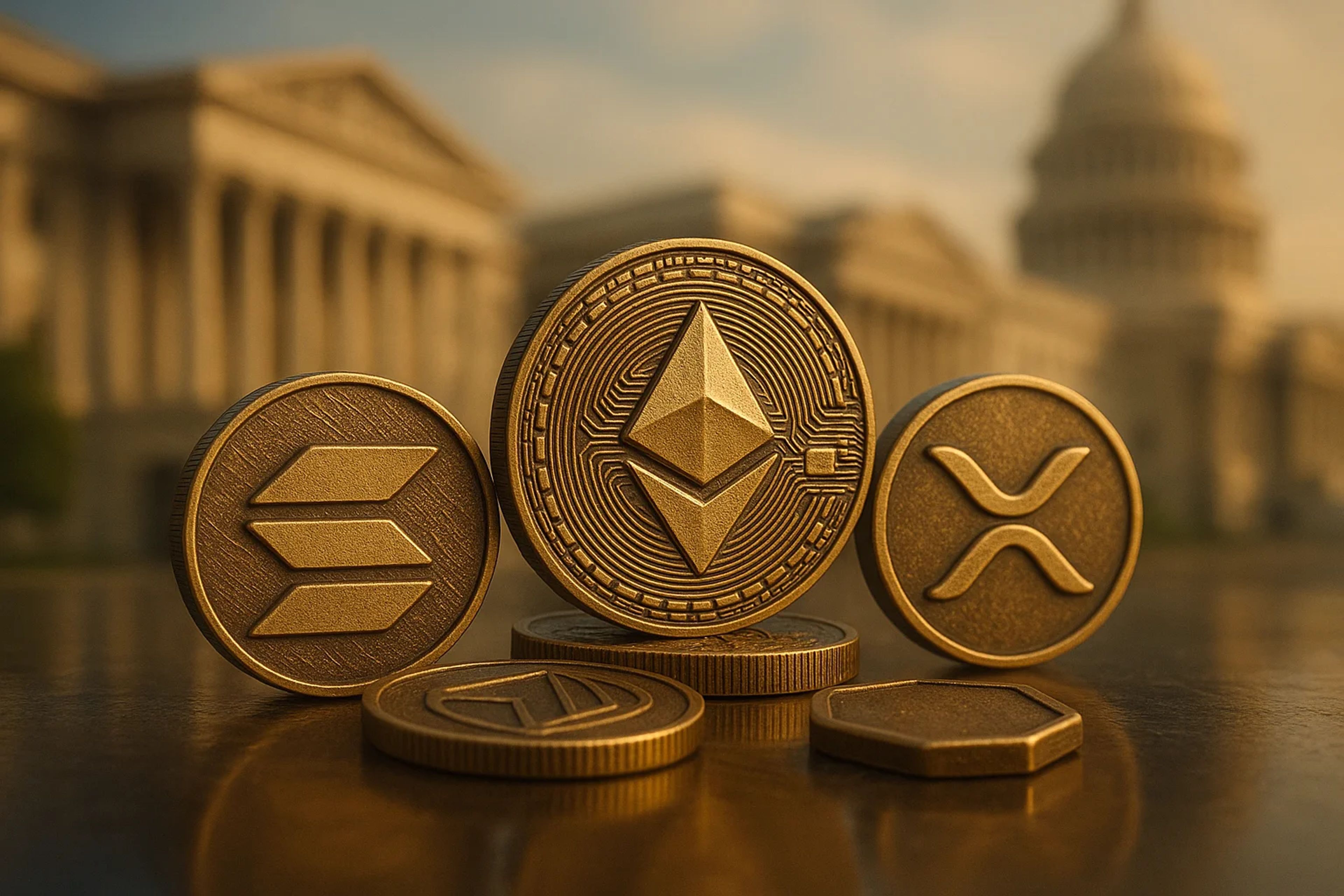
The altcoin ETF wave whats next after SOL and XRP
After SOL and XRP, the altcoin ETF wave is likely to move in a checklist-driven order where regulated US futures history and standardized exchange rules decide who clears the bar next. That shifts attention from one-off 19b-4 deadline drama to whether products can meet generic listing standards and get S-1 disclosures into an SEC-ready template.
Key Takeaways
- The next phase of the altcoin ETF wave is being pulled toward a repeatable pathway built on generic listing standards and “fast-track” eligibility tied to surveillance and regulated futures history.
- SEC plumbing still runs on two tracks: issuer disclosure (S-1 effectiveness) and exchange listing approval (often via 19b-4), with 19b-4 timelines that can stretch to 240 days.
- A source-backed expedited set already exists: DOGE, BCH, LTC, LINK, XLM, AVAX, SHIB, DOT, SOL, and HBAR meet proposed criteria now, while ADA and XRP join after six months of regulated futures trading history.
- Timing risk is not just “the SEC said no.” Process changes, S-1 rewrites, and even a US government shutdown can pause approvals.
Why altcoin ETFs are accelerating now
The backlog is the tell. A comment letter posted on the SEC site cites Bloomberg Intelligence’s James Seyffart estimating 91 outstanding crypto ETF applications spanning 24 individual tokens plus index funds, which is exactly the kind of queue that forces regulators and exchanges to standardize. That is why the current moment looks less like a single SOL-or-XRP coin toss and more like an altcoin ETF pipeline being built to clear volume.
The trigger was the success of the first spot bitcoin products in 2024, which the same SEC comment letter flags as the catalyst for the surge in filings. That matters because the market learned what “institutional wrapper” demand looks like when it is actually tradable on a national securities exchange. For beginners, it helps to anchor the whole discussion to what is a spot bitcoin etf: a spot product forced the SEC and exchanges to operationalize custody, pricing, and surveillance arguments in a way futures-only products never did.
SOL and XRP became focal points because they sit at the intersection of issuer demand and evolving SEC process. Blockworks reported on Sept. 30, 2025 that the SEC approved generic listing standards for crypto ETPs, a step that could allow some crypto ETFs to be approved without rule-changing 19b-4 forms. Blockworks also reported the SEC asked filers to withdraw 19b-4s in light of those standards, attributed to journalist Eleanor Terrett. That is the structural shift: if generic listing standards become the default, the “who’s next” game becomes less about narrative and more about who fits the template.
How the SEC approval pipeline works
Two separate machines have to run before a new crypto fund trades. One is the issuer’s registration statement, usually an S-1, which is the disclosure package that must go effective before shares can be offered. The other is the exchange’s listing pathway, historically handled through a 19b-4 proposed rule change when the exchange needs SEC sign-off to list a new product type.
The SEC comment letter lays out why 19b-4 headlines are so often misleading. Once a 19b-4 is submitted, a 21-day public comment period starts, the SEC has an initial 45-day deadline to approve, reject, or extend, and the review can be extended up to 240 days from submission. That is why “final deadline” calendars can be loud and still not be predictive. The clock is real, but it is not a promise of a decision on the day traders circle.
Generic listing standards are the attempt to turn that bespoke 19b-4 grind into something closer to an assembly line. The SEC comment letter points to the SEC’s 2019 ETF Rule (Rule 6c-11) as the precedent in equities, where standardized conditions replaced case-by-case exemptive orders and compressed launch timelines. In crypto, the equivalent idea is that if an ETP meets pre-set criteria, an exchange can list it without re-litigating the same surveillance and market-integrity arguments every time.
This is also where “ETF” versus “ETP” matters. ETP is the umbrella category for exchange-traded products. ETF is a common structure inside that umbrella with a specific regulatory and disclosure regime. The SEC’s generic listing standards discussion is about crypto ETPs broadly, even if most headlines will keep saying “ETF.”
Which altcoins look next in line
The cleanest answer to “the altcoin etf wave whats next after sol and xrp” is not a market-cap ranking. It is the SEC-facing eligibility set implied by the exchanges’ proposed expedited criteria in the Aug. 28, 2025 SEC comment letter.
That letter summarizes three proposed fast-track conditions. If a token satisfies any one, the exchanges propose its accompanying ETPs should qualify for expedited processing: (1) the commodity trades on a market that is an Intermarket Surveillance Group member, with information access. (2) the commodity underlies a futures contract on a designated contract market for at least six months, with a comprehensive surveillance-sharing agreement. (3) on an initial basis, an ETF with at least 40% NAV exposure to the commodity trades on a national securities exchange.
The same SEC comment letter identifies 10 tokens that meet the expedited-listing criteria now, excluding BTC and ETH: DOGE, BCH, LTC, LINK, XLM, AVAX, SHIB, DOT, SOL, and HBAR. It also adds ADA and XRP will qualify after they reach six months of regulated futures trading history, based on their Coinbase Derivatives start dates, with seasoning in September 2025 for ADA and October 2025 for XRP.
This list is the closest thing in the packet to a source-backed “pending crypto ETFs” watchlist. It also reframes the DeFi ETF and memecoin ETF chatter. A DeFi-branded product still has to map to an underlying that clears the same surveillance and futures-history gates. A memecoin ETF conversation gets less silly when the SEC’s own fast-track-eligible set includes DOGE and SHIB, which are memecoin-adjacent by market identity even if the filings will not market them that way.
What could delay or derail approvals
The first delay risk is operational, not legal. Blockworks reported that a looming US government shutdown could pause listing approvals and make approvals “very unlikely” during a shutdown. That is a blunt constraint: even if issuers are ready and exchanges have a pathway, the tape can stop.
The second delay risk is that “eligible” is not the same as “shippable.” Blockworks reported that issuers were preparing for potential SEC green lights for SOL ETFs and that amended S-1 forms were being submitted, but it was not clear whether approved spot SOL ETFs would include staking. That uncertainty is not cosmetic. A staking etf changes what the fund is doing with the underlying asset, and it forces sharper disclosure around operational mechanics and risks. Blockworks noted S-1 amendments addressed staking, while inclusion was not confirmed.
The third delay risk is that headline timelines can conflict even when the underlying process is moving. Cointelegraph reported that seven Solana ETF applicants filed S-1 statements on June 13, 2025 amid ongoing SEC discussions, and that Bloomberg analyst James Seyffart doubted approval would come as soon as the next week. Blockworks later reported sources suggesting a faster timeline around early October 2025. The point is not which forecast “wins.” The point is that the market tends to trade the rumor while the SEC tends to trade the checklist.
XRP adds a fourth kind of noise: deadline clustering. Coinpedia lists multiple spot XRP ETF final decision deadlines clustered around Oct. 18–25, 2025 and claims around 10 major asset managers have filed. Those dates can matter for attention, but the SEC comment letter’s framework implies the more durable gating item is the six-month futures clock and whether the product fits standardized listing rules.
How to track the next ETF wave
A workable tracker is a process dashboard, not a token leaderboard. The SEC comment letter gives the clocks, and Blockworks gives the procedural tells that matter when generic listing standards are in play.
1. Check whether the token has regulated US futures on a designated contract market and how long it has traded. The SEC comment letter treats six months of DCM futures with surveillance-sharing as a key eligibility gate. 2. Map the product to the exchange pathway. If generic listing standards apply, the exchange may not need a bespoke 19b-4 for each product. Blockworks reported the SEC asked some filers to withdraw 19b-4s in light of those standards. 3. Track the SEC’s formal timing windows when a 19b-4 is still in play. The SEC comment letter spells out the 21-day comment period, the 45-day initial deadline, and the ability to extend up to 240 days. 4. Watch S-1 edits for product-design friction. The SOL cycle shows how disclosure language can become the battleground, especially around staking language and what “spot” exposure really means. 5. Flag operational blockers that can freeze approvals. Blockworks explicitly warned that a US government shutdown could pause listing approvals.
This is also where readers should keep the broader spot bitcoin ETF story in view. The same regulatory machinery that had to be built for spot bitcoin products is now being generalized, and that generalization is what turns “who’s next” into a pipeline question. For readers who want the SOL and XRP specifics, solana and xrp etfs explained is the right mental bridge, but the repeatable edge is learning how generic listing standards and futures seasoning reorder the queue.
The Take
I’ve watched traders obsess over the 19b-4 “final decision” date like it’s an earnings print, then get blindsided when the real work happens somewhere quieter: an S-1 rewrite, a withdrawn 19b-4, or a process change that makes the old clock irrelevant. The Sept. 30, 2025 Blockworks reporting about generic listing standards and the SEC asking filers to pull 19b-4s is exactly that kind of tell.
If there’s one expensive misconception here, it’s thinking market cap or narrative decides the next approvals. The SEC comment letter basically hands the market a draft checklist, including a futures-seasoning gate and a defined eligible set. I’m not interested in “memecoin ETF” jokes or DeFi branding until the underlying clears the same plumbing that made spot bitcoin ETFs possible in the first place.
Sources
Frequently Asked Questions
What does “generic listing standards” mean for altcoin ETFs?
Generic listing standards are pre-set exchange and SEC criteria that can allow certain crypto ETPs to list without a bespoke rule-change filing each time. Blockworks reported the SEC approved generic listing standards for crypto ETPs, and that the SEC asked some filers to withdraw 19b-4s in light of those standards. If this framework sticks, the altcoin ETF pipeline becomes more checklist-driven.
How long can the SEC take to decide on a 19b-4 filing?
The SEC comment letter describes a 21-day public comment period after submission and an initial 45-day SEC deadline to approve, reject, or extend. The review period can be extended up to 240 days from submission. That is why “deadline” headlines often overstate certainty.
Which tokens are structurally next after SOL and XRP for ETF eligibility?
The SEC comment letter identifies 10 tokens meeting proposed expedited criteria now: DOGE, BCH, LTC, LINK, XLM, AVAX, SHIB, DOT, SOL, and HBAR. It also says ADA and XRP will qualify after six months of regulated futures trading history, with seasoning in September 2025 for ADA and October 2025 for XRP. This is a more concrete screen than market-cap rankings.
Could a US government shutdown delay crypto ETF approvals?
Yes. Blockworks reported that a US government shutdown could pause listing approvals and make approvals “very unlikely” during a shutdown. Even if filings are ready, operational disruption can freeze the approval process.
Will spot Solana ETFs include staking?
It is not confirmed. Blockworks reported it was unclear whether approved spot SOL ETFs would include staking, though the most recent round of S-1 amendments addressed staking. That uncertainty is a signal that product design and disclosures can be as important as eligibility.


