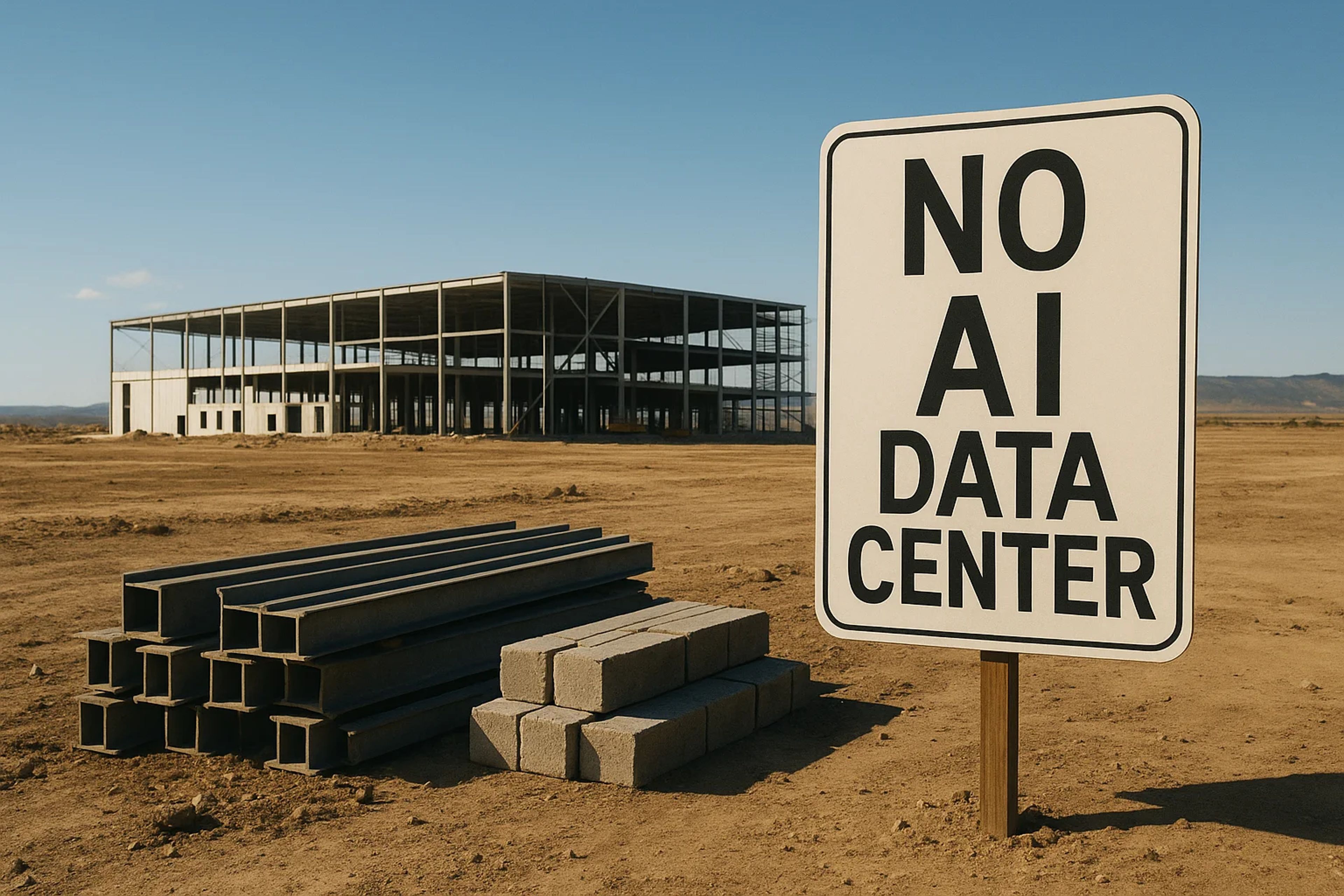
Anthropic plans to flag AI and data-center backlash as an IPO risk factor
The prospectus is expected within weeks after a June confidential filing and early investor meetings in San Francisco.
Anthropic is expected to warn IPO investors that negative public sentiment toward AI and AI data centers could materially hurt its business. The risk-factor language is anticipated in a prospectus expected within weeks, after the company filed confidentially in June.
Key Takeaways
- Anthropic is expected to list negative sentiment toward AI and AI data centers as a risk factor in an IPO prospectus anticipated within weeks.
- The company filed confidentially in June and has already held preliminary meetings with bankers and investors in San Francisco.
- CFO Krishna Rao has been answering diligence questions on margin pressure from open-source models and on what happens if data center construction slows.
- Polling and state actions cited alongside the IPO planning show rising opposition to local AI data centers and permitting moves in Pennsylvania and New York that could tighten the buildout path.
Anthropic’s IPO Prospectus Is Set to Spotlight AI Backlash as a Business Risk
Anthropic is preparing to tell public-market investors that the backlash against AI and the physical infrastructure that powers it is not just a reputational issue, but a business risk that can constrain growth. People familiar with the matter said the company will name negative sentiment toward AI and data centers as a risk factor in its IPO prospectus, and that the document is expected within weeks.
The timing details that are confirmed are limited. Anthropic filed confidentially for an IPO in June, a process that allows draft paperwork to be submitted privately before it becomes public, and it has since held preliminary meetings with bankers and investors in San Francisco. The prospectus itself is not yet available, so the final wording, prominence, and any quantitative framing of the risk factor remain unconfirmed.
Risk factors in an IPO prospectus are not marketing copy. They are the part of the offering document designed to surface material ways the business can break, and to reduce legal exposure if those risks later show up in results.
Compute Buildout as the Growth Bottleneck: Why Permits and Politics Show Up in Diligence
The mechanism investors are pressing on is simple: for frontier AI labs, compute is capacity, and capacity is revenue. The report frames the linkage bluntly, noting that “compute capacity tracks directly with revenue at AI labs,” which is why questions about data center construction timelines are showing up in IPO diligence alongside the usual competitive landscape.
Anthropic CFO Krishna Rao has been fielding two sets of questions that interact in a way equity investors care about. One is competition and margin pressure from open-source models, meaning models whose code or weights are publicly available and can push pricing down for proprietary providers. The other is what happens if data center construction slows, whether from permitting friction, local opposition, or state-level policy moves.
Those two pressures compound. If open-source competition compresses pricing while permitting delays cap capacity expansion, the company can end up squeezed on both unit economics and volume at the same time. That is the kind of combined narrative risk that tends to get written into prospectus language because it is hard to “fix” with a single operational lever.
The Numbers Investors Are Anchoring On: $65B Run-Rate Revenue and Trillion-Dollar Valuation Talk
The scale implied by the investor conversations is large enough that the constraint story matters. Anthropic’s annualized revenue run rate topped $65 billion in July, an estimate that extrapolates the current revenue pace to a full-year figure. The same report described that run rate as roughly $25 billion above OpenAI’s level.
On valuation, the figures being discussed are explicitly framed as expectations rather than terms. Anthropic is described as valued at nearly $1 trillion in private markets, and investors are described as expecting a public float around $2 trillion, meaning the portion of shares expected to be available for public trading after the IPO.
That combination, a $65 billion run-rate revenue figure and trillion-dollar valuation talk, is why the prospectus risk factor is not a throwaway. When the narrative is “this is a $2 trillion float,” the market’s tolerance for any constraint that looks structural, like permitting and politics, tends to drop fast.
Watchlist Into the Prospectus: Wording, Timing, and the Next Permitting Headlines
The first catalyst is the prospectus itself, expected within weeks, and the exact way Anthropic describes the backlash risk. The key detail is whether the company keeps it as a generic sentiment warning or ties it directly to capacity expansion, permitting timelines, and the pace at which new compute can come online.
The second set of signals is policy. The report cites Pennsylvania Governor Josh Shapiro signing an executive order imposing strict standards on data center development, and New York Governor Kathy Hochul ordering a pause on permits for large new data centers. Any expansion, rollback, or copycat actions in other states would change the baseline assumptions for buildout timelines.
The third is whether the polling trend holds. Gallup found in March that 7 in 10 Americans oppose constructing an AI data center in their area, with 48% strongly opposed. A later Heatmap Pro poll of 2,045 registered voters conducted Aug. 8 to 13 by Embold Research put opposition at 75%, up from 42% a year earlier. Pew Research also found 71% of adults expect AI to cut US jobs over the next two decades, up from 64% in 2024, a parallel anxiety that can feed local resistance.
Finally, investor-meeting disclosures matter because they reveal how Anthropic frames compute availability versus revenue growth under scrutiny. If the company starts to quantify how much capacity it needs, and on what timeline, it will make permitting friction legible as a revenue variable rather than a political footnote.
My Take: The Prospectus Risk Factor Is a Tell That ‘Compute Risk’ Is Becoming ‘Demand Risk’
The threshold that matters is whether Anthropic treats backlash as a second-order PR issue or as a first-order constraint on capacity expansion. When a company plans to put “negative sentiment toward AI and data centers” into an IPO prospectus, it is usually because counsel and bankers think the risk is material enough to survive diligence, not because it sounds prudent.
If opposition stays near the 70% to 75% levels cited and state actions like Pennsylvania’s stricter standards and New York’s permit pause become a pattern, compute stops being a pure supply-chain story and starts looking like a demand-side constraint in disguise. In practical terms, the prospectus matters if it ties permitting friction to a slower compute ramp, because that is the path where a $65 billion run-rate narrative can miss on volume, not just on margins.


