
AI
AI safety calls spark sell-off in AMD, Micron, and Intel
Traders mapped “slower model progress” rhetoric to softer near-term demand for accelerators and memory.
·4 min read·
Protocol, Infrastructure and AI Correspondent
Six years in crypto: three auditing smart contracts, three writing protocol research. Reads the contract and the dashboard before the press release, and explains the mechanism before the meaning. Covers the AI stack crypto actually touches — compute markets, onchain agents, and the infrastructure underneath both.
Traders mapped “slower model progress” rhetoric to softer near-term demand for accelerators and memory.

The stance is rhetoric, not a new rule, but it reinforces a competitiveness-first posture with security spillovers for DeFi.

He points to near-100% AI infrastructure utilization and a 14.8x 24-month-forward SOX multiple as demand stays tight.

Democrats urged Speaker Mike Johnson to keep the House in session as frontier-AI safety proposals take shape.

The study reviewed 198.9 million settlements since May 2025 and found USDC made up 99.6% of settled value.

A GlobePRwire release advertises up to 100% bonus tokens but provides no contract address, team, or verifiable performance proof.

The packet claims $TAP Round 4 is priced at $0.0589 with $11.72M+ raised, plus a buyback-and-burn model tied to app fees.

Jacob Coxon’s “immediate future” warning drew backlash and support as Anthropic backed a lawful, verifiable release-pacing mechanism.

Ted Lieu cited an “AI Kill Switch Bill” as Anthropic pointed to a transcript scan and OpenAI declined to comment.

The HTTP 402-based flow is being pitched as a standard paywall handshake for software, with USDC-priced API calls and an AWS CloudFront/WAF path.

The macro investor also sketched a $100 trillion digital-asset market with Bitcoin at 33% share and said he has never sold BTC.

The threat report spans Dec 2025–Aug 2026 and lands amid a US political split over slowing AI versus “winning” it.

A bipartisan safe-harbor bill would permit cross-lab safety coordination, but it is stalled in House Judiciary.

The interoperability effort targets cross-platform AI agent verification, but offers no rollout timeline or adoption commitments yet.

The tooling already links supported AI apps to Advanced Trade with isolated portfolios, while x402 in-request payments are still listed as “coming soon.”

The episode shows X still concentrates high-velocity AI insider discourse despite weaker mainstream engagement.

Cache-read cuts and flat Flash pricing are compressing inference costs while cyber-capable tiers move behind gated programs.

Agent Pay uses tokenized permissions for customer-approved spending, with stablecoin settlement positioned as an optional rail.

The analysis argues wallet keys and transaction signing are becoming treasury controls as quantum shortens encryption lifespans.

Across 26 keyword contracts, implied odds favor Apple-branded AI over OpenAI or Google name-drops.

Kaitlin Durbin said the article ran under her name while she was on her honeymoon and that she “did not write or review a word of it.”

The Nvidia CEO tied the claim to Nvidia GPUs as critics and benchmark authors rejected Astra as proof of general intelligence.

Heavy users and Gartner warn that agent counts are easy to inflate and can hide the supervision and maintenance that decide ROI.

Coldcard’s $114M theft and a Core Lightning emergency add to a pattern of complexity-driven BTC risk.

FedWatch pricing implies a hawkish baseline that could flip quickly on inflation or labor surprises.

The image shows the U.S. flag draped over Canada, Mexico, Cuba, Greenland, and Iceland, with no accompanying policy action.

CEO Vugar Usi tied free spot trading and selected zero-fee futures to PoR audits, insurance funds, and a “financial super app” roadmap.

He said the odds of hashing or proof-of-work breaking are close to zero and noted ~90% of his net worth is already positioned against the crash.
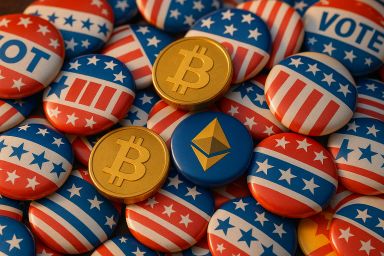
Public Citizen data shows the 2026 cycle has already cleared the full 2024 record, with crypto-linked super PAC money still positioned for late-cycle races.

The provided source is an NPR landing page aggregating unrelated headlines dated Sept. 5–6, 2026.

The piece contrasts fixed-rule bots with systems that pair continuous analysis with automated execution, while warning AI cannot guarantee results.

A September re-run put forecasts in an $84,500–$105,480 band, below May’s reported $102,305 average.

The contract is framed at $1.2B+ over 20 years with extensions, and $3B+ if a 32MW option is exercised.

The platform claims up to 10x faster optimisation and cites early enterprise deployments plus a Q4 2026 GMV target above $6B.

OpenAI says Astra hit a “Critical” cyber threshold and will reach paid ChatGPT tiers, the API, and AWS in the coming days.

The White House is still weighing pre-deployment model testing against a voluntary ratings framework pitched by David Sacks.

Core Scientific and TeraWulf reported stronger AI/HPC economics as hashrate revisited ~900 EH/s after a >1.1 ZH/s peak.

The six-person team and some licensed technology will fold into Adobe’s enterprise marketing AI push, with deal terms undisclosed.

The release pairs “critical” cyber capability disclosures with gated access after a recent alignment failure paused training.

The packet includes only a Yahoo cookie notice, so the underlying reporting cannot be verified from provided materials.

Bullish Exchange also plans to list sUSDai on multiple pairs with a dedicated market-making program.

The August 2026 recap pairs a three-week model release cadence with usage metrics, Pixel 11 on-device Gemini Nano, and new video tooling.

The design is expected to use UPI Circle delegation and Reserve Pay blocked funds, with current Rs 10,000 and 90-day limits under review.

The gauge is down more than 50% from an earlier-summer high as price cuts and open-source competition bite.

His country table implies 4.5%–6% adoption, or roughly 370–500 million BTC holders worldwide.

The open letter urges governments to deploy “defensive AI” to hospitals and water utilities but leaves access and rollout details undefined.

A new FSB letter calls AI-driven cyber risk the most immediate stability concern, citing concentrated third-party providers as the key amplifier.

AXG’s AGENPAY incubation with SC Ventures ties agent identity to payments, but the stablecoin is not live yet.

The two-year exclusive partnership targets 20+ markets at launch on OG Prediction Markets, with settlement tied to PYMNTS Intelligence’s AI adoption measurements.

AI search overviews were less consistent than plain search, with Bing’s summaries failing most often in the test.

OKX, Citi and Coinbase executives agree on crypto rails, but not on the settlement asset.

AI cloud revenue more than doubled to $70.5M, but total revenue fell and adjusted EBITDA dropped 68% in the June quarter.

The state cited FTC-tracked data showing 144,041 reports and more than $8B in 2025 losses, up 38% year over year.

The burst included multiple uploads minutes apart and a ballroom video, alongside a separate WWII-generals battlefield image.

The model offers $18/month hosted access or 300GB+ weights on Hugging Face, after a week atop OpenRouter charts.

The call lands as Treasury doubles long-end bond buybacks to $4B per operation starting Sept. 9.

A 59-page order bars enforcement tied to a directive telling agencies to stop using Claude, and DOJ is expected to fight it.

Binance Research tied about two-thirds of April 2026’s $621M DeFi losses to access-control failures, not code bugs.

The Aug. 4 rollout adds delegated allowances and merchant allowlists, alongside July 1 per-request stablecoin charging for APIs.

Prosecutors said the Las Vegas pitch promised 20%–30% fixed returns tied to an “AI supercomputer” story and took $24 million from 400+ investors.

The Mac Mini debuts M6 on TSMC’s 2nm process and starts at $899, while Mac Studio adds M5 Max and M5 Ultra tiers up to $5,499.

The thesis leans on Bitcoin’s reported 25% August gain and an un-sourced claim of the biggest Bitcoin ETF inflows since Oct. 2025.

Bitdeer’s 16-year Anthropic agreement points to a dual-purpose model that may not unwind quickly even if bitcoin rebounds.

The report offers no details on the error or downstream impact, leaving the story as a risk-sentiment catalyst for now.

The “stealth model” climbed to the top of unnamed online usage charts while being offered at zero cost.

Flop Labs is reviewing an October airdrop of about 20% of supply, with tokenomics and eligibility still being adjusted.

The Markets/Crypto page is timestamped 2026-08-25, but only a cookie-consent overlay is visible in the excerpt.

The Aug. 24 report calls the episode a “dangerous harbinger,” but the provided excerpt gives no operational details or impact.
OpenAI-backed data shows Codex is near-universal internally but under 1% among individual subscribers.

The same weekly packet framed Bitcoin’s move around $69,000 as macro-led, but also cited ~$77,000–$78,000 in an editor’s note.

The prospectus is expected within weeks after a June confidential filing and early investor meetings in San Francisco.

The increases are tied to Rubin and Grace Blackwell systems and are expected to apply to shipments next year.

Attribution remains unresolved as observers split between a Z.ai/GLM-5 lineage and a Microsoft MAI-family hypothesis.

The 2026-08-21 disclosure offers a directional security signal, but no methodology or category breakdown.

The plan targets consumer, competition, and employment laws and would land recommendations at the Legislature within his first month in office.

The service routes requests across multiple model providers and defaults to one-year, opt-out data retention.

Exchange-side risk is bounded mainly by user-funded subaccounts, not a Binance-set agent loss cap.

The numbers come from a paid WorldNewsWire press release that says StreetInsider’s newsroom was not involved.

A Reuters-cited review found 43 of 90 listed models came from Chinese firms under US scrutiny as WorldClaw advertises 300+ models.

The relationship is being framed as evidence that AI demand is still concentrated inside big tech.

Hugging Face counts 151,448 Qwen derivatives, a 2.6x footprint versus Meta as open-weight competition tightens.

OpenRouter and Hugging Face gauges show Chinese models taking leading share on those channels as US ban talk and IPO narratives collide.

His pitch on microtransactions landed as the CFTC floated a lighter-touch SEF order book proposal with a 30-day comment window.

Q2 2026 results show colocation is now the profit engine, but the buildout is being financed with roughly $4.3B of long-term debt.

Critics frame the effort as ideological surveillance, but key details on tools and governance are still missing.

The company says only ~41B parameters are active per token and publishes 2TB-to-600GB memory footprints for deployment.

The eight-week virtual accelerator requires Base as the primary chain and ends with a New York Demo Day in November.

Coinbase’s CEO argues programmable, global, instant, low-fee rails fit autonomous agent payments, but flags regulation and volatility as blockers.

The cross-asset split keeps a risk-off, inflation-sensitive tape in view for crypto beta traders.

The case lands as OpenAI discloses that 0.15% of weekly users show explicit suicidal-intent indicators in chats.

Full access is planned in two weeks after a trusted-partner phase framed around dual-use risk.

The Aug. 16 refresh argues most open-source agents still need human supervision and can degrade after longer sessions.

The near-term trader angle is automated DeFi management, but compute costs, security, and liability remain open problems.

Analysts kept the focus on a $62K–$65K box as BTC sits below key moving averages and miners report a 21% compute drop over three quarters.

A San Francisco jury rejected her necessity defense and convicted her on four misdemeanor counts after a February 2025 sit-in.

The claim dwarfs Hugging Face’s 2026 download counts cited for Google and Meta, but the accounting is not like-for-like.

AI addenda in vendor agreements are emerging as the control layer as legal agents move into production.

A paper submitted June 25, 2026 claims scoped “ownership path” context and a drift gate can curb context overload and hidden divergence.

Scamwatch logged A$45m+ in 2026 investment-scam losses so far, even after ASIC deactivated nearly 12,000 scam sites in 2025.

Nvidia’s planned residual-value support could reach tens of billions, pushing contingent AI credit risk into focus.
Bittensor coordinates specialized AI competitions on-chain while the heavy model work runs off-chain, with rewards routed through TAO and subnet alpha tokens.
Subnets run off-chain tasks and scoring, while on-chain Yuma Consensus and root or dTAO signals decide who gets paid in TAO.
Stablecoins let software agents clear payments continuously onchain, then route fiat payouts and cross-chain USDC via networks like CPN and CCTP.
X402 settles per HTTP request in stablecoins, MPP runs a pre-authorized session that batch-settles, and AP2 adds signed mandates for provable authorization.
X402 turns HTTP 402 into machine-readable payment terms, then settles signed stablecoin authorizations onchain via a facilitator.
It is a shift from buying software seats to commissioning autonomous workflows, with identity, protocols, and settlement deciding who can be trusted and paid.
Smart accounts use scoped session policies and ERC-4337 plumbing so an agent can act without holding your master key or unlimited authority.
X402 standardizes a 402-based HTTP handshake so APIs can quote, verify, and settle payments per request without user accounts.
An agent turns a trade decision into signed requests that bundlers, EntryPoint, and allowance systems can settle as onchain state changes.
Intent-based execution turns a signed outcome request into an auction where solvers pay gas, route the trade, and settle only if constraints are met.
DeFAI agents usually think offchain, then use oracles and constrained wallet permissions to settle DeFi actions onchain with irreversible finality.
ERC-8004 standardizes an on-chain lookup layer for AI agents using an ERC-721 AgentID plus two 0–100 signal registries with off-chain evidence links.
ERC-8004 uses an ERC-721 identity token plus shared registries for reputation and validation so wallets and counterparties can apply consistent policy.
Agent reliability decays across tool calls and handoffs, so production safety comes from limits, verification, and observability, not better prompts.
They standardize orchestration, state, tool calling, and observability so agent behavior is repeatable instead of a one-off demo.
Most crypto agents are two systems glued together: structured onchain analytics tools and a smart account that enforces what can actually be executed.
They run an observe-decide-execute loop and can settle actions on-chain under explicit limits, permissions, and goals.
The key distinction is whether the system can take tool-driven actions like placing orders, not whether it uses an LLM.
ERC-4337 routes wallet actions through UserOperations, bundlers, and EntryPoint, creating a parallel inclusion and fee market to normal Ethereum transactions.
They replace a single seed phrase with either off-chain threshold signing via MPC or on-chain recovery rules in a smart contract wallet.
A multisig wallet executes transactions only after a preset threshold of signers approves, turning key custody into an explicit approval pipeline.
MPC wallets split signing authority into key shares so m-of-n approvers can produce one normal on-chain signature without reconstructing a full private key.
A hardware wallet keeps private keys off your laptop or phone by signing transactions inside the device and showing the final details on a trusted screen.
Wallet “types” mainly differ by where the private key lives and what you expose when you sign transactions and dapp approvals.
The right wallet choice starts with how you will protect and restore a 12–24 word seed phrase and how you will verify transactions under stress.
A wallet is a signing system that derives many addresses from one seed and proves spending rights with cryptographic signatures.
A wallet app is replaceable, but your seed phrase is the master key that controls funds and recovery if your device disappears.
Hot wallets keep signing keys on internet-connected software, while cold wallets keep keys offline to reduce exposure but slow access.
A crypto wallet generates addresses and signs transactions, and the real decision is whether you or a custodian controls the private key.
USDC is a Circle-issued dollar stablecoin whose $1 peg is enforced by redemption, and it can still depeg when banking rails or reserve access are stressed.
USDT tends to win on liquidity, USDC on reserve verification cadence, and DAI on DeFi-native issuance and governance.
DAI is a soft-pegged, crypto-collateralized stablecoin created by borrowing against onchain collateral in Sky Protocol Vaults.
Most designs defend a $1 peg by minting and burning tokens, but the rules can amplify a bank-run when liquidity and confidence vanish.
Stablecoin interest is earned by deploying coins into lending, liquidity, or Treasury-linked wrappers, and the exit terms under stress decide whether the yield was real.
Stablecoins trade near $1 when the market can reliably mint or redeem size fast enough to close price gaps under stress.
Stablecoins target $1 by relying on redemption, liquidation, or arbitrage, and they depeg when that conversion path slows or shuts.
Stablecoin “types” differ less by label than by who can redeem at par and what assets must be sold when redemptions surge.
A disputed Polymarket resolution triggers a bonded challenge, a 24–48h evidence window, and can end in a ~48h UMA vote that finalizes settlement.
Kalshi markets price Yes/No contracts from $0.01 to $0.99 and settle at $1 or $0, so your entry price is your max loss per contract.
Polymarket US is a CFTC-regulated designated contract market run by QCX LLC, while international trading is gated by IP-based geoblocking at order time.
Polymarket pays out in Polygon USDC, so cashing out means redeeming to USDC, sending it to a Polygon-ready off-ramp, then withdrawing fiat.
Kalshi is broadly available with USD rails and a wider market board, while Polymarket U.S. is invite-only and can be cheaper for takers if you can access it.
Staking locks proof-of-stake tokens as consensus collateral for variable rewards, with liquidity lockups and enforceable penalties.
Yield farming pays fees, borrower interest, and token incentives, but the return is compensation for risks like IL, depegs, exploits, and costs.
Treat every stablecoin APY as payment for one dominant blow-up mode, then choose the simplest engine you can explain and exit.
Aave “lending” is supplying to a chain-specific pool, receiving aTokens that accrue variable interest, then redeeming them to withdraw.
AMMs quote prices from pool reserves, so every swap shifts inventory, creates price impact, and invites arbitrage to realign the pool with external markets.
DeFi gas fees are native-token network charges, and your total cost is driven by gas units used and the live fee market.
DeFi “insurance” is usually a time-bounded, size-capped cover contract with narrow triggers, funded by a pool that may or may not have capacity in a correlated blow-up.
DeFi routes trading, lending, and stablecoin activity through smart contracts and oracles, shifting trust from institutions to code and key management.
An LRT is a tradable receipt for a restaked position, bundling staking rewards with restaking rewards and layered slashing risk.
DeFi contagion is a mechanical chain reaction where shared dependencies and automated liquidations transmit stress across protocols faster than humans can react.
Aave v3.3 turns bad debt into an explicit per-asset reserve deficit by burning leftover borrower debt after liquidation.
AI news signals interpret breaking headlines by filtering relevance, mapping affected assets, and explaining the mechanism that could move price.
Yield farming pays you for supplying liquidity or capital to DeFi protocols, but the same mechanics that create yield also create unique risks.
A Bitcoin send spends prior unspent outputs, creates new outputs (including change), and becomes final as blocks confirm it.
In 2026, the strongest yield aggregators are the ones that make strategy logic, fees, and risks clear enough to compare net returns across chains.
Under €100, the real differences are verification (screen vs phone), connectivity (USB vs QR vs NFC), and recovery.
Reduce mainnet (L1) gas by bridging once to an L2 like Arbitrum, Optimism, Loopring, StarkEx apps, or Polygon
TVC is proposed as a companion metric to show how much onchain capital is explicitly protected, not just deposited.
The next phase focuses on tradable yield, compliant collateral mobility, and privacy tooling that fits institutional constraints.
Taurox describes a pool-share token whose price rises with trading profits, replacing emissions and manual reward claiming.
 btc$77,091-0.78%
 eth$2,477.07-1.68%
 usdt$1+0.01%
 bnb$716.8-0.98%
 xrp$1.4+0.85%
 usdc$1+0.00%
 sol$100.57-0.86%
 trx$0.34-0.41%
 doge$0.08-1.88%
 link$11.37-0.16%
 ada$0.2-2.38%
 xlm$0.19+4.13%
 bch$221.19-0.44%
 uni$6.6+4.34%
 ltc$52.72-2.23%
 hbar$0.08+0.42%
 avax$7.47+0.93%
 sui$0.71-2.04%
 dot$0.99-2.95%
 etc$7.4-2.99%
 pol$0.1-0.17%
 algo$0.1-1.29%
 atom$1.59-0.75%
 fil$0.89-11.01%
 vet$0.01-7.20%