Riot locks in $9bn, 20-year Anthropic compute deal as miners chase AI cash flows
Bitdeer’s 16-year Anthropic agreement points to a dual-purpose model that may not unwind quickly even if bitcoin rebounds.
Riot Platforms’ $9 billion, 20-year compute contract with Anthropic is the clearest price tag yet on a shift by public bitcoin miners toward long-duration AI and high-performance computing revenue. Bitdeer’s newly announced 16-year Anthropic deal adds weight to the view that parts of the sector are building a barbell model: flexible bitcoin mining on one end, contracted AI workloads on the other.
Key Takeaways
- Riot Platforms signed a $9 billion compute agreement with Anthropic that runs for 20 years earlier in August 2026.
- Bitdeer announced a separate 16-year deal to provide compute for Anthropic while saying it expects to keep mining bitcoin under a dual-purpose operating model.
- Bitcoin traded around $80,000 after peaking near $124,000 in October 2025, and the move to AI/HPC is being framed as sticky even with the rebound.
- Analyst Wolfie Zhao expects public miners to keep winding down bitcoin mining hardware in coming quarters, arguing that AI/HPC retrofits and long GPU colocation leases are hard to reverse.
Riot’s $9bn Anthropic Deal Puts a Price Tag on the Miner-to-AI Pivot
Riot Platforms’ agreement with Anthropic is being treated as the cleanest example of what the miner-to-AI pivot looks like when it is no longer a pilot. The contract is described as a $9 billion compute deal with a 20-year term, signed earlier in August 2026.
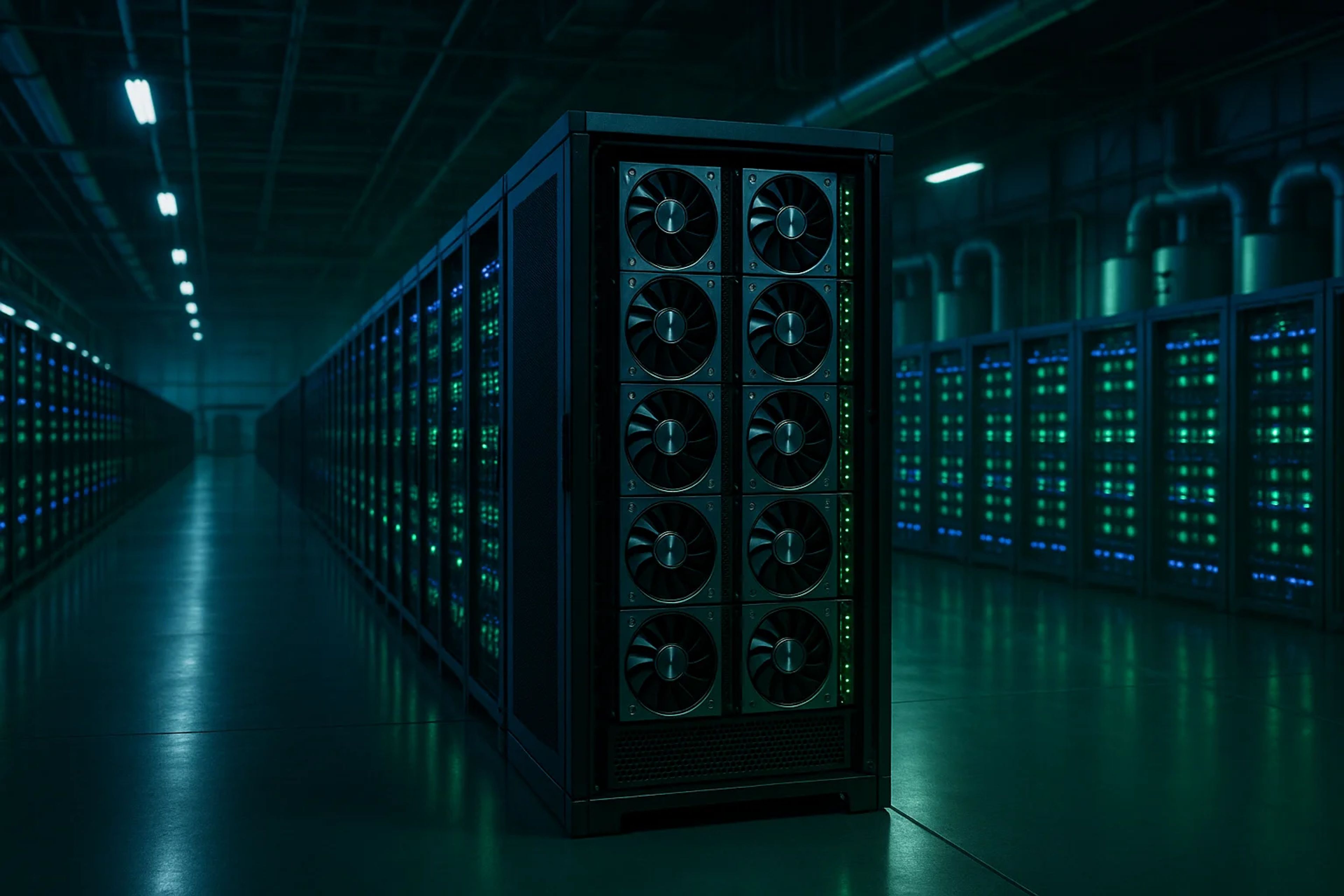
Mechanically, that kind of deal turns a miner’s core asset from “hashrate pointed at bitcoin” into “power, cooling, and data-center operations sold under a long lease.” In AI terms, it resembles a GPU colocation lease, meaning a customer rents space, power, and cooling in a data center to run GPU servers, typically for multi-year terms. The consequence is that revenue starts to look more like contracted infrastructure yield than a levered bet on bitcoin price and network difficulty.
The same pattern is showing up across the public-miner complex, with multiple firms described as diverting investment and infrastructure away from bitcoin mining and toward AI and high-performance computing (HPC). HPC, in this context, is large-scale computing infrastructure used for intensive workloads like AI training and scientific computing.
From $124k Peak to $80k: Mining Economics Behind the Shift
The pivot is being linked to a simple squeeze: mining rewards fell while bitcoin’s price came off its peak. Bitcoin reached about $124,000 (£91,000) in October 2025, then fell sharply, before rallying more recently to around $80,000, described as up almost 30% so far in August 2026.
Bitcoin mining is the process where specialized computers validate Bitcoin transactions and earn newly issued BTC as rewards. When rewards compress and price is off the highs, miners with large fixed power footprints start looking for alternative buyers of the same inputs: megawatts, buildings, and operational discipline.
Industry analysts cited in the report argue miners have an edge in that market because they already know how to source cheap electricity and run large data centers efficiently. That advantage matters because AI infrastructure demand is being described as a spend cycle measured in billions, with firms like Anthropic signing long-duration compute arrangements.
The catch is reversibility. Wolfie Zhao said the shift can become effectively one-way once a site is rebuilt for AI/HPC tenants. “Once that multi-gigawatt power infrastructure has been retrofitted to AI or HPC colocation, there is no turning back,” Zhao said. He tied the lock-in to contract structure as much as hardware: “You can unplug from the Bitcoin network any time but signing a GPU colocation lease for 10 or 20 years means steady revenue and a commitment to keep the infrastructure up for the tenants.”
Who’s Repositioning: Miners, Rebrands, and New AI/HPC Messaging
The report names TerraWulf, Ionic Digital, Core Scientific, Iris Energy, Bitdeer, Riot Platforms and Hut 8 as companies increasingly redirecting investment and infrastructure from bitcoin mining toward AI.
Some of the evidence is not financial engineering, it is plain messaging. Applied Blockchain has renamed to Applied Digital. TerraWulf’s website language is cited as shifting from calling itself an “infrastructure-focused bitcoin mining company” to focusing on “next-generation AI and high-performance computing.” That kind of copy change is not dispositive on its own, but it usually follows internal capital allocation decisions rather than preceding them.
Outside the US-listed cohort, Enegix is presented as another datapoint. The company opened a large bitcoin mining site in Ekibastuz, Kazakhstan in 2020, promoted at the time as a symbol of crypto’s rise. Its CEO Yerbolsyn Sarsenov said the company is now reorienting toward AI: “Today, we are moving confidently towards artificial intelligence and planning the gradual alignment of our energy and infrastructure capabilities, both in Kazakhstan and elsewhere, towards the development of AI infrastructure,” he said.
Enegix said it is in active discussions with AI and HPC companies and plans to transform a “significant” portion of its business to AI. The report does not quantify what “significant” means, and it does not provide a timeline.
Bitdeer’s newly announced 16-year deal to provide compute for Anthropic adds a second long-duration anchor to the trend, but with a different framing. Chief strategy officer Haris Basit said Bitdeer will continue mining bitcoin, arguing for a dual-purpose model: “Bitcoin mining is particularly well suited to that model because it is flexible and interruptible, while AI workloads can provide longer-duration contracted revenues,” he said.
Signals Traders Can Track as Miners Reallocate Power and Capex
The next confirmations are likely to come in contract form. Additional long-duration AI/HPC announcements from TerraWulf, Ionic Digital, Core Scientific, Iris Energy, Hut 8, Bitdeer, and Riot Platforms would help traders map how much of the sector is moving from opportunistic hosting to multi-decade commitments, especially where term length and total contract value are disclosed.
Hardware drawdowns are the other tell. Zhao said, “We expect to see many public miners continue winding down their Bitcoin mining hardware in the coming quarters,” which makes fleet retirement disclosures, site conversion updates, and any explicit reduction in mining emphasis the cleanest operational signals.
Enegix is a specific open loop. Any detail on what portion of its business or capex is being redirected to AI, and on what schedule, would turn a narrative pivot into a measurable one.
Bitcoin’s price path still matters, but more as a pacing factor than a reset button. The report’s context levels, around $80,000 now versus the October 2025 peak near $124,000, frame the question as whether miners maintain dual-purpose operations or accelerate AI/HPC conversion as contracts stack up.
My Read: AI Contracts Are Becoming the New ‘Difficulty Adjustment’ for Public Miners
The part that decides this isn’t whether bitcoin can bounce from $80,000. It is whether miners keep signing 10-to-20-year AI/HPC commitments that turn power sites into tenant infrastructure instead of optionality on hashrate.
The threshold that matters is conversion plus term length. If more miners pair fleet wind-downs with multi-decade compute deals like Riot’s $9 billion, 20-year contract and Bitdeer’s 16-year agreement, the sector’s cash flows start to behave less like a pure bitcoin beta trade and more like a hybrid of mining and contracted data-center revenue, and that is not something a single BTC rally can quickly unwind.


