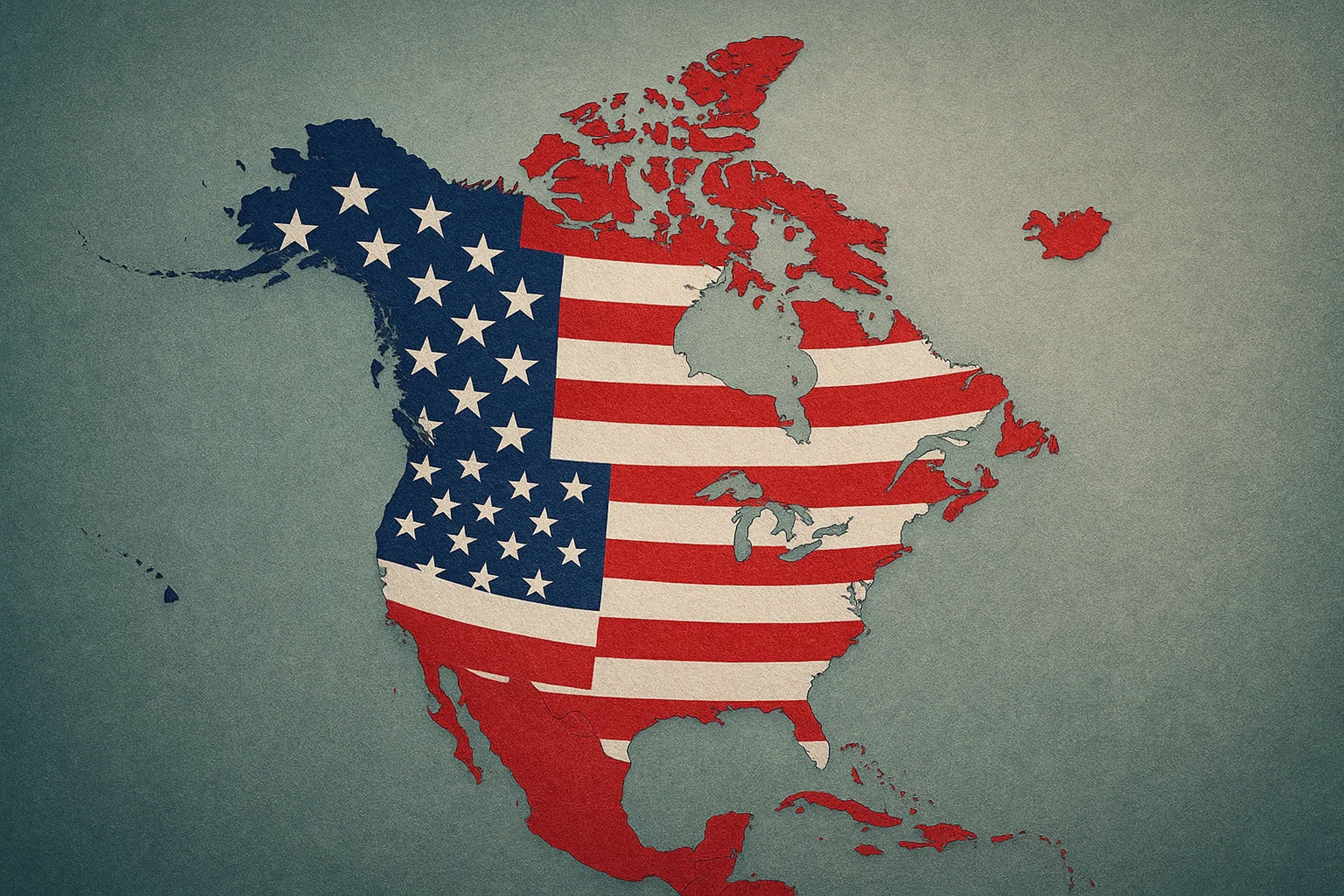
Trump posts AI-style annexation map of North America on Truth Social
The image shows the U.S. flag draped over Canada, Mexico, Cuba, Greenland, and Iceland, with no accompanying policy action.
President Donald Trump posted an apparently AI-generated map on Truth Social on Monday showing the U.S. flag covering all of North America, implying annexation. The post adds headline-driven geopolitical-risk noise even as there is no official action attached to it.
Trump’s Truth Social Map Shows North America Draped in the U.S. Flag
Trump posted an apparently AI-generated map to Truth Social on Monday, Sept. 7, depicting the stars and stripes covering the North American landmass. The image includes Canada, Mexico, Cuba, Greenland, and Iceland under the same U.S.-flag overlay.
The post landed as another iteration of Trump’s annexation-and-renaming themed social messaging rather than a formal statement of intent. The same source context frames it alongside prior trolling about annexing Greenland, Canada, and Venezuela, plus renaming provocations that included calling Lake Ontario “Lake America” and floating “New America” as a new name for New Mexico.
The map also echoes earlier content. The image was described as “very similar” to one Trump posted in January 2026 in a photo featuring French President Emmanuel Macron, U.K. Prime Minister Keir Starmer, and European Commission President Ursula von der Leyen. A separate characterization referenced in the same context said that January image appeared to be edited from a picture taken during an August 2025 meeting in Washington, D.C., but the excerpt does not provide independent verification of that edit claim.
Public reaction was immediate and framed the post as expansionist signaling. One widely shared caption summarized the read bluntly: “Trump posts a map depicting the US conquering the entirety of North America.” Former Marine fighter pilot and political figure Amy McGrath criticized the implication by writing, “What would we do and say if the Chinese president posted a map of China taking over the Western Pacific?”
Other reactions leaned on domestic political contrast and alliance risk. The account “Not Your Average Liberal” posted: “Imagine Obama posting a map of the U.S. taking over North America. MAGA lost their fucking minds when he simply wore a Tan Suit.” Commentator Danielle Langlois argued the post benefits Russia and harms alliances, writing: “The only person this helps is Vladimir Putin. It aspirationally normalizes his imperialist expansionism. It ignores the brutality that is required to accomplish such things. It shits on our allies and NATO. And it makes abundantly clear to our enemies that we have an Executive in…”
Geopolitical-Noise Catalyst: Why a Viral Annexation Meme Can Still Hit Risk Sentiment
For macro-sensitive crypto desks, the mechanism here is not policy transmission. It is headline sensitivity. A viral image that visually implies territorial absorption can pull geopolitics back into the intraday tape, even when the underlying facts are thin and the “action” is just a post.
The “apparently AI-generated” label is part of that mechanism. The excerpt provides no technical provenance for how the image was made, which leaves room for argument, dunking, and amplification across platforms. That ambiguity tends to extend the news cycle because the debate becomes about both the message and the medium, and markets often price the cycle before they price the substance.
The other mechanical detail is target breadth. By depicting not just Canada and Mexico but also Cuba, Greenland, and Iceland, the image widens the set of governments that could respond or be asked to respond. That increases the odds of a follow-on diplomatic headline, even if the initial post is treated as trolling.
The near-term tells are straightforward and time-bounded. Any follow-up statement from the White House or U.S. agencies that clarifies whether the post reflects policy intent would change the story from meme to signal. Responses from the governments explicitly depicted, especially if they elevate the issue from online backlash to formal diplomatic friction, would be the next escalation point.
The shorter fuse is Trump’s own posting cadence. If the annexation or renaming theme repeats over the next 24–72 hours, it stops being a one-off and starts behaving like a sustained narrative cycle that can keep risk assets headline-reactive. Amplification or condemnation by mainstream U.S. political or national-security figures would also raise the probability that the story bleeds into broader “risk-off” framing.
My Read: Treat It as Volatility Fuel, Not a Policy Signal—Until Something Official Follows
The threshold that matters is whether anything with institutional weight attaches to the image: a White House clarification, an agency comment, or a diplomatic response that forces a formal walk-back. Without that, this reads like narrative escalation optimized for social spread, not evidence of an imminent policy move.
The real test is whether the post becomes a multi-day loop. If it stays confined to Truth Social and reaction posts, it is mostly volatility fuel. If it pulls in official pushback from any of the depicted governments or gets echoed by senior U.S. political figures, the setup starts to look like tradable geopolitical-risk noise rather than a disposable meme.


