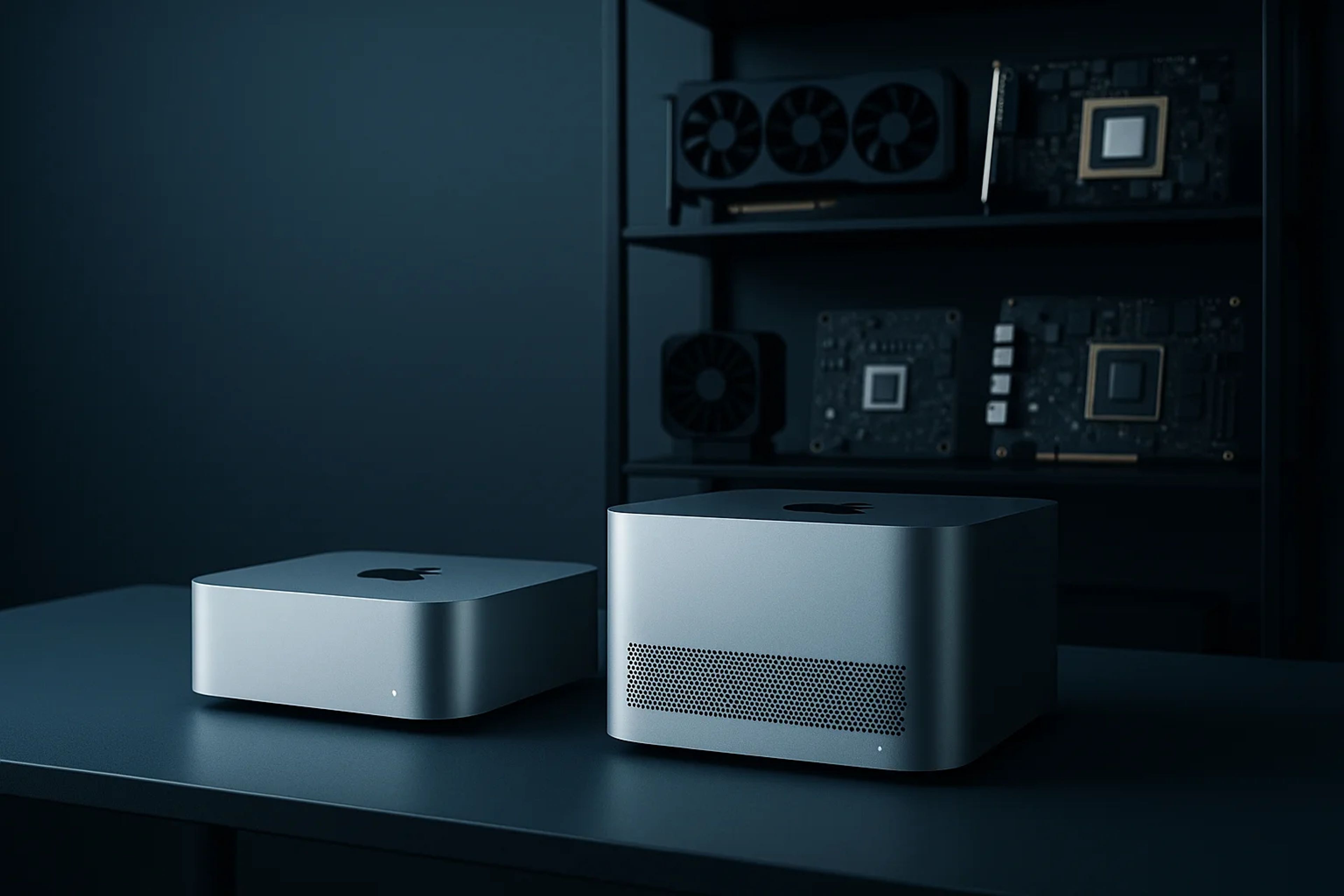
Apple refreshes Mac Mini and Mac Studio with AI-first pitch ahead of Sept. 22 shipping
The Mac Mini debuts M6 on TSMC’s 2nm process and starts at $899, while Mac Studio adds M5 Max and M5 Ultra tiers up to $5,499.
Apple unveiled new Mac Mini and Mac Studio desktops positioned for running and fine-tuning large AI models locally, with presales starting Tuesday and shipments set for Sept. 22. The refresh pairs aggressive Apple-provided LLM speed claims with higher entry pricing on Mac Mini and a new $5,499 M5 Ultra Mac Studio tier.
Apple’s new Mac Mini and Mac Studio refresh is being sold less as a spec bump and more as a workflow decision: run AI on your desk, not in a cloud tab. Apple framed the desktops as strategically important for its AI developer foothold, pointing to developers building agents with software like OpenClaw who prefer a dedicated Mac Mini over cloud deployments.
The company’s own framing is explicit about local model work. “With these frameworks and new chips, developers can run and fine-tune large AI models locally on their Mac,” Apple said in its press release. In practice, that means Apple is leaning on two hardware primitives it controls end-to-end: the “neural engine,” a dedicated block on its chips designed to accelerate AI computations more efficiently than general-purpose CPU work, and a RAM architecture Apple says is designed to reduce memory bottlenecks.
On the Mac Mini, Apple is also using the product as the first shipping vehicle for its next chip generation. The new Mac Mini can be configured with an M6 or an M5 Pro, and Apple said the M6 is manufactured on a 2-nanometer process from Taiwan Semiconductor Manufacturing Co. A 2-nanometer process is a leading-edge manufacturing node that generally implies denser transistors and better performance-per-watt, which is why it tends to matter to traders tracking compute supply chains.
Pricing moved up with the AI pitch. The Mac Mini now starts at $899, up from $799 for the prior model, and Apple pointed to an earlier summer increase from $599 that it attributed to memory costs. Apple also attached a headline performance number to the M5 Pro configuration, saying an M5 Pro Mac Mini can process large language model prompts 8.5 times faster than older Pro versions of the Mac Mini. A large language model (LLM) is the class of model most traders think of when they hear “local inference,” and prompt processing speed is the kind of metric that gets repeated even when the test harness is not disclosed.
Mac Studio is the high-end counterpart now that Apple’s Mac Pro was discontinued earlier in 2026, leaving Studio as the company’s most powerful computer without a built-in screen. Apple said Mac Studio models with an M5 Max chip will run LLMs nearly four times faster than the predecessor, and it is also offering configurations with an M5 Ultra, which Apple described as its most powerful chip.
The most ambitious claim is about scaling beyond a single box. Apple said multiple Mac Studios with the Ultra chip can be linked to work as one machine, pool memory, and run “trillion-parameter frontier AI models.” A trillion-parameter model is an extremely large system that typically demands enormous memory and compute to run, so the operational question is less whether the link works and more what the real limits are in memory capacity, bandwidth, and software support.
Mac Studio pricing starts at $2,499 for the M5 Max tier, which Apple said is unchanged, and $5,499 for the M5 Ultra tier. Apple previously charged at least $5,299 for a Mac Studio with an Ultra chip, and the past model used an M3 Ultra chip.
Sept. 22 Ship Date Puts a Near-Term Timestamp on the ‘On-Device AI’ Trade
The near-term catalyst is simple: Apple said the new computers go on presale Tuesday and ship Sept. 22, which puts real-world benchmarks and teardown-level detail on a calendar. The first wave of independent testing is the only thing that can validate the two numbers Apple is anchoring the pitch on: 8.5x faster LLM prompt processing on an M5 Pro Mac Mini versus older Pro Minis, and nearly 4x faster LLM performance on an M5 Max Mac Studio versus its predecessor.
The other datapoint traders will want, and the announcement does not provide, is the configuration envelope that makes the “local AI” story real. Apple talked about neural engines and memory bottlenecks, and it talked about pooling memory across linked Ultra Mac Studios for trillion-parameter models, but it did not disclose the practical limits that would determine whether this is a niche lab setup or a repeatable developer workflow.
Pricing is the second timestamped signal. The Mac Mini’s $100 base-price increase to $899 is a clean read-through on Apple’s willingness to push average selling prices while tying the value proposition to AI performance. On the Studio side, the $5,499 M5 Ultra tier is a clear line in the sand for how much Apple thinks “local model” buyers will pay, and early presale configuration mix will be one of the few immediate demand signals available.
My Read: Big Claims, Higher Entry Price, and a Narrative Tailwind—But Few Hard Adoption Numbers
The threshold that matters is whether Sept. 22 benchmarks confirm Apple’s LLM speed claims in the configurations developers actually buy, not in a best-case lab build. If the 8.5x and ~4x figures hold up under common local inference workloads, Apple strengthens the “local inference” narrative with a product that ships at scale and a supply-chain story anchored in TSMC’s 2-nanometer node.
The catch is that the announcement is heavy on capability framing and light on adoption math. If Apple does not follow with clearer disclosure on memory ceilings, multi-Studio pooling constraints, and real demand for the $5,499 Ultra tier, this looks more like a sentiment catalyst than a fundamental shift in how much AI compute actually moves off-cloud and onto desks.


