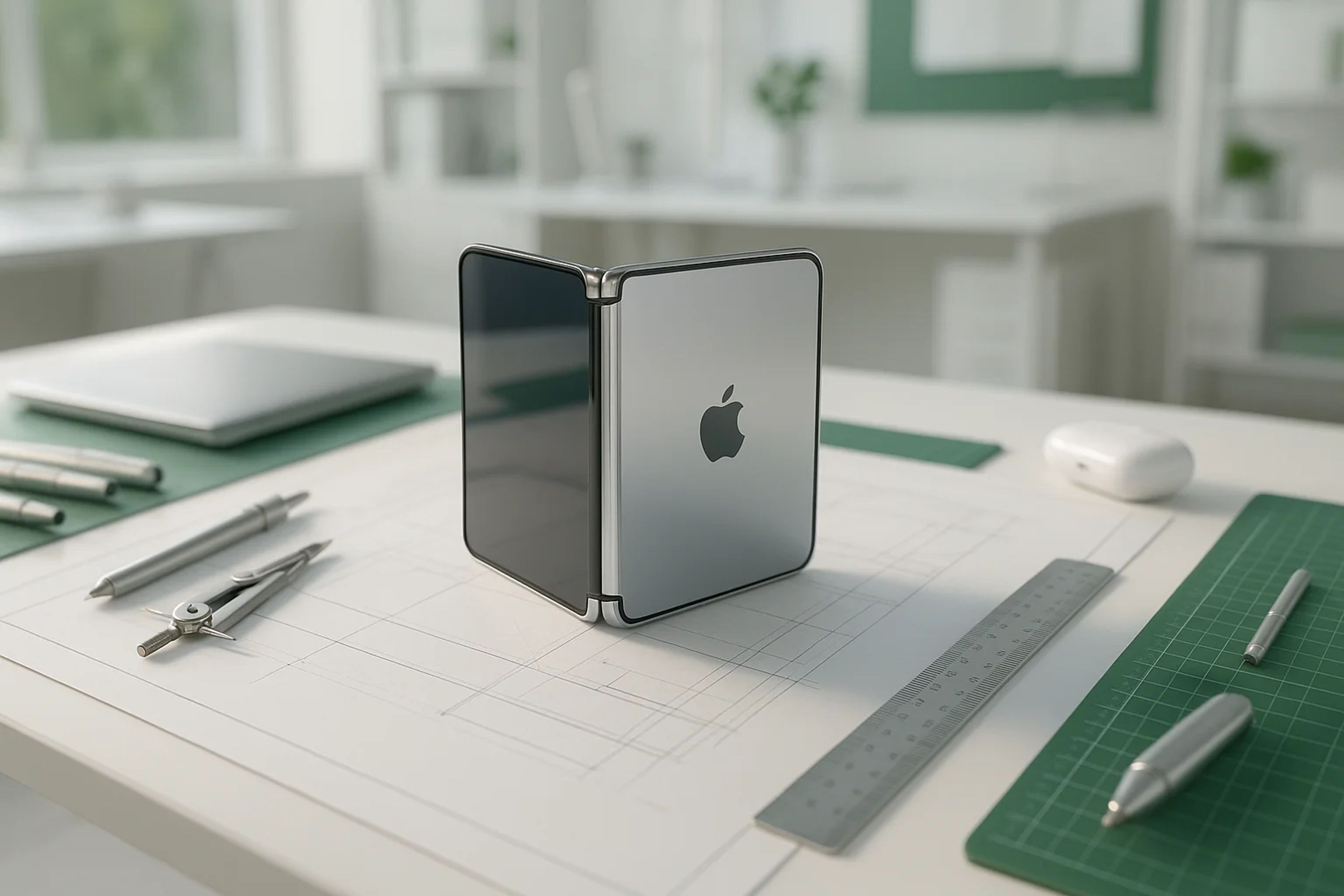
Kalshi Traders Price Apple Keynote for Foldables and “Apple Intelligence”
Across 26 keyword contracts, implied odds favor Apple-branded AI over OpenAI or Google name-drops.
Kalshi prediction-market traders are positioning for Apple’s “Surprise and Shine” keynote at 1 p.m. ET Wednesday by buying contracts tied to the words CEO John Ternus will say on stage. The market is pricing a foldable iPhone mention and Apple-branded AI messaging as the base case, while assigning lower odds to explicit callouts of OpenAI/ChatGPT or Google/Gemini.
Key Takeaways
- Apple’s “Surprise and Shine” keynote starts at 1 p.m. ET Wednesday, with CEO John Ternus leading his first iPhone launch as chief executive.
- More than $26,000 has traded across 26 Kalshi contracts tied to whether specific words or topics are mentioned on stage.
- The highest implied odds centered on “fold/folding/foldable” (82%), “Apple Intelligence” (77%), and “Siri” (56%).
- Outside AI brand mentions were priced lower, with “OpenAI/ChatGPT” at 25% and “Google/Gemini” at 15%.
Kalshi Prices the Keynote as “Foldable + Apple Intelligence”
Kalshi’s board going into Apple’s Wednesday keynote is being traded like a script preview. Traders are buying and selling contracts that settle on whether Ternus says specific keywords during the “Surprise and Shine” presentation, with more than $26,000 traded across 26 markets.
The top of the board is blunt about what the crowd expects to hear. “Fold,” “folding,” or “foldable” led at 82% implied odds, a pricing level that treats a foldable iPhone mention as close to table stakes for the event. “Apple Intelligence,” Apple’s AI branding, followed at 77%, with “Siri” at 56%.
For event-driven traders, the mechanism is simple: these contracts trade like probabilities, so the price is the market’s implied chance the word lands on stage. The catalyst timing is also clean. The keynote begins at 1 p.m. ET Wednesday, and the contracts resolve on the transcript-level outcome rather than on product availability or shipment dates.
Apple-Branded AI Messaging Leads, While Partner Name-Drops Get Discounted
The AI split on Kalshi is less about whether Apple is using outside models and more about whether Apple will say so out loud. “Apple Intelligence” at 77% and “Siri” at 56% implies traders expect Apple to foreground its own labels and surfaces, not the underlying partner stack.
That expectation is reinforced by how the market is pricing explicit third-party mentions. “OpenAI” or “ChatGPT” traded at 25%, while “Google” or “Gemini” sat at 15%. Those are not zero, but they are discounted relative to Apple’s own AI terms.
The packet’s source text also cites Reuters reporting that Google’s AI technology will help power Apple’s revamped Siri. Even with that context in circulation, Kalshi’s pricing still leans toward an Apple-only narrative on stage. In practice, that means traders are distinguishing between “powered by” reality and “branded as” messaging, and they are betting Apple will keep the keynote language inside its own product names.
Bloomberg’s “iPhone Duo” Report Hits the “Ultra” Contract and Reframes the Price Narrative
The sharpest repricing on the board came from a naming rumor, not a feature leak. “Ultra” fell 55 points to 32% after an overnight Bloomberg report, cited in the source text, that Apple’s foldable will launch as the iPhone Duo. The same report was cited as pegging a roughly $2,000 starting price, with higher-storage versions potentially reaching $3,000.
That move matters because it shows how quickly a single narrative can propagate through event markets once it offers a concrete anchor. If “Ultra” was the internal placeholder traders were leaning on, the “Duo” report gave them a cleaner target, and the contract repriced accordingly.
The pricing language around cost is also telling. “Afford” or “affordable” was priced at 20%, which lines up with the Bloomberg-cited ~$2,000 entry point. Traders are effectively saying that if Apple is about to introduce a new form factor at a premium price band, the keynote is more likely to frame it as a flagship category expansion than as a value pitch.
Watch Keywords Rotate From Broad Health to Specific Metrics
The Apple Watch-related contracts show a different kind of positioning: traders rotating from broad themes to measurable specifics. “Health” or “fitness” fell 17 points to 39%, while “heart rate” jumped 18 points to 39%, putting the two at parity after moving in opposite directions.
The source text cites Bloomberg reporting that Apple plans a new Readiness app using data including heart rate and blood-oxygen levels, alongside broader health upgrades. That kind of reporting fits the contract shift. A “health” keynote segment can stay high-level, but “heart rate” is the sort of term that appears when Apple is describing a concrete metric, sensor, or app workflow.
Outside the headline themes, the lower-probability contracts sketch the rest of the board. “Dynamic Island” traded at 22%, “AirPods Pro” at 18%, “AirTag” at 15%, and “Apple Watch SE” at 8%. “Tariff” sat near the bottom at 7%, and “Samsung” was priced at 10%, implying traders expect little direct airtime for a major rival even in a category where Samsung has sold foldables since 2019.
My Read: The Market Is Betting Apple Will Own the Narrative, Not Share the Stage
The threshold that matters is whether the keynote language matches the top-of-board trio: “fold/foldable,” “Apple Intelligence,” and “Siri” at 82%, 77%, and 56%. If those land cleanly while “OpenAI/ChatGPT” (25%) and “Google/Gemini” (15%) stay unmentioned, the market’s core bet will have been right for the right reason: Apple can use partner tech while keeping the on-stage story fully Apple-branded.
The real test is whether the “iPhone Duo” framing and the Bloomberg-cited ~$2,000 starting price get any on-stage confirmation, because that is what would turn the foldable from a vibes trade into a priced product tier. If the name and price band are validated, the setup starts to look structural rather than narrative-driven, and the post-event reaction window becomes the next session, given the cited historical pattern of -0.3% on launch day and +0.5% the following session across 24 launches.


