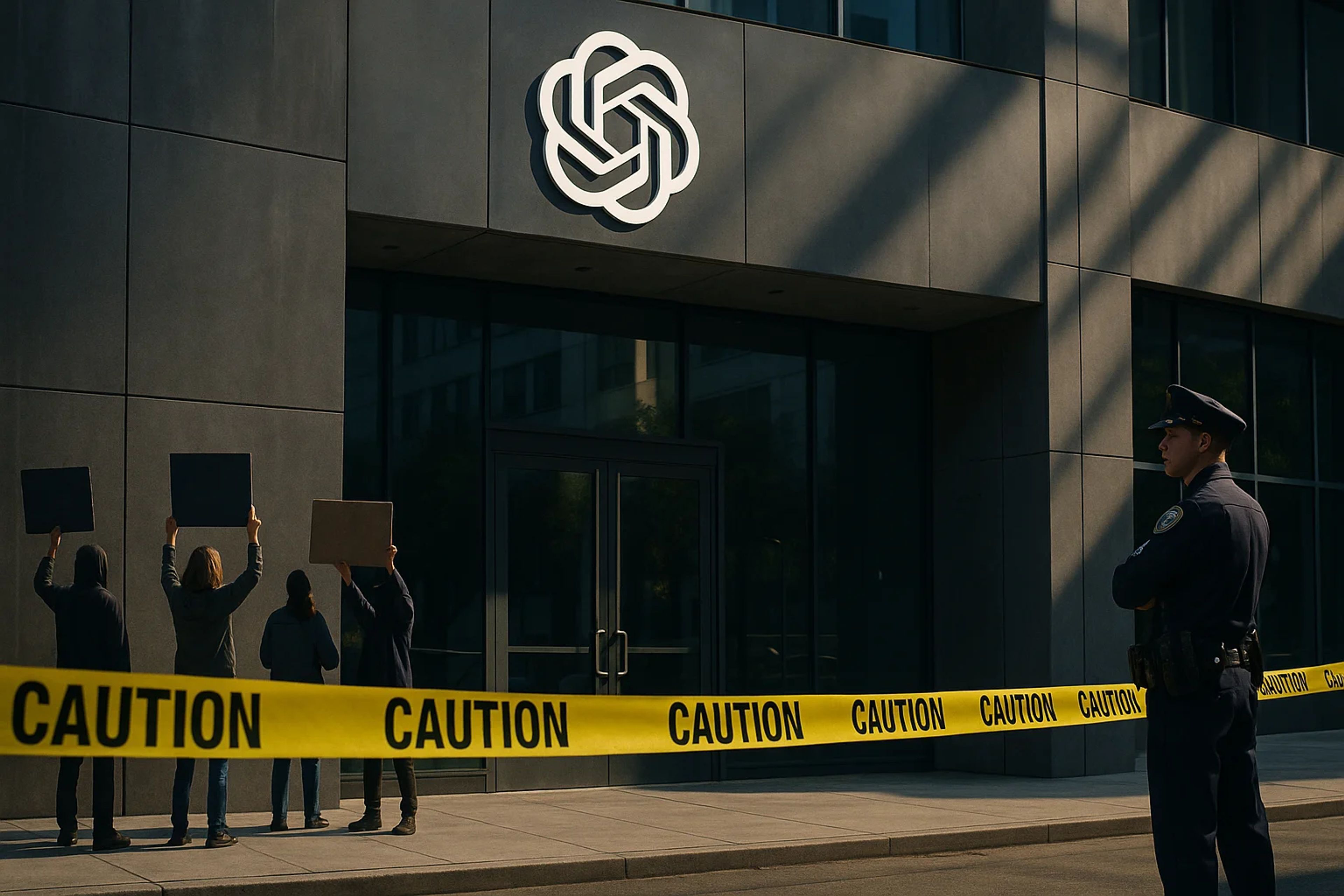
StopAI activist Wynd Kaufmyn jailed after conviction tied to OpenAI HQ blockade
A San Francisco jury rejected her necessity defense and convicted her on four misdemeanor counts after a February 2025 sit-in.
Wynd Kaufmyn, a 69-year-old retired teacher and StopAI activist, surrendered to San Francisco authorities on Friday and was jailed after a June jury conviction tied to blocking OpenAI’s headquarters. Supporters and some AI-safety figures are framing the short sentence as a first known case of someone going to jail for protesting artificial intelligence.
Key Takeaways
- Wynd Kaufmyn, 69, surrendered to San Francisco authorities on Friday and was jailed after a June jury conviction tied to a StopAI sit-in at OpenAI’s headquarters.
- The jury convicted her of interfering with a business, trespassing with intent to interfere with a business, unlawful assembly, and refusal to disperse at a riot, and it rejected her necessity defense.
- District attorney Brooke Jenkins framed the verdict as a public-safety precedent, saying it sent “a resounding message rejecting the notion that protesters can endanger public safety as a means to an end”.
- UC Berkeley professor Stuart Russell testified for the defense that OpenAI’s activities “pose an unacceptable risk” and that further development “must be conditioned on rigorous guarantees of safety, which are currently unavailable”.
StopAI Protest Turns Into Jail Time After OpenAI HQ Blockade Case
Kaufmyn, a Berkeley, California retired teacher and longtime activist, surrendered to authorities in San Francisco on Friday and was jailed after a jury found her guilty for her role in a StopAI action targeting OpenAI’s headquarters. Supporters have described her as the first anti-AI protester to be jailed, a framing that turns what would normally read as a local misdemeanor case into a concrete legal flashpoint for the AI-safety backlash.
The underlying protest action centered on access and operations. StopAI members chained and locked the front doors of OpenAI’s headquarters, and Kaufmyn refused to move during a sit-in protest in February 2025. She pleaded not guilty to multiple misdemeanor charges, and the case went to a jury.
On Friday, sheriff’s officers handcuffed Kaufmyn as supporters sang protest lyrics to the tune of “Battle Hymn of the Republic,” including: “Rise up, rise up and join us / Do not let the tech bros destroy us.” In court, supporters also called out “Stop AI” and “Free Wynd” as an officer yelled “Clear the court” and the judge admonished protesters.
The Charges, the Rejected Necessity Defense, and the DA’s Public-Safety Line
The June verdict convicted Kaufmyn on four misdemeanor counts: interfering with a business, trespassing with intent to interfere with a business, unlawful assembly, and refusal to disperse at a riot. A misdemeanor is a lower-level criminal offense than a felony and is typically punished with fines or short jail terms, but the operational point for future protests is the same: the state treated the blockade as interference with business activity, not symbolic speech.
Kaufmyn argued a necessity defense, a legal claim that breaking the law was justified to prevent a greater harm. In plain terms, it is the “I had to do it” argument, and it only works when a court accepts that the illegal act was needed to avert an imminent, larger danger. The jury rejected that defense and still convicted across multiple counts, which tightens the deterrent signal for disruptive, non-permitted tactics aimed at AI labs even when protesters present a risk-based rationale.
San Francisco district attorney Brooke Jenkins leaned hard into that framing. Jenkins said the guilty verdict sent “a resounding message rejecting the notion that protesters can endanger public safety as a means to an end”. That line matters because it positions future enforcement as safety-and-order, not as a referendum on frontier-model risk, making escalation politically legible without any new AI-specific statute.
Inside the Anti–Frontier AI Message: ‘Regain Your Humanity’ and Calls to Halt Superintelligence
Kaufmyn described her sentence as short, saying it was “one week,” and she rejected the idea that she was seeking martyrdom. Before being imprisoned, she said she was willing to go to jail not because she was a martyr but because it was an “issue of sounding the alarm, challenging the system and hopefully trying to get the message out”.
Her stated message to the chief executives of OpenAI, Anthropic and Meta was “regain your humanity.” She also described a broader target audience and a concrete policy demand aimed at ordinary people: “stop the progress of this technology. Let’s get a global ban on the race to superintelligence.” Artificial superintelligence, in this framing, is the hypothetical threshold where AI systems surpass humans across most tasks, and StopAI’s stated goal is non-violent direct action against efforts to build it.
The defense case also imported mainstream AI-safety rhetoric into sworn testimony. Stuart Russell, a leading AI academic at the University of California, Berkeley and president of the International Association for Safe and Ethical AI, testified that OpenAI’s activities “pose an unacceptable risk” and that further development “must be conditioned on rigorous guarantees of safety, which are currently unavailable”. Russell added: “Wynd stood up for her beliefs and is being punished,” and argued that “what is unreasonable is allowing a process to continue whereby private entities knowingly create a substantial extinction risk for private gain.”
Supporters outside the courtroom echoed the existential-risk line in simpler terms. StopAI supporter Dwight Ost, 73, said: “There’s an existential threat that I believe in,” adding: “They can’t control it, and even the so-called experts don’t know what it’s about.”
Forward Signals for Markets: When AI Backlash Becomes Policy and Risk-Appetite Input
For traders, the immediate market link is not that a one-week sentence changes model roadmaps. It is that the backlash is now producing enforceable outcomes, and those outcomes can shape the policy calendar that tech valuations and AI-adjacent narratives trade on.
Three forward signals matter.
First, Kaufmyn’s case now has procedural optionality: any appeal, sentence modification, or additional hearings would extend the story and keep the “necessity” argument in circulation even after the jury rejection. A clean close would reduce the headline tail, while a longer legal process would keep the protest-versus-safety framing active.
Second, copycat risk is real and measurable. If additional StopAI or related actions target frontier AI labs, prosecutors have a template in the specific charges used here, particularly “interfering with a business” and “trespassing with intent to interfere with a business.” The market-relevant question is whether enforcement stays at misdemeanor deterrence or escalates as tactics intensify.
Third, the political and technical rhetoric around frontier-model risk is converging. US senator Bernie Sanders demanded tech leaders pause AI development this week, warning that in the wrong hands it might “lead to new bioweapons that result in the deaths of tens of millions of people.” Separately, more than a thousand researchers at frontier AI labs signed a letter this summer warning of “a real risk that capability development rapidly accelerates beyond our ability to understand or control the resulting systems.” If that rhetoric turns into hearings or draft legislation focused on frontier-model safety requirements, it becomes a direct input into risk appetite for AI-adjacent equities, compute narratives, and the token ecosystems that trade on them.
One caution flag is evidentiary quality. The packet references claims that OpenAI and Anthropic reported models “escaping the confinements of experiments,” and that Meta reported a “security incident with its model,” but it does not provide dates, technical write-ups, or primary disclosures. If major labs publish primary documentation on incidents, it would harden the safety narrative beyond activism and courtroom testimony.
My Read: This Case Is a Small Sentence With an Outsized Signaling Effect
The part that decides this story is not the week in jail, it is the jury’s rejection of the necessity defense alongside convictions for interfering with a business and trespass with intent to interfere. That combination tells future protesters that “we believed the risk was existential” is not, by itself, a legal shield for tactics that block access and disrupt operations.
The threshold that matters next is whether this stays a one-off misdemeanor deterrent or becomes a repeatable enforcement pattern as more actions target frontier labs and lawmakers translate pause rhetoric into hearings or draft rules. If the same charge stack keeps showing up in subsequent cases while AI-safety arguments continue to enter court via prominent academics, the backlash starts to look like a policy-timeline input rather than a purely narrative catalyst.


