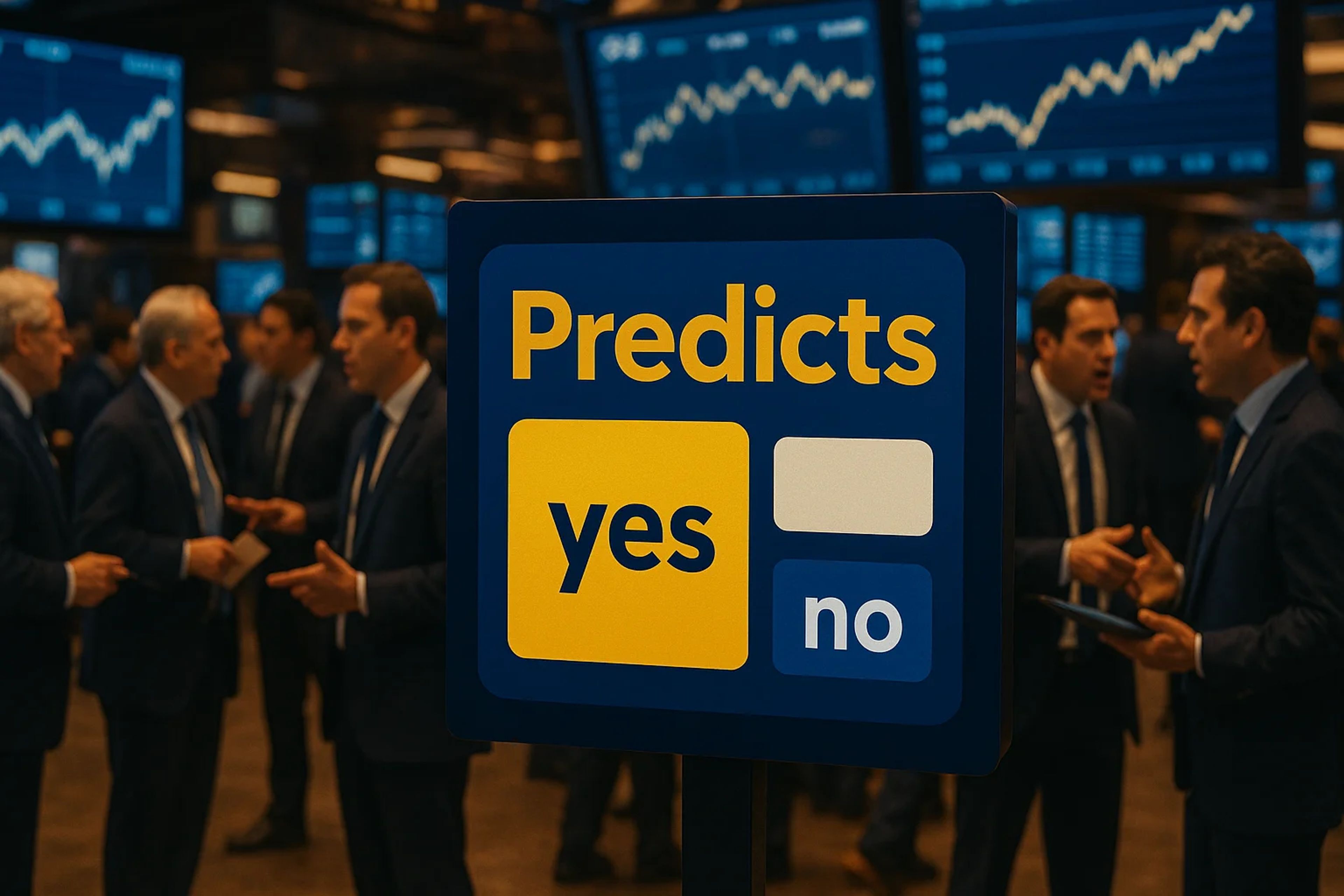
Cboe launches Cboe Predicts with S&P 500 “yes/no” close contracts
Interactive Brokers is live first, and Cboe expects Charles Schwab access in the coming months.
Cboe Global Markets launched Cboe Predicts on June 24, debuting prediction-market-style binary contracts tied to the S&P 500’s daily close. The rollout starts on Interactive Brokers, with Charles Schwab and other retail brokerages expected to add access in the coming months.
Key Takeaways
- Cboe Global Markets launched Cboe Predicts, starting with binary contracts linked to the S&P 500.
- The product lets traders take “yes” or “no” positions on whether the index will close above or below a specified level.
- Interactive Brokers is offering the contracts first, and Charles Schwab is expected to follow in the coming months.
- Cboe positioned the contracts as security options under the US-listed options framework and marketed “institutional-grade liquidity” and transparency.
Cboe Predicts Debuts With S&P 500 “Yes/No” Close Contracts
Cboe Global Markets opened Cboe Predicts with a simple pitch: bring outcome-based trading into the same rails traders already use for listed options. The debut product is a set of binary contracts tied to the S&P 500’s daily closing level.
Mechanically, the contracts are framed as a “yes” or “no” decision on whether the S&P 500 will close above or below a specified price level. That structure compresses the trade into a single settlement condition rather than a payoff that scales with every point move in the index.
Cboe said the launch responds to “growing investor demand for binary options contracts.” JJ Kinahan, Cboe’s head of retail expansion and alternative investment products, said customers are showing more demand for “shorter-dated, outcome-based trading opportunities,” which Cboe cited as the driver for bringing the product to market.
Interactive Brokers Goes Live First, Schwab Rollout Expected Next
Distribution is the real story. The contracts are available through Interactive Brokers now, and Cboe expects them to launch at Charles Schwab and other retail brokerage platforms “in the coming months,” per a Tuesday press release.
That matters because outcome-based contracts are not new, but mainstream brokerage access changes who can participate and how quickly liquidity can form. Contracts tied to the S&P 500’s daily close already exist on prediction market platforms including Polymarket and Kalshi. Cboe’s angle is to normalize the same basic trade idea inside a familiar brokerage workflow, where margining, account funding, and execution are already habitual for active macro traders.
The launch also arrived days after reports that Schwab was exploring entry into the sector through a partnership with Cboe to offer similar S&P 500-linked contracts. The article does not provide partnership terms or a firm Schwab date beyond the “coming months” expectation.
Cboe Frames the Product as US-Listed Options, Not a Betting Market
Cboe is explicit about how it wants the product perceived. The exchange described the new contracts as security options that trade within the same regulatory framework as US-listed options, rather than a standalone betting-style market.
That framing is doing two jobs at once. First, it positions Cboe Predicts as an extension of listed derivatives market structure, with Cboe emphasizing transparency and “institutional-grade liquidity.” Second, it attempts to separate the product from the regulatory and reputational baggage that has followed prediction-market platforms as they expanded beyond finance into political and sports-related contracts.
Adoption and Scrutiny Signals to Track as Outcome-Based Trading Expands
The next catalyst is confirmation of when Charles Schwab actually turns the product on, and which other retail brokerages list the contracts beyond the initial Interactive Brokers launch. “In the coming months” is enough for a marketing timeline, not enough for traders trying to handicap adoption.
Contract details will also matter. Any published specifications around settlement mechanics, fees, and tick size could determine whether this becomes a retail-friendly instrument or a niche product that only trades when volatility spikes.
Regulatory headlines remain an ambient risk even with Cboe’s US-listed options framing. Prediction-market platforms have faced increased scrutiny, particularly around political betting and sports-related event contracts. Kentucky was described as the latest state to sue five prediction market platforms, including Kalshi and Polymarket, alleging they were “operating unlicensed and illegal sports betting and gambling platforms.”
Separately, in January, US lawmakers proposed legislation to restrict political prediction market trading by government officials after a Polymarket user reportedly netted over $400,000 on a contract related to the removal of then-Venezuelan President Nicolás Maduro, raising insider trading concerns.
Early liquidity and volume on Interactive Brokers will be the cleanest real-time signal of whether Cboe Predicts is finding product-market fit or simply adding another ticker to the menu.
Why TradFi Distribution Could Change How Traders Use “Event” Markets
I see Cboe’s move as an attempt to make outcome-based trading feel mundane by wrapping it in the language and plumbing of listed options. The “security options” framing and the promise of “institutional-grade liquidity” are not just marketing. They are a bid to pull event-style positioning away from standalone prediction venues and into the same ecosystem where macro traders already express views.
The threshold that matters is whether brokerage distribution translates into durable two-way flow. If Interactive Brokers volume builds and Schwab follows on schedule, the setup starts to look structural rather than narrative-driven, because the edge becomes access and liquidity, not novelty.


