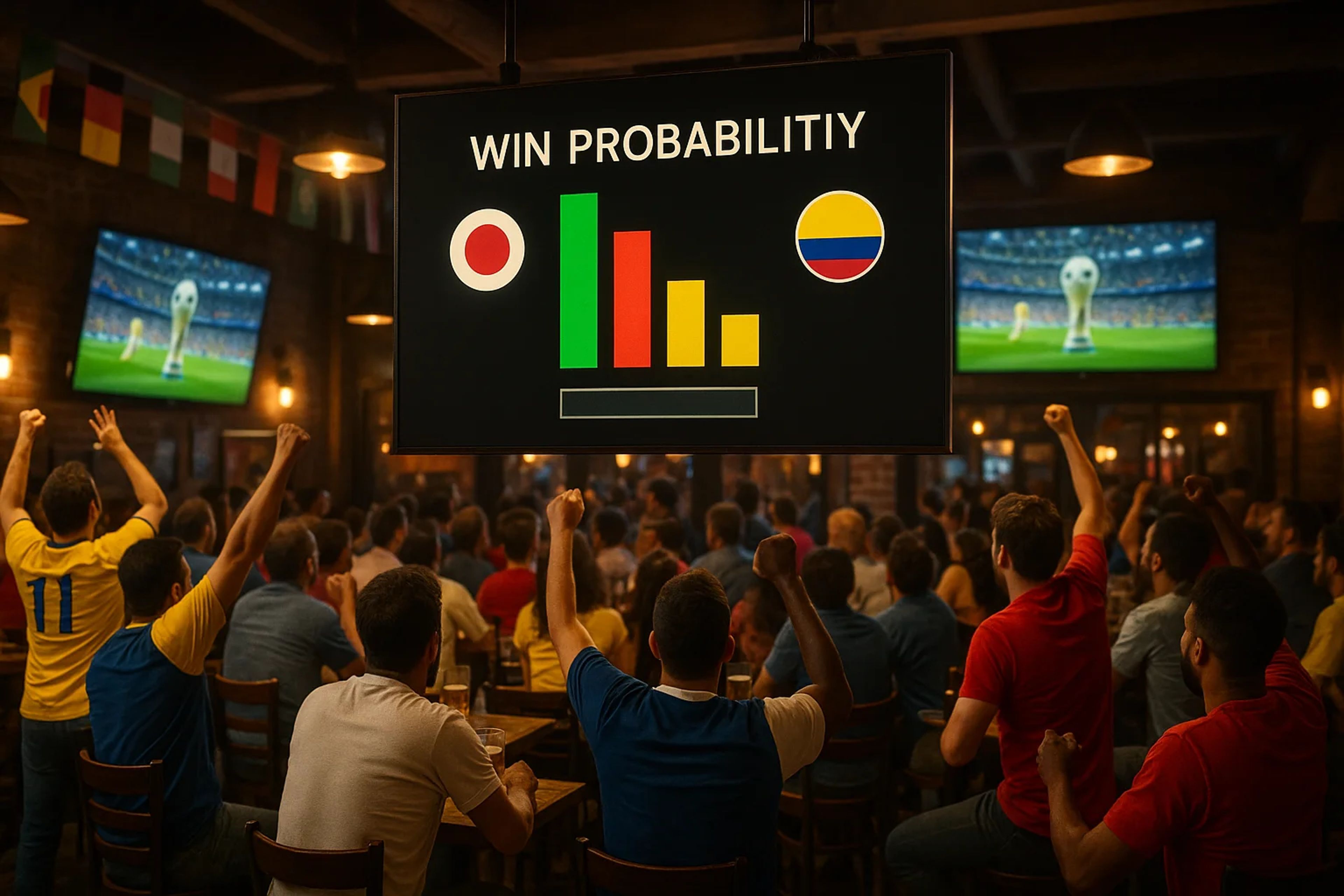
ChatGPT quietly surfaces Kalshi World Cup win probabilities in search results
The odds appear as implied chances of winning and are labeled informational-only, with no in-app betting.
OpenAI’s ChatGPT has begun displaying Kalshi-based FIFA World Cup prediction-market odds directly inside ChatGPT search results. The integration was not publicly announced at the time of publication and does not let users place bets through ChatGPT.
Key Takeaways
- Kalshi-derived implied win probabilities for FIFA World Cup matchups are now appearing inside ChatGPT search results.
- The odds display is informational-only and does not enable betting within ChatGPT under OpenAI guidance cited alongside the feature.
- Example queries showed France at a 59% implied chance to beat Spain and England at 55% against Argentina, with Kalshi labeled as the source.
- Kalshi posted more than $33 billion in June 2026 monthly notional volume, about $22 billion ahead of Polymarket, per Dune Analytics data cited.
ChatGPT Quietly Adds Kalshi World Cup Odds to Search Results
ChatGPT has started surfacing prediction-market pricing from Kalshi when users search FIFA World Cup matchups, inserting a market-implied “forecast” layer directly into the AI search experience.
The rollout has been notably quiet. “The integration had not been publicly announced at the time of publication.” Kalshi declined to comment, and OpenAI did not immediately respond to a request for comment. That combination leaves the commercial terms and even the rollout scope unconfirmed, which is consistent with a limited test or early-stage deployment rather than a fully launched feature.
For traders, the product change matters less as a sports widget and more as distribution. Even without execution, putting regulated prediction-market probabilities in front of default search behavior can normalize these prices as the quick reference point people cite, share, and anchor to.
What the Odds Look Like, and What Users Can’t Do
The odds appear as graphics that translate Kalshi market prices into implied chances of winning. In the examples cited, a France vs. Spain query showed France at 59% to win, while England vs. Argentina showed England at 55%, with Kalshi labeled as the source.
OpenAI guidance cited alongside the display frames it as read-only. “The integration does not allow users to place bets through ChatGPT, according to OpenAI’s guidance cited by the report, with Kalshi data intended for informational purposes only.”
That constraint is the tell. This is distribution of pricing, not a funnel to immediate wagering inside the interface. The second-order effect is still real: a probability shown in a search result can function as a default reference for sentiment, even if the user never touches the underlying market.
Kalshi’s Scale and the Broader Push to Embed Prediction Markets in Mainstream Surfaces
Kalshi is positioned as a regulated prediction-market venue where users trade contracts tied to real-world outcomes across categories including economics, politics, and sports. The platform’s scale helps explain why its numbers are increasingly portable into other products.
Dune Analytics data cited shows Kalshi recorded more than $33 billion in monthly notional volume in June 2026, about $22 billion ahead of Polymarket. Monthly notional volume is not the same as open interest or net exposure, but it is a clean proxy for activity and liquidity. If a mainstream surface wants a stable, continuously updating probability feed, it will tend to prefer the venue with deeper flow.
This also fits a broader integration trend. Google integrated prediction-market data from Kalshi and Polymarket into Google Finance and Google Search products in November 2025. Kalshi struck partnerships with CNN and CNBC in December 2025 to integrate market data into coverage. Polymarket partnered with Dow Jones in January 2026 to bring prediction-market data to products including The Wall Street Journal. ChatGPT now appears to be joining that same distribution arc.
Signals to Watch for ChatGPT shows Kalshi World Cup odds
The first signal is confirmation. Any public announcement, documentation, or product notes from OpenAI or Kalshi would clarify whether this is a formal partnership, a data-licensing arrangement, or a narrower experiment.
Scope is the next tell. If the display expands beyond World Cup matchups into Kalshi’s other event categories like economics or politics, the odds feed becomes a more direct input into macro and election narrative cycles.
Rollout mechanics matter too. Traders should watch for the feature appearing or disappearing across regions, logged-in versus logged-out states, or different ChatGPT tiers, which would indicate whether OpenAI is scaling distribution or keeping it gated.
Finally, relative market share can decide whose probabilities get embedded. Updates to Kalshi and Polymarket volume metrics, including Dune-tracked monthly notional volume, will influence which venue becomes the default “source of truth” for mainstream surfaces.
Why AI Search Distribution Could Matter for Event-Risk Traders
I treat this as a distribution story, not a betting story. The threshold that matters is whether ChatGPT keeps presenting Kalshi’s implied probabilities as a first-look answer across more event categories, because that’s how market pricing turns into narrative gravity.
This looks more like a sentiment catalyst than a fundamental shift in market plumbing, at least while ChatGPT remains informational-only. If the odds feed persists and broadens, the setup starts to look structural rather than narrative-driven, because it would hardwire prediction-market pricing into one of the highest-frequency information surfaces on the internet.


