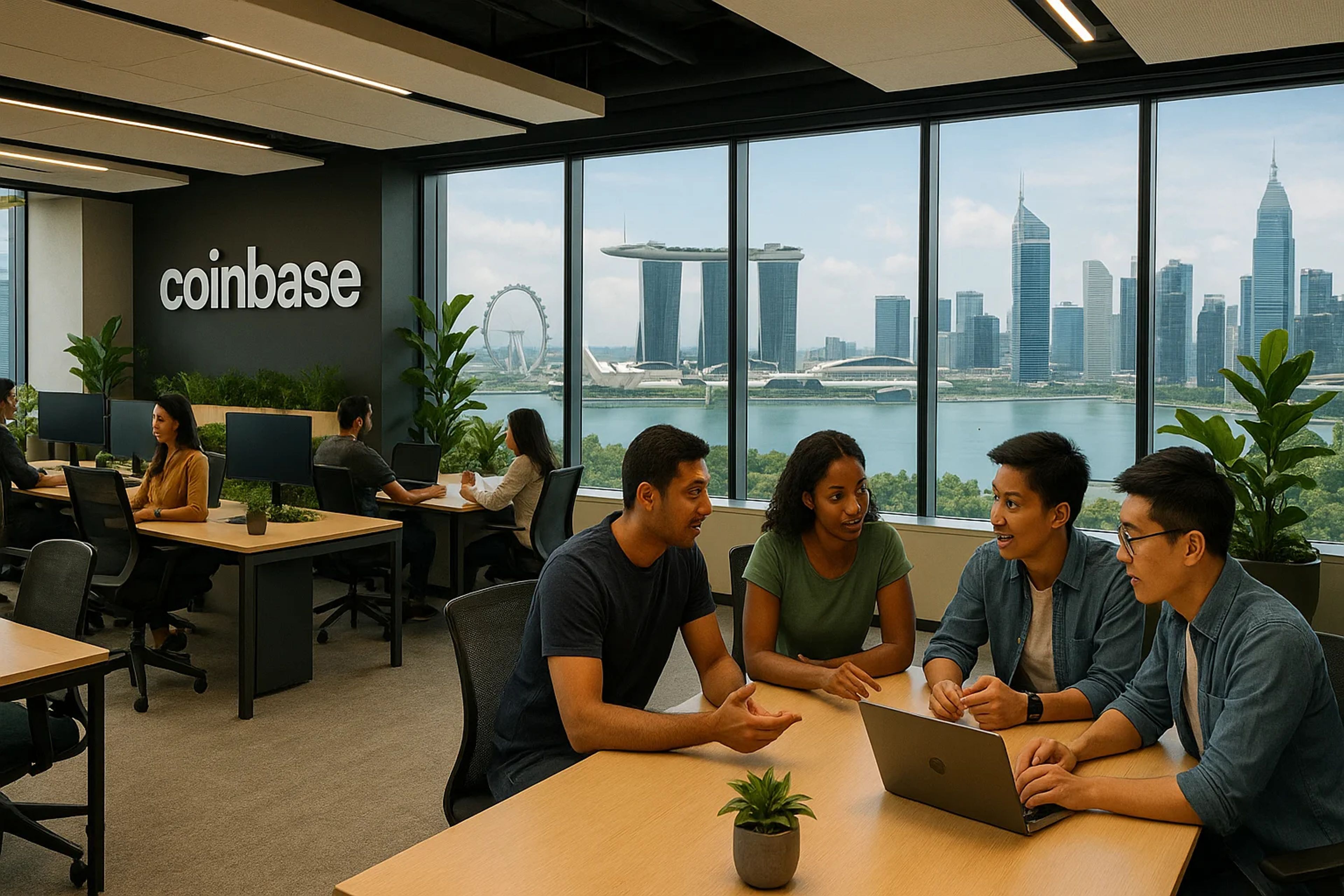
Coinbase targets 200 Singapore staff by end-2026 as it scales under MAS license
The plan lifts the local team from 150 and focuses hiring on engineering, support, and institutional-facing roles.
Coinbase plans to expand its Singapore office from 150 to about 200 employees by the end of 2026, extending a regulated buildout in one of Asia’s most tightly licensed crypto markets. The hiring mix spans engineering through institutional sales, signaling a push to deepen both product capacity and distribution after securing a key MAS license in 2023.
Key Takeaways
- Coinbase plans to grow its Singapore headcount from 150 to about 200 employees by end-2026, a roughly 25% increase.
- The hiring push targets engineering, customer service, relationship management, and institutional sales roles.
- Singapore country director Hassan Ahmed outlined the staffing plan in an interview with The Business Times.
- Coinbase’s October 2023 Major Payment Institution license from the Monetary Authority of Singapore enabled expanded services for individuals and institutions.
Coinbase Sets a 200-Employee Target for Singapore by End-2026
Coinbase has set a target to expand its Singapore office from 150 to about 200 employees by the end of 2026. The plan was disclosed by Hassan Ahmed, identified as Coinbase’s country director for Singapore, in an interview with The Business Times.
The company’s Singapore office opened at One Raffles Quay “on Wednesday” relative to the interview, though the exact calendar date was not specified in the excerpt. Coinbase did not immediately respond to a request for comment.
For traders, the headline number matters less than the time horizon and location. A two-year-plus runway to add roughly 50 roles points to a deliberate buildout in a jurisdiction where regulatory permissions and local operating footprint tend to be prerequisites for durable market access.
What Coinbase Is Hiring For: Engineering to Institutional Sales
Coinbase’s role mix in Singapore is broad: engineers, customer service staff, relationship management staff, and institutional sales representatives. That spread reads like an operating model, not a single product pod.
Engineering hires typically map to localization and platform work, but the inclusion of customer service and relationship management is the tell. Those functions are operational capacity that scales with active users and higher-touch clients. Layer in institutional sales and the intent looks two-sided: keep retail service levels stable while building a pipeline for larger accounts.
Ahmed framed the strategic rationale directly, saying, “Singapore is increasingly becoming a strategic hub for cryptocurrency innovation.” The staffing plan aligns with that positioning by covering both build (engineering) and distribution (institutional sales), with support and relationship management acting as the glue that keeps the machine running when volumes and client complexity rise.
MAS Licensing Context: MPI Status and a Shrinking Field of Providers
Coinbase’s ability to scale in Singapore is tied to regulatory footing. The company received a Major Payment Institution (MPI) license from the Monetary Authority of Singapore (MAS) in October 2023, which enabled it to expand services to Singaporean individuals and institutions.
MAS is Singapore’s central bank and financial regulator, and it oversees licensing for digital payment token service providers. At the time referenced, MAS’s directory listed 38 licensed entities “on Thursday,” with the exact date not specified in the excerpt.
The licensing regime has also acted as a competitive filter. MAS tightened licensing requirements for digital payment token service providers in 2025, which pushed unlicensed firms to leave the market. In that context, regulated incumbents have a clearer incentive to invest in-country, because the addressable market is increasingly gated by supervisory approval and ongoing compliance.
Milestones That Confirm the Buildout Is Translating Into Market Share
The next signals are regulatory and operational, not narrative. Any MAS licensing or supervisory updates that further tighten requirements would likely raise the value of already-licensed platforms, while increasing the cost of entry for marginal players.
On Coinbase’s side, the practical check is whether the hiring pace tracks toward the ~200 target by end-2026, including new team or office announcements that indicate sustained execution rather than a one-off hiring burst. Traders should also watch whether the MAS directory count of licensed digital payment token service providers changes from the 38 figure cited, since churn there can reshape competitive intensity.
Finally, the MPI license only matters if it turns into institutional traction. New institutional offerings or partnerships tied to Singapore would be the cleanest confirmation that headcount is being converted into distribution and client activity.
Marcus Hale’s Take: Why Singapore Headcount Matters More Than a PR Number
I don’t treat headcount targets as bullish or bearish by default. The signal is the composition. Coinbase isn’t just adding engineers. It’s adding customer service, relationship management, and institutional sales in the same market, which is what a firm does when it expects real client volume and higher-touch flows that need coverage.
The threshold that matters is whether the MPI-enabled footprint translates into visible institutional product and partnership cadence in Singapore while MAS keeps the licensed set tight. If that holds, the setup starts to look structural rather than narrative-driven, because regulated access plus local execution becomes a moat that shows up in market share, not press releases.


