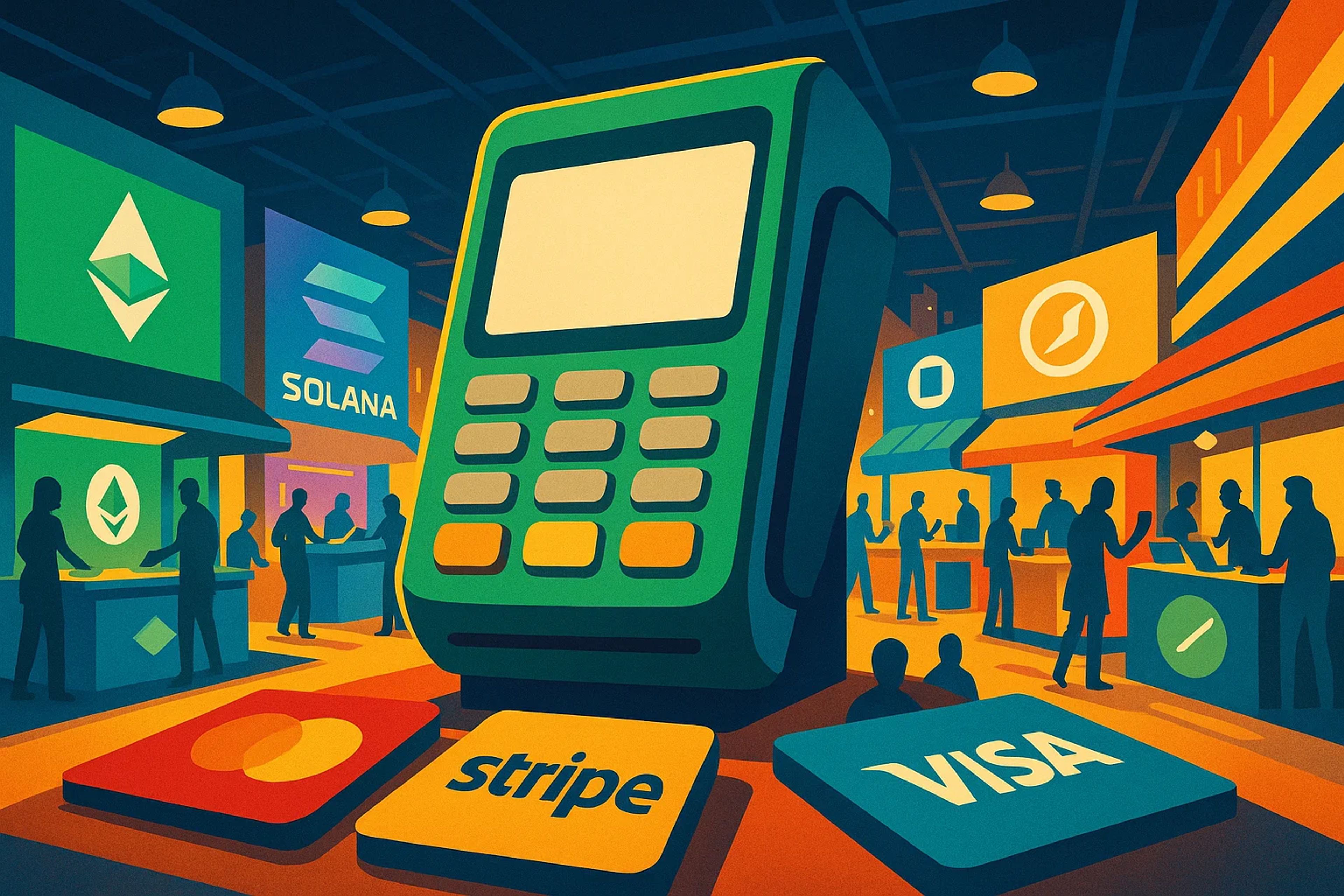
Open Standard launches OUSD on Ethereum, Solana, Base and Tempo with $1B+ liquidity pledge
Coinbase, Mastercard, Shopify, Stripe and Visa joined as founding partners with equal initial equity stakes and usage-linked rewards.
Open Standard’s dollar stablecoin Open USD (OUSD) is now live on Ethereum, Solana, Coinbase’s Base, and Stripe-backed Tempo, with five founding partners committing more than $1 billion to seed liquidity over the coming months. The launch pairs multi-chain issuance with an equity-and-rewards model that pays partners for growing supply and transaction activity, aiming to compete with USDT and USDC on distribution and usage rather than reserve-income economics.
Key Takeaways
- Open USD (OUSD) went live on Ethereum, Solana, Base, and Tempo on Wednesday, giving Open Standard a four-chain footprint from day one.
- Coinbase, Mastercard, Shopify, Stripe and Visa became the first five founding partners and investors, each receiving an equal initial equity stake in Open Standard.
- More than $1 billion has been committed by the founding group to establish OUSD liquidity over the coming months, a practical prerequisite for tight spreads and usable size.
- Open Standard plans to distribute the “overwhelming majority” of its equity over the next 4–5 years based on partners’ contributions to OUSD supply growth and transaction activity.
OUSD Goes Live on Four Chains With $1B+ Liquidity Pledge
OUSD’s launch is straightforward on paper and unusually ambitious in its starting lineup. Open Standard brought Open USD live on Ethereum, Solana, Base, and Tempo on Wednesday, positioning the token for payments, banking, settlement, institutional trading, and lending in a stablecoin market the company described as worth more than $300 billion.
The immediate tradable detail is the liquidity commitment. Coinbase, Mastercard, Shopify, Stripe and Visa are Open Standard’s first five founding partners and investors, and the group committed more than $1 billion to establish OUSD liquidity “over the coming months.” Open Standard framed that liquidity as something founders will actively support through a mix of holding OUSD on balance sheet or on-chain and market-making activity, rather than treating the token as a passive product launch.
OUSD is entering a market still dominated by Tether’s USDT at about $143 billion in circulation and Circle’s USDC at roughly $74 billion. That dominance is not just brand, it is routing: desks and payment flows default to the stablecoin that clears size with minimal slippage, and new entrants typically fail at that first hurdle.
A Stablecoin Model That Pays for Usage: Equity and Rewards Tied to Supply + Transactions
Open Standard’s pitch is that stablecoin competition is shifting away from “issuing another digital dollar” and toward distribution, liquidity, and the platforms where stablecoins are actually used. CEO Zach Abrams put the positioning bluntly: “We want to be the most useful stablecoin, the same way the U.S. dollar is useful,” and “Every other stablecoin is building a fund. We're building money.”
Mechanically, the model tries to turn distribution partners into long-duration growth agents. Stablecoin issuers earn interest on the cash and securities backing tokens, and incumbents have historically kept most of that economics at the issuer level, with some revenue-sharing arrangements for key distribution partners. Open Standard is leaning into that relationship as the core product.
Abrams said founding partners will not receive a special share of revenue. Instead, they participate under the same framework as other partners, earning rewards based on the amount of OUSD supply they generate. The bigger swing is equity: Abrams said the “overwhelming majority” of Open Standard’s cap table will be distributed over the next 4–5 years to founders and non-founders based on how they help grow OUSD supply and transaction activity.
That second metric matters because it targets behavior, not just balances. Partners that meet a minimum threshold can earn equity based on a combination of supply and transaction activity, which is designed to reward moving OUSD through real flows rather than simply warehousing it. The catch is that Open Standard did not disclose the minimum threshold required to qualify.
Where Liquidity Could Concentrate: Ethereum, Solana, Base — and Tempo’s Bid to Be the Deep Pool
Four chains at launch is a distribution choice, but it is also a liquidity coordination problem. Ethereum, Solana, and Base already host deep stablecoin markets and established trading venues, while Tempo is trying to win the “deep pool” narrative early by tying its own growth targets to OUSD.
Tempo chief business officer Dan Romero said OUSD will eliminate minting and burning fees. Those fees are the charges paid to create (mint) or redeem (burn) stablecoins, and they compound quickly for high-churn users like market makers, treasuries, and payment flows that repeatedly move in and out of stablecoin inventory. Zero mint and burn fees is a direct attempt to make OUSD cheaper to cycle, but only if mint and redeem rails are reliable and liquidity is real where the flows actually settle.
Romero also laid out Tempo-specific targets that are explicitly forward-looking: roughly $1 billion of OUSD on Tempo “within the next few months,” more than $10 billion during 2027, and potentially exceeding $100 billion over the next several years. He said Open Standard plans to issue OUSD across multiple blockchains, while Tempo intends to compete to become OUSD’s deepest liquidity pool.
For market makers and larger movers, the practical question is where the $1B+ commitment gets deployed first. Liquidity that is fragmented across chains and venues can look impressive in aggregate and still trade poorly at the point of execution, while a single venue that clears size with tight spreads is what turns a new stablecoin into a routing option.
What Comes Next for Open USD launches with $1B liquidity
Two timelines are now running in parallel: the liquidity rollout “over the coming months,” and the equity distribution plan over 4–5 years. The near-term signals are more measurable, but Open Standard has not yet published the thresholds and mechanics that will determine who earns what.
The first missing disclosure is the minimum threshold partners must meet to earn equity and rewards tied to OUSD supply and transaction activity. Without that number, it is hard to model whether the incentive system will concentrate rewards among a few high-volume endpoints or broaden them across the network.
The second is where liquidity actually concentrates as the founding partners deploy their commitments. Ethereum, Solana, Base, and Tempo all launched at once, but the market will quickly pick a primary pool if one venue offers consistently better execution.
A third watch item is whether zero mint and burn fees changes behavior in a way that shows up in turnover. If mint and redeem rails are smooth and the fee savings are meaningful, OUSD could attract the kind of churn that makes a stablecoin feel “liquid” even at lower headline supply.
Finally, Open Standard expects the founding group to expand from five companies to roughly 10–12, and it plans to establish a founders-led board of directors. Announcements that add founders, or clarify governance and decision rights, will matter because the project is trying to scale a partner-heavy model without turning it into a slow committee.
What I Think Matters Most: The Partner Network Is the Product, but the Missing Thresholds Are the Tell
The launch is being read as “another dollar token,” and that misses what Open Standard is actually selling. The product is the partner network and the incentive wiring that turns distribution into ownership, which is why the equal initial equity stakes for the five founders and the plan to distribute most of the cap table over 4–5 years are doing more work than the multi-chain deployment itself.
The threshold that matters is the undisclosed minimum partners must hit to earn equity and rewards, because that single number will decide whether the model creates broad-based distribution pressure or just subsidizes a handful of high-volume pipes. If liquidity concentrates quickly on one venue and the mint and redeem rails support real churn with zero mint and burn fees, OUSD starts to look like a routing candidate rather than a branding exercise.


