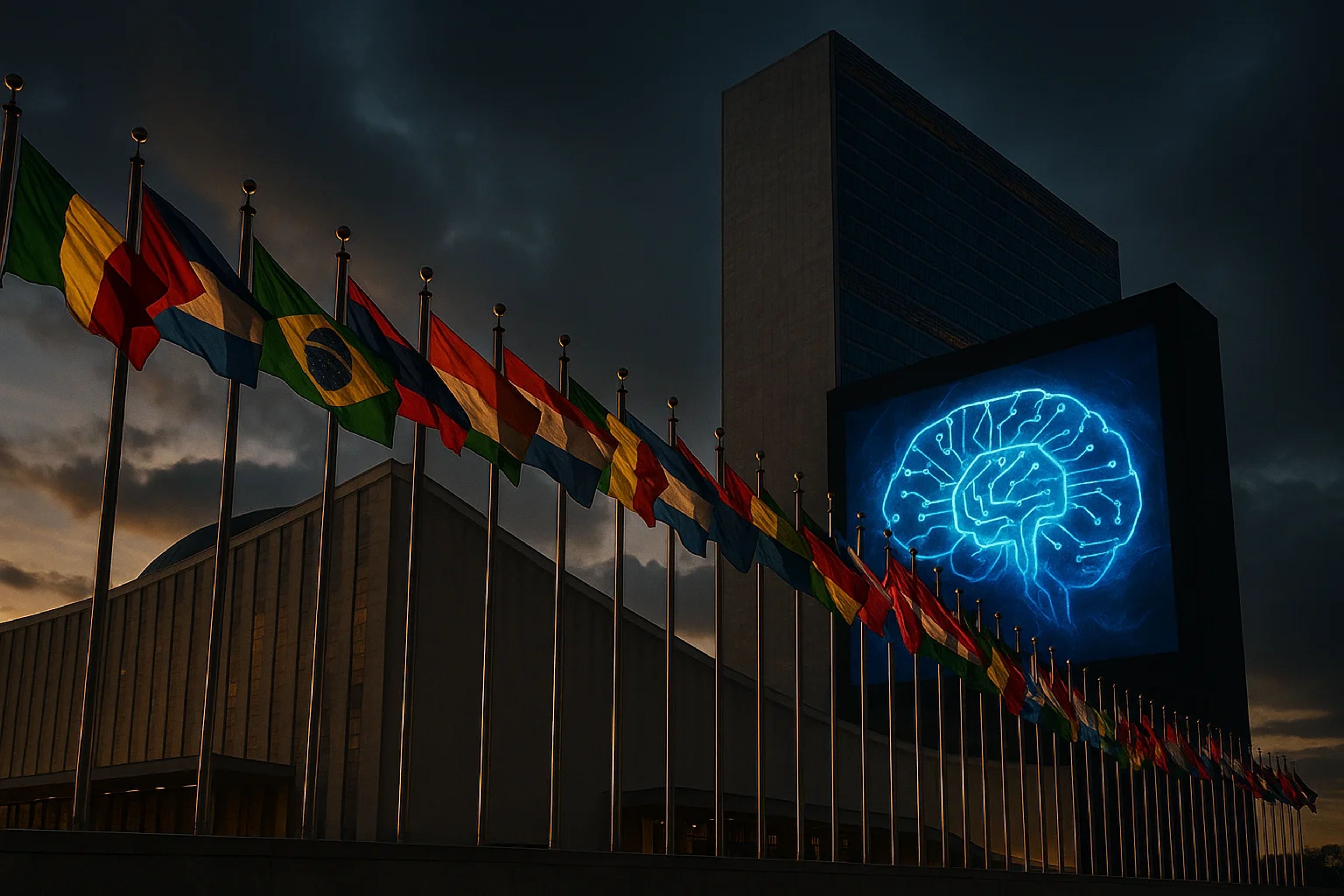
Trump tells UN the US will rename AI to “super intelligence” in official documents
He paired the rebrand with a rejection of a “globality scheme” to control AI and framed lighter regulation as a China-competition edge.
President Donald Trump used his United Nations General Assembly speech to say the U.S. will rename “artificial intelligence” as “super intelligence” across U.S. documents, using the shorthand “SI.” He tied the terminology shift to rejecting international AI governance efforts and argued less regulation is needed to keep pace with China.
Trump’s UN Rebrand: AI Becomes “Super Intelligence”
Trump told the United Nations General Assembly on Tuesday that the U.S. will rename “artificial intelligence” as “super intelligence” in U.S. documents, and he introduced “SI” as the shorthand. “From this point forward, all of United States documents and hopefully the world’s will be changed to use the much more accurate term super as opposed to artificial,” he said. “In other words, welcome to the new world of super intelligence — SI.”
The pitch was explicitly about framing. Trump argued that “The use of the word artificial makes intelligence sound fake,” then added, “It is not fake. It’s actually amazing. But we have to be careful. In fact, it is exactly the opposite of what it purports.” He also left room for the possibility that the rebrand does not stick, saying: “Let’s see if that goes. It sounds much better. It is much better, and it’s much more accurate.”
The term choice matters because “super intelligence” already has a loaded definition in the AI world. It is commonly used to describe a form of AI that exceeds human intelligence, and it sits at the intersection of two competing narratives: the stated endgame of frontier AI firms building the most advanced general-purpose models, and the core fear-case for critics warning about AI’s threat to humanity.
Deregulation-by-Message: Rejecting a “Globality Scheme” as U.S.-China AI Rivalry Heats Up
Trump did not present the rename as a standalone branding tweak. He embedded it inside a broader rejection of international control frameworks, telling the UN: “The United States also totally rejects any attempt to construct a globality scheme to control for the artificial intelligence being spoken of so much now, hereinafter called super intelligence. Changing the name,” before continuing into his argument for the new label.
That pairing is the mechanism worth noticing for markets: the administration’s posture is being communicated as a package of (1) rhetorical escalation on capability, and (2) resistance to multilateral governance. Even without a policy document attached, the message is legible as a lighter-regulation stance, framed as a competitive necessity.
The speech landed into a Washington debate that has been running on two rails at once: safety fears and geopolitical competition. Trump’s remarks were framed as arriving amid “spiking fears” after a former Anthropic researcher warned that AI could soon destroy humanity, a claim cited as intensifying the regulatory argument. In the same breath, the political case for deregulation was tied to beating China in an “AI arms race,” with AI described as a major topic this week both at the UN General Assembly and during Chinese President Xi Jinping’s planned state visit to Washington with Trump.
What Traders Should Watch for: From Rhetoric to Policy Paper
The first confirmation point is operational, not rhetorical: whether the White House issues an executive order, Office of Management and Budget guidance, or agency-level directives that actually force “super intelligence/SI” into federal documents. Without that plumbing, the rename is a speech-line, not an implementation change.
The second is whether any concrete regulatory moves follow the competition framing. That can look like explicit rollbacks, narrower agency enforcement, or a stated preference for voluntary standards over binding rules, consistent with the “beat China” logic Trump invoked.
The third is diplomatic language. AI is expected to be a major topic during Xi’s Washington visit, and the readout will matter for whether the U.S. is signaling bilateral governance coordination, pure competition, or a mix of both.
A final loose end is the safety catalyst referenced in the speech context: the former Anthropic researcher warning is cited as a driver of “spiking fears,” but the source does not provide the person’s identity, timing, or exact wording. If that claim becomes a focal point in U.S. policy debate, it will likely show up through named testimony, agency briefings, or formal proposals rather than anonymous paraphrase.
My Read: A Narrative Catalyst, Not Yet a Rule Change
The threshold that matters is paperwork. A rename only becomes real when it appears in an executive order, OMB style guidance, or agency memos that force procurement language, reporting templates, and compliance documents to change. None of that is in hand here, so the immediate effect is sentiment and positioning, not a new regulatory regime.
What stands out is the coupling: “super intelligence” as capability branding, plus a flat rejection of a “globality scheme” as governance branding. If that pairing gets translated into actual directives or rollbacks, the setup starts to look structural rather than narrative-driven, and that is when it would matter in practical terms for how AI policy risk is priced.


