
Crypto
UK Crypto APPG opens inquiry into alleged debanking and crypto payment limits
A six-week evidence call will feed a report and recommendations to the UK Government on banking access and transfer restrictions.
A six-week evidence call will feed a report and recommendations to the UK Government on banking access and transfer restrictions.

The order cites Washington gambling laws, leaving the scope and user impact unclear from the available packet.

The prospectus names BitGo, BNY Mellon, and CSC Delaware Trust, but leaves fees and APs undisclosed.

The orders credit payments against a partially suspended $4.72B judgment tied to Celsius’ 2022 collapse.

Japan and South Korea also tightened crypto’s legal footing, pairing new enforcement hooks with longer-dated framework shifts.

The proposed 5:00 pm–7:50 am session would start with ETPs tied to UK or US markets while daytime hours stay unchanged.

The scenario ties bull confirmation to stablecoin exchange netflows turning positive and maps $152.3k and $200k–$220k upside levels.

The complaint alleges only about 13% of investor funds went to mining and payouts stopped by March 2025 with over $20M unpaid.

Blocksbridge flagged a $50B sector funding need and rising insider-sale scrutiny as the next overhangs.

The firm reported 7,430 ETH added in a week, with about 85% staked and 5.5M shares repurchased under a $4B plan.

The upgrade is Cardano’s first hard fork proposed, debated, and ratified entirely through onchain governance voting.

Volatility picked up into the Wall Street open, but July’s $65,000 cap held as oil stayed above $80 and tech-selling claims resurfaced.

The company guided to $10M–$13M in annual cash opex savings by 2027 and $2.5M–$3.5M in pre-tax charges.

The veteran trader also mapped a 2029 cycle peak at $250,000–$300,000 as BTC traded near $63,661.

The latest SEC 8-K shows cash reserves rising to $3.225B with about $23.5B of common ATM capacity still available.

The firm’s Q2 2026 report pegs 88.3% of $764M stolen to keys, signers and infrastructure, pressuring institutions to demand continuous controls.

Draft No. 1194918-8 would cap retail purchases and outbound transfers while formalizing crypto use in cross-border trade.
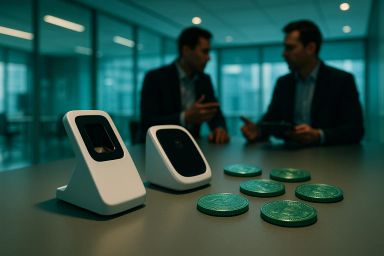
The wholesale CBDC pilot expands to nine banks and adds P2P, biometrics, and subsidy-payment tests via deposit tokens.

The rebound is only slightly larger than the prior slump’s smallest weekly outflow, keeping “institutional demand is back” unproven.

With no major U.S. data due, Alphabet, Tesla, and Intel earnings are the next test for AI-linked risk appetite.
 btc$75,830-2.71%
 eth$2,398.62-4.67%
 usdt$1-0.04%
 bnb$711.52-1.25%
 xrp$1.29-9.77%
 usdc$1-0.02%
 sol$97.09-5.08%
 trx$0.33-1.50%
 doge$0.08-4.63%
 link$10.86-6.46%
 ada$0.19-6.76%
 xlm$0.18-10.39%
 bch$218.2-1.94%
 ltc$50.84-3.94%
 uni$6.3-4.53%
 hbar$0.07-4.36%
 avax$7.24-4.13%
 sui$0.69-4.78%
 dot$0.94-4.70%
 etc$7.16-4.80%
 pol$0.09-5.67%
 algo$0.09-7.08%
 atom$1.5-5.34%
 fil$0.81-9.25%
 vet$0.01-6.07%