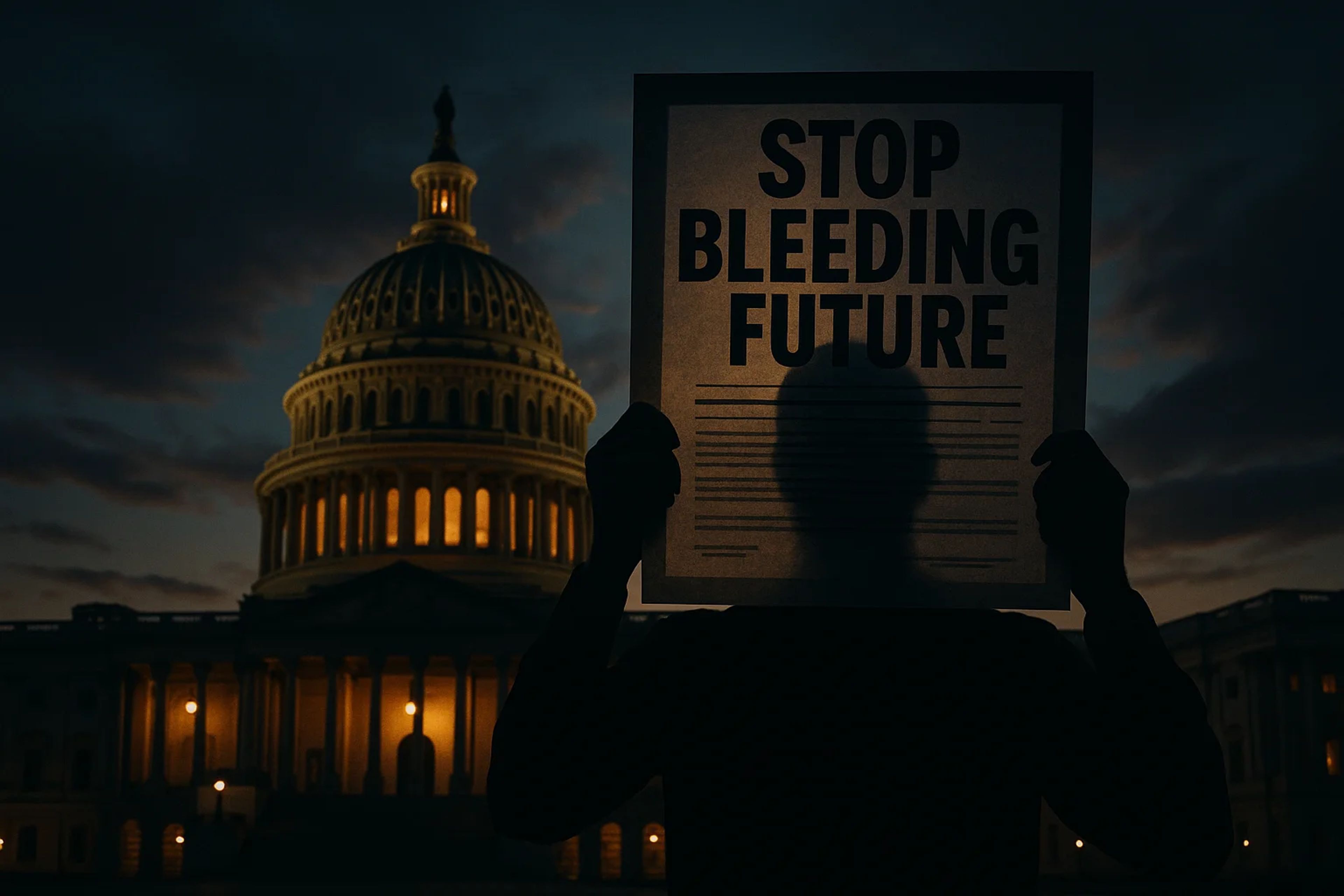
Democrats push candidates to blacklist AI PAC money, citing crypto’s $130M lesson
The “Stop Bleeding the Future” pledge lands as Senate Democrats sink the Clarity Act, crypto’s top bill for two years.
Democratic-aligned organizers are circulating a new “Stop Bleeding the Future” pledge that asks candidates to refuse money from the most active AI industry PAC and publicly condemn efforts to block “commonsense AI laws.” The campaign is being framed through crypto’s recent Washington experience: more than $130 million in 2024 election spending, followed by a Senate defeat for the industry’s top legislative priority.
Key Takeaways
- The “Stop Bleeding the Future” pledge asks candidates to refuse all money from the most active AI industry PAC and to condemn its push against “commonsense AI laws.”
- QuitGPT began circulating the pledge in May, and organizer Michael Baick said the strategy is to make the AI PAC “irrelevant and toxic.”
- Senate Democrats sank the Clarity Act, described as crypto’s top legislative priority for the last two years.
- The crypto industry spent more than $130 million on the 2024 elections to help elect friendly politicians from both parties, yet the bill still failed.
Democrats Roll Out an Anti-AI Money Pledge — and Invoke Crypto as the Warning
Democratic-aligned groups are moving from “AI needs guardrails” messaging to a more specific political weapon: making AI industry money itself a liability for candidates. The new “Stop Bleeding the Future” pledge commits signers to “refuse all money from” the most active AI industry PAC and to “condemn its efforts to stop commonsense AI laws.”
The framing is not subtle. Organizers and strategists are explicitly pointing to crypto’s recent influence campaign as the cautionary tale, arguing that big super PAC budgets can buy access and airtime without delivering durable legislative wins. For traders, that matters less as a morality play and more as a signal about how Washington’s risk premium gets repriced when “industry capture” becomes a campaign line.
The timing also lines up with a fresh datapoint on crypto’s side: Senate Democrats sank the Clarity Act on Tuesday, described as the cryptocurrency industry’s top legislative priority for the last two years. That defeat is now being used as proof that the “crypto playbook” is not a guaranteed path from election spending to statute.
Inside the “Stop Bleeding the Future” Pledge: Refuse AI PAC Cash, Condemn Anti-Regulation Efforts
Mechanically, the pledge is simple and designed for enforcement by activists rather than regulators. Candidates are asked to do two things: reject money from the most active AI industry PAC, and publicly denounce that PAC’s efforts to block AI regulation described as “commonsense AI laws.” It is less a policy platform than a reputational tripwire.
QuitGPT, the coalition that wrote the pledge, began circulating it in May. Michael Baick, one of its organizers, described the goal in blunt political terms: “We want to make them irrelevant and toxic,” he said. He added, “We want any politician or staffer who gets an email from these guys to think: This is bleeding the future.”
The pledge is being rolled out into a broader ecosystem of Democratic-aligned AI organizing. The same week, a “Pro-Human Assembly” event featured Steve Bannon and Sen. Bernie Sanders (I-Vt.) anchoring programming focused on AI dangers and government “guardrails.” Sanders tied the issue directly to super PAC spending, saying: “I say to them that if you believe in democracy, if you believe that the people have a right to determine their future, stop pouring hundreds of millions of dollars into super PACs.”
There is already an internal warning embedded in the anti-money strategy. New York state legislator Alex Bores argued the pledge should not be limited to a single AI industry PAC because “they’re already finding ways to shift their money,” adding: “But they’re toxic to this debate.” The AI industry PAC referenced in the pledge, “Leading the Future,” chose not to comment.
Crypto’s Capitol Hill Reality Check: Clarity Act Sunk After $130M in 2024 Election Spending
Crypto’s recent political mechanism was straightforward: spend heavily through super PACs and other “soft dollars” vehicles to elect friendlier lawmakers from both parties, then try to legislate in a Senate where the filibuster makes most bills a 60-vote problem. The Semafor analysis puts the 2024 election spend at more than $130 million, deployed “out of necessity, because the filibuster wasn’t likely to get busted for their bill.”
The consequence is the part Democrats are now using against AI donors. Even after that spending, Senate Democrats sank the Clarity Act, described as the industry’s top priority for two years. The piece suggests Republicans could try to resurrect the bill after the midterms, but adds it is “not likely after a failure this big.”
The analysis also sketches why Democratic incentives shifted. It asserts the president and his family had made more than $1 billion from crypto, framing that as a political complication for Democrats who took PAC help and then faced attack lines about enriching the president. Sen. Ruben Gallego (D-Ariz.) is quoted summarizing the objection as Republicans caring “more about making sure the president keeps making money than actually bringing regulations.”
That is the bridge to AI politics: if an industry’s money becomes synonymous with “soft dollars” and enrichment narratives, the marginal value of additional spending drops. Democratic strategist Sam Silverman made the comparison explicit, arguing that AI donors cannot replicate crypto’s influence. “The industry still thinks soft dollars will buy them love, in part because of the mistaken belief that the crypto playbook is repeatable,” Silverman said. “It’s not. Voters don’t give a f*ck about crypto. When AI is the defining topic of the election, do you think taking millions from Marc Andreessen, Greg Brockman, and Joe Lonsdale will be palatable to the base?”
Signals Traders Should Track Into the Midterms: Revival Odds, Messaging Shifts, and PAC Workarounds
The first signal is whether Republicans make any concrete move to reintroduce or reframe the Clarity Act after the midterms, despite the analysis arguing a revival is unlikely “after a failure this big.” A rebrand, a narrower bill, or a procedural shift would be the tell that the industry still has a legislative path.
The second is adoption velocity for the “Stop Bleeding the Future” pledge. If more federal candidates sign, it becomes a real constraint on AI-aligned spending. If it stays limited, it reads more like a messaging test than a durable funding blockade.
The third is whether the pledge expands beyond one AI industry PAC, which is where the money-routing failure mode shows up. Bores’ warning that donors are “already finding ways to shift their money” is the blueprint for how this gets bypassed, either through new committees, allied nonprofits, or different branding.
The fourth is messaging from Democratic lawmakers tying crypto policy to alleged presidential-family crypto profits. The analysis frames that “enrichment” line as a reason Democrats backed away from crypto legislation, and a repeat of that playbook would raise the odds that future crypto bills get dragged into broader campaign narratives rather than handled as technical market-structure work.
Finally, watch for escalation of anti-“soft dollars” rhetoric at national events, Sanders-style. If the political fight becomes less about AI or crypto specifics and more about super PAC legitimacy, both industries get pulled into the same backlash bucket.
My Read: The Bigger Risk Is a Broader ‘Soft Money’ Backlash That Sweeps Up Crypto Again
The part that decides this is not whether AI or crypto can outspend opponents. It is whether Democratic candidates start treating industry money as a contaminant, because once that norm sets, the marginal influence of the next $10 million drops fast.
The threshold that matters is whether the anti-AI pledge model generalizes into a wider anti-super-PAC posture that makes “soft dollars” itself the target. If that holds, crypto’s $130 million 2024 play stops looking like a one-off failed push for the Clarity Act and starts looking like the template Democrats cite when they want to say no to the next crypto bill, regardless of how it is drafted.


