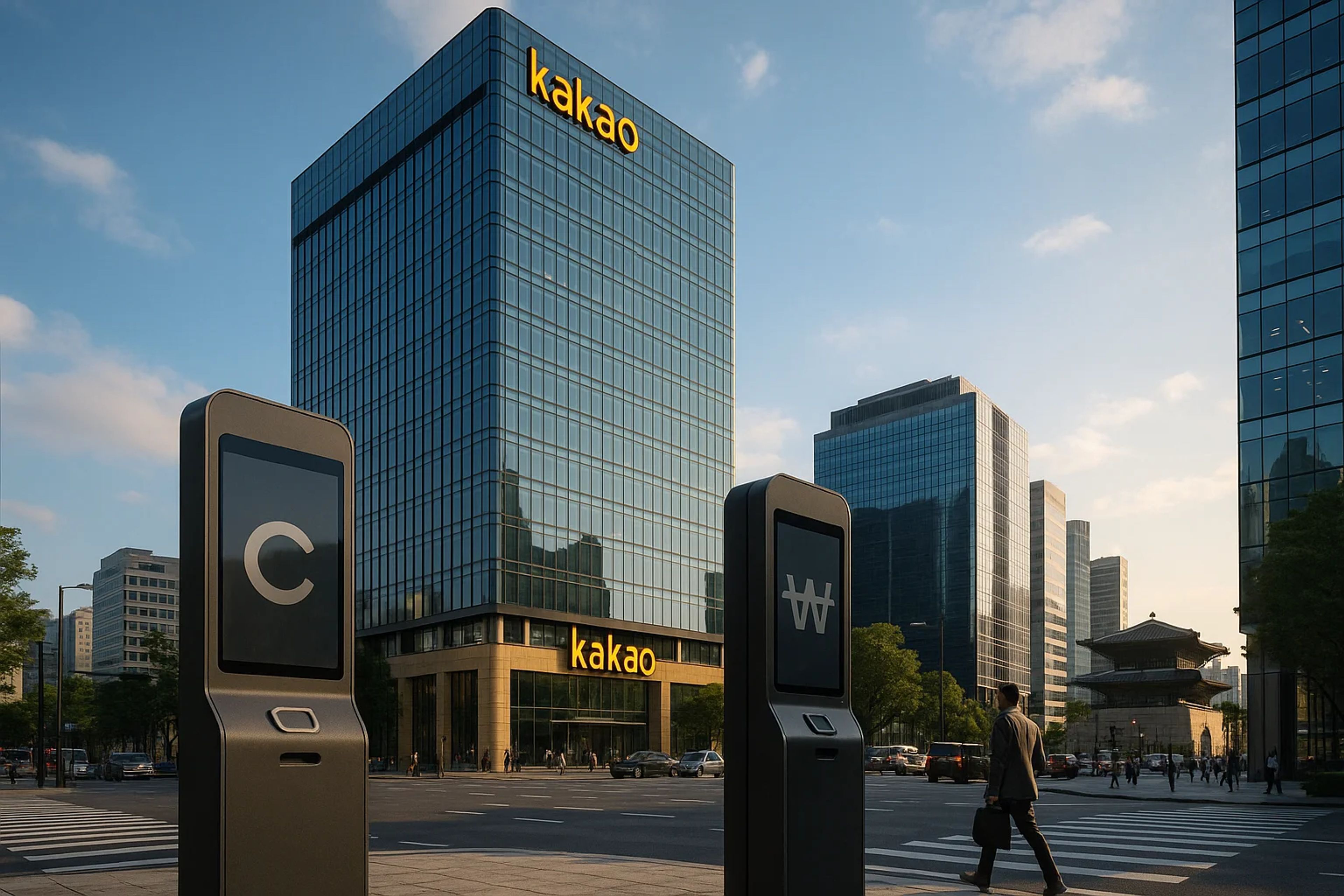
Kakao, Kakao Pay, and Kakao Bank sign MOU with Circle on KRW stablecoin rails
The work targets payments, remittances, and merchant settlement as Korea’s issuer-eligibility rules remain unresolved.
Kakao Group’s consumer and financial units signed a strategic memorandum of understanding with Circle Internet Group to explore won-backed stablecoin payment infrastructure in South Korea. The agreement lands while Seoul’s stablecoin rulebook is still stuck on a core question: who is allowed to issue a KRW stablecoin, and under what ownership constraints.
Key Takeaways
- Kakao, Kakao Pay, and Kakao Bank entered a strategic MOU with Circle Internet Group to explore won-backed stablecoin payments and supporting infrastructure.
- The stated scope spans stablecoin payments, cross-border remittances, merchant settlement, and links between existing financial systems and blockchain networks.
- Tokenized financial services are part of the exploration, but the parties “did not disclose any products or launch timelines.”
- Korea’s stablecoin legislation remains stalled amid a dispute over issuer eligibility and whether banks must hold majority ownership in issuers.
Kakao–Circle MOU Puts KRW Stablecoin Rails on the Table
Kakao Group announced a strategic memorandum of understanding signed by Kakao, Kakao Pay, and Kakao Bank with Circle Internet Group to explore infrastructure for won-backed stablecoin use cases in South Korea.
The framing matters for traders. This is not a product launch or a commitment to issue a KRW stablecoin. It is positioning by a major consumer platform and its payments and banking arms to wire potential stablecoin rails into existing distribution before the regulatory perimeter is finalized.
The companies described the intent as connecting Circle’s blockchain and global payment infrastructure with Kakao’s consumer platforms and financial services. No commercial terms, technical design, or rollout sequencing were disclosed.
What the Workstreams Cover: Payments, Remittances, Settlement, and Bank-to-Chain Links
The MOU workstreams are explicitly payments-native. The parties said they will examine stablecoin payments, cross-border remittances, merchant settlement, and connections between existing financial systems and blockchain networks.
That last item is the operational hinge. “Connections” implies bank-to-chain plumbing, not just a wallet feature. If it progresses, it would likely touch onboarding, compliance workflows, and settlement finality across legacy rails and onchain networks, which is where most stablecoin pilots either stall or become real.
The MOU also includes considering support for tokenized financial services. That expands the aperture beyond payments into tokenized claims and programmable settlement, but it is still exploratory. The only hard constraint disclosed is what is missing: the companies “did not disclose any products or launch timelines.” Near-term market impact, then, is less about rollout risk and more about whether follow-on pilots or architecture disclosures arrive alongside regulatory clarity.
South Korea’s Issuer-Eligibility Fight Is Still the Gating Item
South Korea is preparing a broader framework for won-backed stablecoins aimed at encouraging digital payment innovation while addressing reserve, redemption, and issuer-oversight risks. A bill under preparation is described as setting requirements around issuance, collateral management, and internal controls.
The gating issue is issuer eligibility. The legislative process is described as stalled because policymakers disagree on which institutions should be permitted to issue won-based stablecoins.
The split is clean. The Bank of Korea has argued that “banks should retain a majority stake in stablecoin issuers.” The Financial Services Commission has warned that “eligibility limits could restrict competition and innovation.” Until that conflict resolves, any KRW stablecoin path for platforms like Kakao is structurally constrained, regardless of technical readiness.
Signals Traders Can Track Next in Korea’s Stablecoin Rulemaking
The next concrete catalyst is legislative, not technical. Korea’s economic growth strategy announced on 2026-07-14 listed advancing the Digital Asset Basic Act among priorities for the second half of 2026, which gives traders a time window for potential movement.
The real signal will be language that settles the Bank of Korea versus Financial Services Commission dispute, especially any final requirement for bank-majority ownership in stablecoin issuers and the breadth of eligible non-bank participants.
On the industry side, traders should watch for follow-on Kakao–Circle disclosures that move from “explore” to “pilot,” including merchant-settlement or remittance trials and any detail on how existing financial systems would connect to blockchain networks.
Comparable pre-regulatory testing is already happening. In 2026-04, internet bank Kbank partnered with Ripple to test blockchain-based remittances in South Korea. In 2026-05, KB Financial Group completed a pilot spanning stablecoin issuance, offline merchant payments, and cross-border remittances through the Kaia blockchain, and said it was preparing to introduce stablecoin services once regulations take effect.
This Is Positioning, Not a Launch—Until Seoul Decides Who Can Issue
I treat this MOU as a distribution-and-rails alignment ahead of a policy decision, not a near-term supply event for a KRW stablecoin. The threshold that matters is whether Korea’s rulemaking resolves issuer eligibility in a way that lets large platforms participate without forcing a bank-controlled structure that narrows competition.
If that constraint clears and Kakao–Circle follows with pilot specifics, the setup starts to look structural rather than narrative-driven. Until then, the practical impact is limited to signaling who is lining up for KRW stablecoin flow once the issuer rulebook is written.


