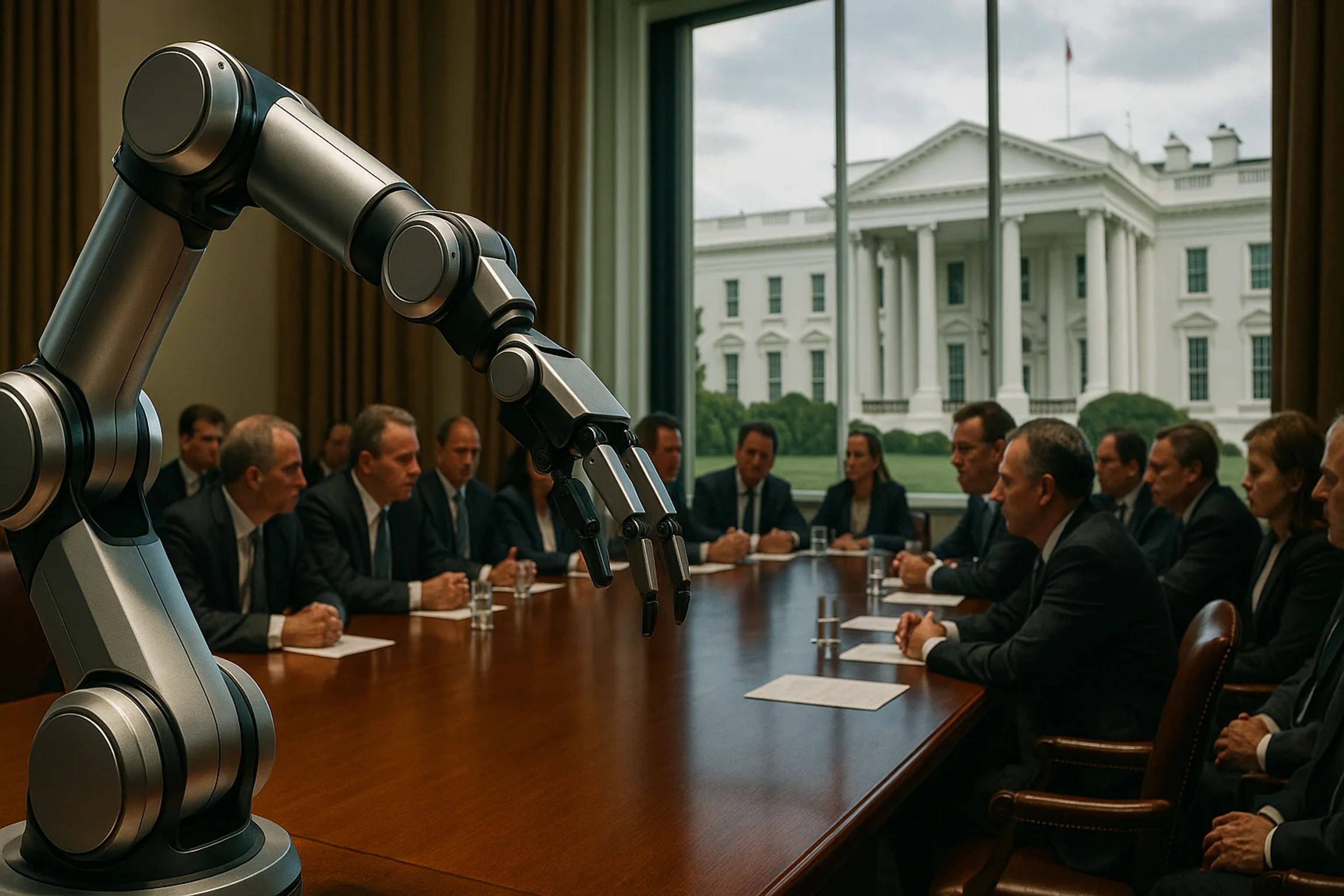
Trump reportedly lines up DNI Jay Clayton as White House AI czar
The White House called the reports speculation as Trump pushes an AI agenda built around industry “self-policing.”
President Donald Trump is expected to appoint Director of National Intelligence Jay Clayton as the White House “AI czar,” based on reports citing unidentified sources. A White House official pushed back, saying any announcement would come directly from Trump and characterizing the reporting as speculation.
Key Takeaways
- Unnamed-source reporting has Trump preparing to name current Director of National Intelligence Jay Clayton as the White House “AI czar.”
- A White House official disputed the certainty of the reports, saying any decision would be announced directly by Trump and calling the chatter speculation.
- Trump convened AI and technology leaders at the White House this week to sign a pledge to “self-police” AI models and development.
- David Sacks said his earlier 130-day stint as crypto and AI czar ended due to the special government employee time limit, with policy work continuing through PCAST.
Trump Reportedly Eyes Jay Clayton for AI Czar Role, White House Pushes Back
President Donald Trump is expected to appoint Jay Clayton, the current US director of national intelligence, as the new White House “AI czar,” based on reports that cite unidentified sources.
The catch is confirmation risk. A White House official told CBS that any announcement would come directly from Trump and dismissed the reports as speculation. That leaves markets with a headline that can move narrative positioning without a signed, on-the-record mandate.
Unidentified sources cited by CNN also indicated Clayton is expected to remain in his current role as director of national intelligence while serving as AI czar. That dual-hat structure is not confirmed by an official announcement, and the scope of the AI czar portfolio has not been formally defined.
Why Clayton’s Resume Matters: From SEC Chair to DNI to AI Coordinator
Clayton’s name carries regulatory memory for crypto traders even if the job title is “AI.” He previously served as chair of the US Securities and Exchange Commission during Trump’s first term, a role that anchors him in market-oversight mental models.
He was Senate-confirmed in July to lead the intelligence community as director of national intelligence. That matters because it frames the AI coordinator role less as a tech-policy appointment and more as a cross-agency, national-security flavored coordination post, depending on how the White House structures it.
During his confirmation hearing, Clayton described AI as a “game changer” and said it is “not only an opportunity but a threat.” Those lines are likely to be recycled as justification for a centralized coordinator role, even if the administration’s near-term posture is to avoid new binding rules.
The personnel context also matters. Venture capitalist David Sacks previously served a 130-day tenure as crypto and AI czar and said the special government employee limit had been exhausted. “We’ve now used up that time,” Sacks said, adding that he planned to continue policy recommendations as co-chair of the President’s Council of Advisors on Science and Technology.
That 130-day constraint is not a footnote. It is a structural reason the White House may prefer a different employment status or a different institutional home for the “czar” function if it wants continuity.
The Administration’s AI Governance Signal: ‘Self-Police’ Over New Rules
The reported Clayton move lands on top of a clear governance message from the White House. On Tuesday, Trump gathered AI and technology chiefs at the White House to sign a commitment to “self-police” their companies’ AI models and development.
Trump has framed his AI initiative as managing the fast-growing sector without adding regulations that could slow innovation, per a Truth Social post described in the source material. That is the policy tell markets care about: voluntary commitments first, formal rulemaking later, if at all.
The backdrop is an active public debate about AI risk and pacing. On Sept. 12, Anthropic CEO Dario Amodei circulated a three-step proposal to slow AI development, warning unchecked progress could “outrun our ability to understand and control these systems.” Anthropic later selected Accenture as an embedded evaluator to help moderate the pace of AI development, described as moving ahead with the first step in Amodei’s proposal.
Reaction across major AI leadership has been mixed. OpenAI CEO Sam Altman and SpaceX CEO Elon Musk responded positively to Amodei’s proposal, while Nvidia CEO Jensen Huang argued such regulation was not necessary. The White House’s “self-police” posture sits closer to the Huang framing than the Amodei framing, at least on the evidence available so far.
What Traders Should Watch Next in Washington’s AI Playbook
The first signal is binary: a direct statement from Trump confirming or denying Clayton as AI czar. The White House official’s comment to CBS effectively sets the market’s validation standard as a Trump announcement, not background-source reporting.
The second signal is structure. Reporting has suggested Clayton could hold the AI czar role while remaining DNI, but the arrangement is unconfirmed. If the White House clarifies whether this is a formal dual appointment, an advisory overlay, or a time-limited coordinator role, that will shape how much authority the market should assign to the title.
The third signal is substance behind “self-police.” Traders should look for details on what the commitment actually requires, including any monitoring, audits, enforcement hooks, or reporting standards. Without those mechanics, the pledge reads as a sentiment and lobbying win for industry, not a compliance regime.
The fourth signal is whether the administration formalizes the concept Trump previously floated as an “AI Force.” Any executive action that creates durable authorities would be a different category of policy than voluntary commitments and would change how markets price regulatory tail risk.
My Read: This Is a Narrative Catalyst, Not a Rulebook—Yet
The threshold that matters is confirmation. With the White House calling the Clayton chatter speculation and insisting announcements come directly from Trump, this trades like a headline-driven catalyst with a built-in reversal risk if the appointment does not materialize.
If Clayton is confirmed and the White House pairs that with a concrete framework for “self-police” that includes audits or reporting standards, the setup starts to look structural rather than narrative-driven. Until then, the practical impact is limited to how quickly risk markets price a lighter-touch AI posture into AI-linked and broader high-beta positioning.


